
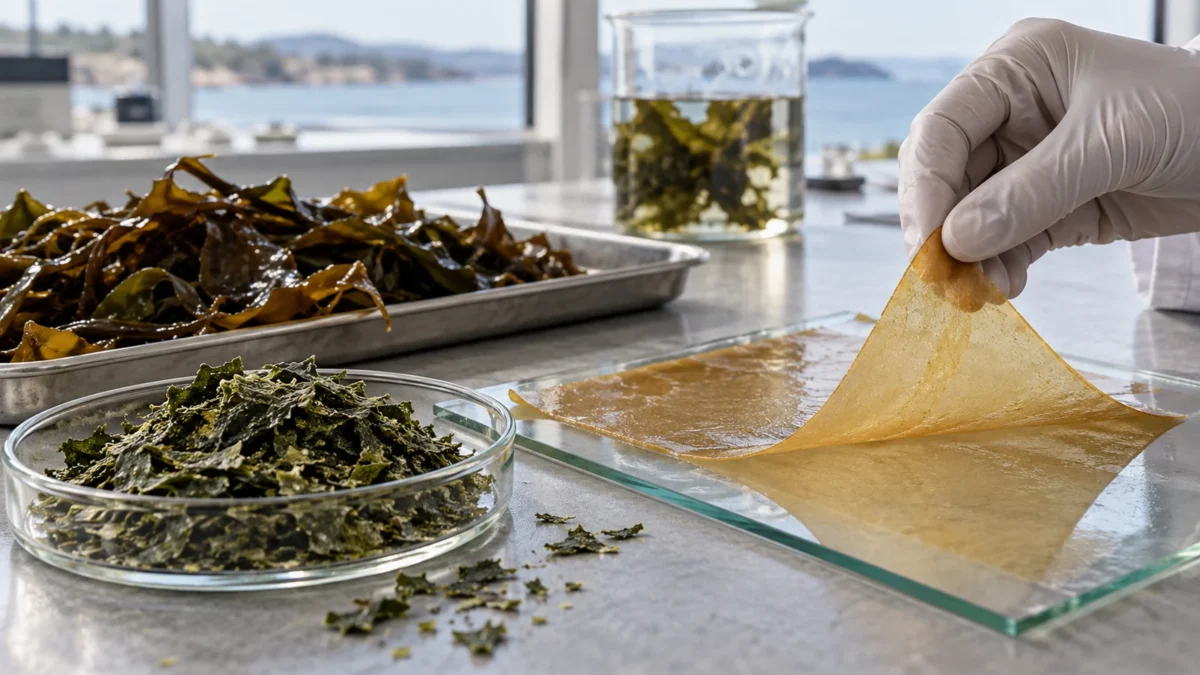
Seaweed-derived polysaccharides can form packaging films, but a useful oxygen barrier in a cast specimen does not establish moisture resistance, sealability or commercial-line performance.
The feedstock grows in water. It can supply film-forming polysaccharides such as alginate, carrageenan and agar. Some seaweed-derived films show excellent oxygen or grease barrier. Some can carry antioxidants, antimicrobial agents or freshness indicators. Some are edible.
That combination makes it easy to jump from promising material to plastic replacement.
The studies and reviews examined here include laboratory-cast films, processing comparisons and food-application demonstrations. They establish particular capabilities, but do not constitute a census of commercial products or prove drop-in replacement across packaging lines.
The useful question is therefore not:
“Can seaweed make packaging film?”
It clearly can.
The useful question is:
“Which seaweed-derived polymer, processed by which route, has demonstrated which packaging function—and what still has not been proven at industrial scale?”
Polymer identity and film formation
The chemistry is real: seaweed contains established film-forming polymers
“Seaweed film” is not one material.
Commercial and research systems use several different seaweed-derived fractions:
- alginate, mainly associated with brown seaweeds;
- carrageenan, mainly from red seaweeds;
- agar, also from red seaweeds;
- ulvan, associated with green seaweeds;
- seaweed-derived cellulose;
- less-purified or whole-biomass seaweed fractions.
These polymers differ in ionic functionality, gel formation, sulfate content, chain structure, water affinity and film behavior.
The alginate and carrageenan reviews examined here describe distinct polymer structures and film networks. “Seaweed-based” identifies an origin; it does not specify composition, charge or the full film construction. [S1] [S2]
Film formation is well demonstrated
Alginate, carrageenan and agar can all form continuous films under laboratory conditions.
Solution casting is the most common research route. A polymer is dissolved or dispersed in water, combined with plasticizer and other ingredients, spread as a liquid layer and dried.
This method is excellent for answering scientific questions:
- Can the polymer form a coherent film?
- How does glycerol change flexibility?
- Does calcium crosslinking reduce alginate water sensitivity?
- Does a nanofiller improve tensile strength?
- Can an antioxidant be immobilized in the matrix?
But casting is also where the first technology-readiness boundary appears.
A laboratory film dried slowly in a Petri dish has not yet demonstrated high-speed coating, web handling, heat sealing, roll storage, printing or form-fill-seal compatibility.
A 2025 review on taking edible films from laboratory to industry makes this distinction directly: solution casting dominates laboratory research, while industrial flexible-film production typically requires faster continuous processes such as extrusion, coating, calendering or related web technologies. [S6]
Barrier networks and moisture
Alginate has a clear barrier strength and a clear weakness
Alginate is one of the best documented seaweed-derived packaging polymers.
A 2025 review focused specifically on plastic-free alginate cast films concluded that alginate can provide strong oxygen and fat barrier, while high water-vapor permeability, water solubility and brittleness remain major limitations. [S1]
This is not a small caveat.
Food packaging often has to resist both oxygen and moisture. Alginate demonstrates why those functions must be separated.
For the related distinction, see the difference between gas, grease and moisture barrier metrics.
| Function | What has been demonstrated | What limits wider use |
|---|---|---|
| Oxygen barrier | Strong performance reported for dense alginate films under suitable conditions | Performance can change with humidity and formulation |
| Grease / fat barrier | Useful resistance reported in alginate-film literature | Finished-package defects and wet exposure still matter |
| Water vapor | Generally weaker because alginate is hydrophilic | Moisture uptake and vapor transport |
| Liquid water | Can be improved by ionic crosslinking | Swelling, solubility and non-uniform crosslinking |
| Mechanical performance | Can be adjusted with plasticizer/crosslinking | Brittleness or loss of strength under wet conditions |
Source basis: [S1]. This table is an editorial comparison, not a product qualification or statutory checklist.
The material is therefore not “good barrier” or “bad barrier.”
It is selective.
Evidence and scope: [S1]. Comparative tables in this section are editorial synthesis, not a new test.
Calcium crosslinking improves alginate—but creates another process problem
Alginate chains can be ionically crosslinked using multivalent ions, especially calcium.
Crosslinking can improve water resistance and mechanical integrity because the ionic network restricts chain movement and swelling.
The same 2025 review identifies several practical complications: [S1]
- crosslinking can be non-uniform;
- films can shrink during crosslinking;
- the resulting material is not automatically compatible with conventional thermal sealing or thermoforming;
- processing history strongly affects final properties.
This is a recurring theme in seaweed packaging.
A laboratory modification can solve one material weakness while creating a converting problem.
Carrageenan films are tunable, but humidity still controls the network
Carrageenan is another established seaweed hydrocolloid, but “carrageenan” also describes multiple structures.
κ-, ι- and λ-carrageenan differ in sulfate content and gel-forming behavior. Ionic environment and blend composition can therefore change the film network significantly.
A 2025 open-access review of carrageenan food-packaging films describes water-vapor permeability as strongly dependent on film integrity, hydrophilic/hydrophobic balance, chain packing and mobility. Blending carrageenan with starch, proteins, chitosan, nanocellulose, clays or other components can improve water-vapor performance. [S2]
Carrageenan type, ionic environment and blend architecture need to be specified before transferring a mechanical or barrier result to another film.
That is a more realistic model than “carrageenan film has property X.”
Agar works, but it also needs formulation help
Agar has strong film-forming ability and is widely studied for edible coatings and films.
The broader edible-film production review describes polysaccharide film formation and formulation choices; agar is one such film-forming platform, not a complete package specification. [S6]
The same review identifies persistent limitations:
- brittleness;
- humidity sensitivity;
- limited barrier performance for some applications;
- need for added functionality or modification.
So alginate, carrageenan and agar reach a similar engineering conclusion through different chemistry:
the base seaweed polymer can form a film, but the commercial package usually requires additional network engineering.
Processing beyond the cast film

What has been demonstrated beyond simple cast films?
Recent research is beginning to move beyond the classic Petri-dish film.
A study assigned to the 2026 Food Hydrocolloids volume compared casting and melt compounding of Ulva biomass and extraction residues. The original authors’ abstract and institutional record were checked; the full experimental methods were not re-audited. [S7]
The processing route changed the result. Melt-compounded films were more opaque and, in the reported systems, showed different stiffness, extensibility, water-vapor permeability and hydrophilicity from cast films. [S7]
This study matters less for its individual values than for its processing lesson:
seaweed-derived material behavior changes when the production route moves closer to thermoplastic processing.
It is one of the more relevant bridges between seaweed-film research and scalable manufacturing.
Whole biomass could simplify extraction—but it creates variability
One attraction of minimally refined seaweed biomass is the possibility of avoiding purification of a single polymer fraction.
Whole or partially processed biomass can contain:
- multiple polysaccharides;
- cellulose;
- proteins;
- minerals and ash;
- pigments;
- phenolic compounds;
- salts.
That can reduce purification steps and retain useful functional components.
It also makes the feedstock less uniform.
The Ulva authors report composition and film-property differences associated with extraction and processing. These are specimen-specific findings, not measured seasonal feedstock consistency. [S7]
For industrial packaging, this raises a major question:
Can seasonal, species and processing variability be controlled tightly enough to produce a repeatable film specification?
That remains a scale-up issue, not a solved raw-material advantage.
Active packaging is scientifically demonstrated—but usually formulation-specific
Seaweed-polysaccharide films are frequently used as carriers for:
- antioxidants;
- essential oils;
- plant extracts;
- antimicrobial compounds;
- pH-sensitive indicators;
- nanoparticles.
Published active-film studies report food-application experiments, but a formulation-specific finding does not establish commercial readiness.
A 2026 original-study abstract describes seaweed-polysaccharide/carboxymethyl-chitosan film development and a strawberry-preservation application. Without a full-method assessment, it is treated here as an attributed laboratory example, not a quantitative shelf-life promise. [S9]
These experiments demonstrate that seaweed polymers are useful functional matrices.
They do not demonstrate that every such formulation is ready for unrestricted commercial food packaging.
Migration, toxicology, regulatory status, scale-up, additive stability and recycling/end-of-life effects all have to be assessed for the actual formulation.
Sealing and handling evidence
Edible does not mean “commercially interchangeable with plastic film”
Many alginate, carrageenan and agar systems are described as edible films. [S6]
That term can be technically appropriate when the film is formulated entirely from food-compatible ingredients and intended to be consumed.
But edibility does not automatically solve:
- moisture barrier;
- seal strength;
- machineability;
- storage stability;
- hygiene during handling;
- printing and labeling;
- food-contact authorization for every additive;
- consumer acceptance.
A film being edible and a film being an industrial replacement for polyethylene are different claims.
The heat-sealing problem is often underreported
Flexible packaging lines depend heavily on reliable heat sealing.
Hydrocolloid films do not necessarily soften and fuse in the same way as conventional thermoplastics. Ionically crosslinked alginate, for example, can become more water-resistant while remaining poorly suited to ordinary thermal sealing.
This creates a translation bottleneck between “film can be made” and “film can run on packaging equipment.”
The relevant questions include:
- Can it be sealed at production speed?
- What is the seal initiation temperature?
- How wide is the sealing window?
- Does humidity change seal strength?
- Can the film survive roll winding and unwinding?
- Does it block during storage?
The reviewed laboratory-film evidence does not substitute for an identified converting-line trial with sealing, handling and throughput data.
Laboratory tensile strength is not machineability
A strong cast film can still fail on a converting line.
Industrial film needs a balance of:
- tensile strength;
- elongation;
- tear resistance;
- puncture resistance;
- fold endurance;
- coefficient of friction;
- sealability;
- dimensional stability under humidity;
- consistent gauge.
A tensile-strength result alone does not report the converting variables in that list. The edible-film production review identifies process efficiency and available equipment as additional scale-up considerations.
This is why isolated tensile-strength values should not be compared directly with commercial packaging film and treated as proof of drop-in replacement.
Biodegradable is plausible; “marine biodegradable” requires separate evidence
Seaweed polysaccharides are biologically derived and many can be biodegraded by microorganisms.
That does not establish a fixed environmental degradation time for a finished seaweed package.
The formulation may include crosslinkers, hydrophobic modifiers, nanofillers, proteins, other polymers, coatings or active compounds.
And marine origin of the feedstock does not mean the finished film has automatically demonstrated biodegradation in seawater.
For the related distinction, see why biological origin does not prove a disposal outcome.
The same evidence boundary applies to seaweed-derived systems:
environmental fate belongs to the finished formulation, specimen and test environment—not to the botanical origin of the feedstock.
What each type of evidence establishes
| Evidence level | What is reasonably established | What remains to be proven broadly |
|---|---|---|
| Laboratory film formation | Alginate, carrageenan and agar readily form films/coatings | Not equivalent to continuous industrial film production |
| Barrier engineering | Strong oxygen/grease performance possible; moisture can be improved | Stable performance across high RH and real distribution conditions |
| Mechanical tuning | Plasticizers, crosslinking, blends and fillers can improve properties | Long-term aging, roll handling and converting robustness |
| Active/intelligent packaging | Many functional systems demonstrated in model foods | Migration, regulation, stability, manufacturing consistency |
| Thermoplastic-like processing | Emerging melt-compounding and extrusion-related work exists | High-speed, economical, repeatable commercial processing across grades |
| Environmental end of life | Seaweed polysaccharides are biodegradable in suitable systems | Finished-formulation claims across compost, soil or marine environments |
Source basis: [S1] [S2] [S6] [S7]. This table is an editorial comparison, not a product qualification or statutory checklist.
What should a buyer ask when offered “seaweed packaging”?
| Question | Why it matters |
|---|---|
| Which seaweed-derived polymer? | Alginate, carrageenan, agar, ulvan, cellulose and whole biomass behave differently |
| How much of the finished film is seaweed-derived? | A blend may rely heavily on another polymer or filler |
| Cast, coated, extruded or melt-compounded? | Processing route changes morphology and industrial relevance |
| What plasticizer/crosslinker? | Controls flexibility, moisture sensitivity and network stability |
| What OTR/WVTR conditions? | Humidity strongly affects hydrophilic films |
| Can it heat seal? | Packaging-line compatibility cannot be inferred from tensile strength |
| What is the aging/storage condition? | Humidity and plasticizer redistribution can change performance |
| Which active/nano additives? | Changes food-contact, migration and environmental assessment |
| What finished-food trial exists? | Model-film data do not prove real food performance |
| What end-of-life test covers the final formulation? | Seaweed origin alone does not prove compost, soil or marine degradation |
Source basis: [S1] [S6] [S9]. This table is an editorial comparison, not a product qualification or statutory checklist.
What the evidence changes
A credible seaweed-film proposal identifies the polymer fraction and full formulation, then demonstrates the required barrier, sealing and handling performance by the intended process. Published film formation and selected food trials are useful evidence; a particular commercial substitution still needs its own complete specification.
Methodology and editorial note
This technical explainer synthesises the identified official guidance, public standard scopes and research records. Study findings remain specific to their reported materials and conditions. Sources checked 19 October 2026; no product testing, factory inspection or independent certification assessment was performed for this article.
The main image is an AI-generated editorial illustration of an unnamed conceptual scene. The explanatory figure is an original editorial synthesis, not a photograph of an experiment, microscopic structure or measured result.
Official sources and reference notes
- [S1] Sophie Schenk et al. Challenges of Alginate-Based Cast Films in Plastic-Free Food Packaging Applications: An Overview. Polymers 17(22), 3061; published 19 November 2025. Alginate oxygen/fat versus moisture behavior; ionic crosslinking; process and sealing limitations. Relevant full public review sections checked. Not a commercial-market census or product qualification. Accessed 19 October 2026.
- [S2] Thulasidhas Dhilipkumar et al. Exploring recent advances in carrageenan-based films for sustainable food packaging applications. European Food Research and Technology 251 (2025), 3151–3173; published 4 July 2025. Carrageenan types; network, moisture/barrier and application limitations. Relevant full public review sections checked; formulation-specific evidence retained. Accessed 19 October 2026.
- [S6] S. Weng; I. Marcet; M. Rendueles; M. Díaz et al. Edible Films from the Laboratory to Industry: A Review of the Different Production Methods. Food and Bioprocess Technology 18 (2025), 3245–3271; published online 5 November 2024. Abstract and laboratory/pilot/industrial process distinction. Relevant full public review sections checked; industrial route suitability is not validated for every seaweed formulation. Accessed 19 October 2026.
- [S7] Vanesa Sanz et al. Valorisation of Ulva spp. green seaweed and its residues from pressurized hot water extraction: A comparative study of casting and melt-compounding techniques for film production. Food Hydrocolloids 172(2026),112087; DOI10.1016/j.foodhyd.2025.112087. Original-author institutional bibliographic record; original authors’ abstract, also indexed by FAO AGRIS. Author record and authors’ abstract checked; full methods not audited. No commercial scale or numerical performance extrapolation. Accessed 19 October 2026.
- [S9] Xinyang Hu et al. Multifunctional active packaging film based on seaweed polysaccharides and carboxymethyl chitosan for enhanced food preservation. International Journal of Biological Macromolecules 348,150836;March 2026;DOI10.1016/j.ijbiomac.2026.150836. Original publisher/PubMed abstract: composite construction and strawberry example. Official indexed author abstract only; numerical performance, migration and regulatory approval not inferred. Accessed 19 October 2026.
The public corrections channel is currently inactive. Read our corrections policy.