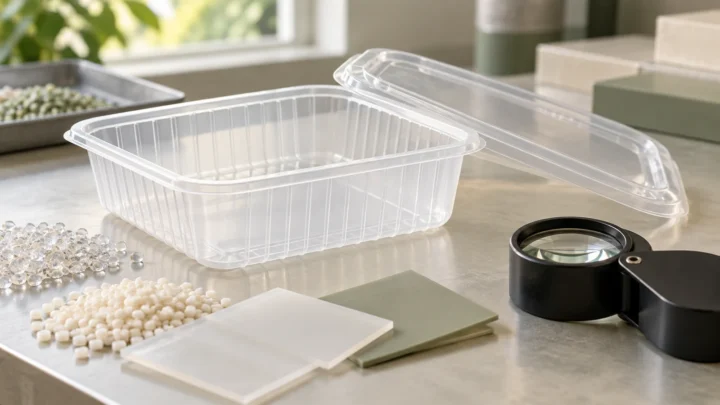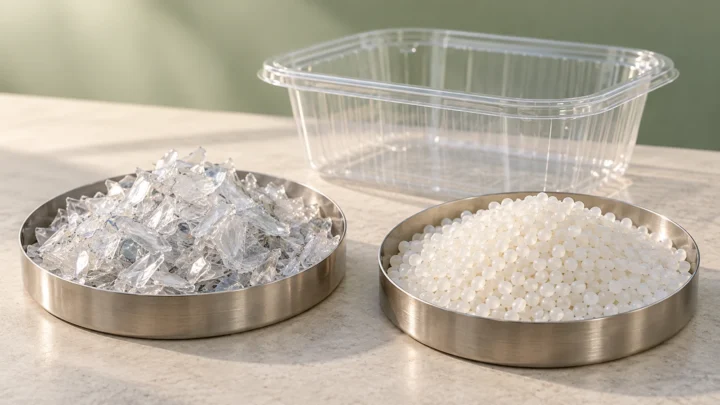
A plastic food-contact declaration should connect an identified material or article to its permitted conditions of use. The words “PP”, “PET” or “food grade” alone cannot perform that job. Regulation (EU) No 10/2011 sets specific rules for plastic food-contact materials within its scope, alongside the general food-contact framework. [1]
The useful reading task is to connect four things: the supplied construction, the substances and restrictions relevant to it, the intended food-contact conditions, and the evidence supporting that use. A document that leaves those connections unclear may be difficult to apply even when it cites the right regulation.
Scope comes before the test result
Article 2 distinguishes the plastic materials and layers covered by the regulation. A finished pack may also contain printing inks, adhesives, coatings or other materials for which the regulatory route needs separate consideration. A statement about one resin does not automatically describe every component of a multilayer or converted article. [1]
Articles 11 and 12 address specific and overall migration, while Articles 15 and 16 connect declarations and supporting documentation. The relevant question is not simply whether “migration testing” occurred. It is whether the assessment addresses the restrictions and use conditions applicable to this construction. This article does not prescribe a test programme or approve a finished pack.
| Question | Rule or evidence | Important boundary |
|---|---|---|
| Material identity | Polymer, layers and relevant components | A resin trade name does not identify the finished article |
| Use conditions | Food type, contact time and temperature | A cold-use assessment does not automatically cover hot filling |
| Declaration | Applicable legal basis and restrictions | Connect it to the supplied construction and version |
| Supporting evidence | Migration assessment and relevant records | A signed declaration is not a substitute for its factual basis |
Read the use conditions as part of the conclusion
Food type, contact duration, temperature and repeated use can change the assessment. If the supplied document covers a different use, the correct next step is to establish the missing connection; it is not to assume that the most demanding-looking temperature on the page covers every application.
The same care applies to formulation changes. A new coating, colourant, adhesive or processing condition can make a previous document a poor description of the supplied version. Traceable identification allows the responsible operator to decide whether existing evidence remains applicable instead of relying on a generic certificate file.
The 2025 transition is not an indefinite grace period
Regulation (EU) 2025/351 amended the plastics, recycled-plastics and good-manufacturing-practice rules. Article 4 provides a stock transition for qualifying plastic materials and articles first placed on the market before 16 September 2026. It also specifies a declaration condition for certain nonconforming intermediate products or substances first placed on the market after 16 December 2025. These are different supply-chain situations. [2]
Those dates should not be reduced to “all old certificates remain valid”. The relevant first-placement event, compliance with the earlier rules and other applicable EU legislation matter. The Commission’s legislation register also lists later substance-list changes, including Regulation (EU) 2026/245. A historical list is therefore not a current formulation clearance. [3][4]
What a declaration can establish
An adequately supported declaration can identify the operator’s conclusion for a specified article and use. It is not evidence that Degradable Packaging tested the item, that every food-contact application is covered, or that the package is recyclable or compostable.
The strongest procurement record is consequently a connected one: an exact supplied version, explicit intended use, the applicable declaration and access to the relevant supporting assessment through the responsible operator. The material name remains useful identification; it does not replace that chain.
Sources
Sources checked 21 October 2026. Legal text, official interpretation and editorial examples are distinguished above. No individual product or business conformity assessment was performed.
- European Commission / Official Journal via BOE. Regulation (EU) No 10/2011 on plastic food-contact materials. 14 January 2011; base act read with amendments identified below. Locator: Regulation 10/2011 Articles 2, 11–12, 15–16 and Annex IV; Regulation 2025/351 Article 4; 2026/245 Annex I amendment. Relevant full original provisions read in the official Spanish rendition; English explanation is an editorial paraphrase, not an official translation.
- European Commission / Official Journal via BOE. Regulation (EU) 2025/351 amending plastic food-contact and GMP rules. 21 February 2025. Locator: Regulation 10/2011 Articles 2, 11–12, 15–16 and Annex IV; Regulation 2025/351 Article 4; 2026/245 Annex I amendment. Relevant full original provisions read in the official Spanish rendition; English explanation is an editorial paraphrase, not an official translation.
- European Commission, DG SANTE. Food-contact materials: legislation overview. Current official page checked 21 October 2026. Locator: Regulation 10/2011 Articles 2, 11–12, 15–16 and Annex IV; Regulation 2025/351 Article 4; 2026/245 Annex I amendment. Relevant official text read; scope is the cited provision or guidance.
- European Commission / Official Journal via BOE. Regulation (EU) 2026/245 amending the plastics Union substance list. 2 February 2026. Locator: Regulation 10/2011 Articles 2, 11–12, 15–16 and Annex IV; Regulation 2025/351 Article 4; 2026/245 Annex I amendment. Relevant official text read; scope is the cited provision or guidance. Read through official web reader; direct local retrieval restricted or unavailable; selected evidence notes retained.
The public corrections channel is currently inactive. Read our corrections policy.