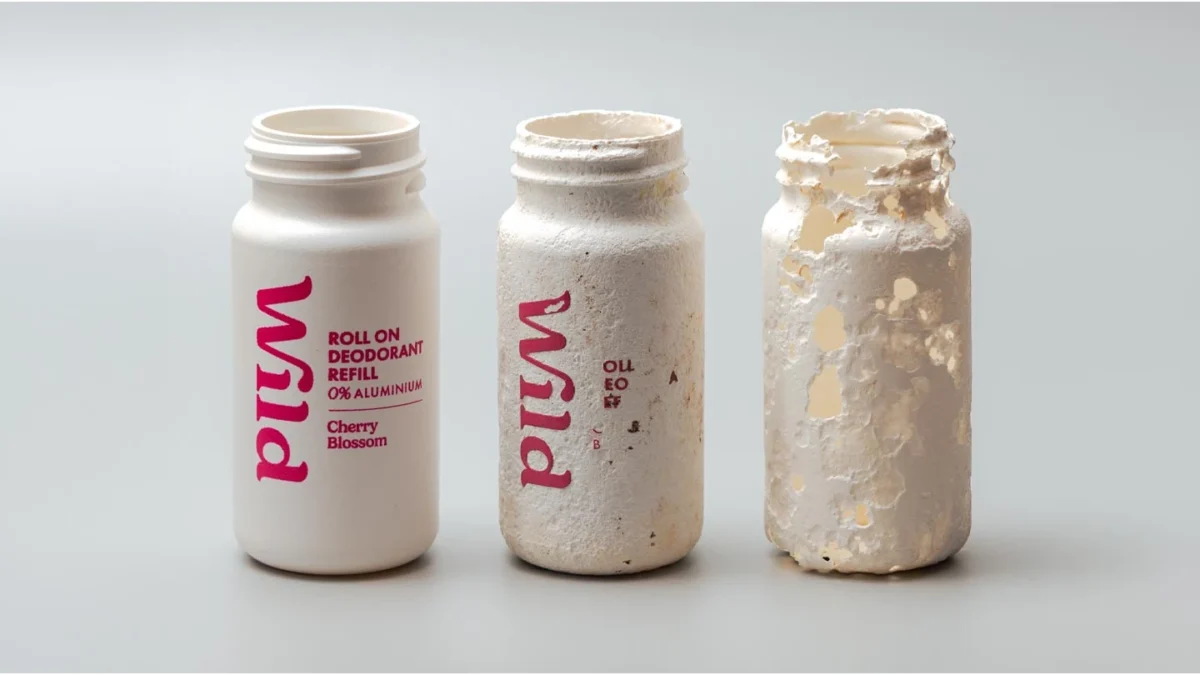
MYGroup announced a collaboration with Shellworks on 12 October 2026 to provide a take-back route for packaging made from Shellworks’ VIVOMER material. The announcement appears in MYGroup’s official news listing. Packaging Europe subsequently reported that empty containers would enter retail collection schemes and be processed into a board material. The event concerns recovery infrastructure for a named material, rather than a claim that compostable packaging now has a universal disposal route.
The industry question is concrete: what happens when a consumer cannot or does not compost the pack? A material developer can describe an intended end of life, but consumers still need an accessible collection route and an operator willing to handle the item.
A route through retail collection and board manufacture
Packaging Europe’s 13 October account says MYGroup supplied collection boxes to more than 800 stores participating in schemes including Recycle at Boots, Harrods H Beauty’s MyBeauty and Reselfridges Recycle. It reports that the material goes to MYGroup’s Hull facility and is recovered into MYboard, a wood-replacement board used in applications such as furniture and displays.
MYGroup’s 12 October official release, subsequently examined in full, directly describes those collection schemes and the Hull-to-MYboard route. These remain operator-reported particulars rather than independent checks of every store. The release also describes separate bioconversion trials; those trials must not be confused with the reported board-manufacturing recovery route.
Most importantly, the reported route is board manufacture. It should not be described as industrial composting or as a process returning the containers to new beauty packaging. A second use for recovered material and a closed loop back to the original package are different outcomes.
Collection access is not a collection rate
A network’s announced reach describes the potential opportunity to return an item. It does not show how many consumers use it, how much VIVOMER is collected, or what proportion becomes usable output. Those require material-specific operating data and a defined denominator.
For example, a total collected across many health and beauty materials cannot establish this new material’s capture rate. The relevant comparison would follow VIVOMER packaging placed on the market, returned through the scheme, accepted for processing and incorporated into the next material. Each quantity answers a different question.
The announcement is therefore an infrastructure milestone. It is not evidence that a specified share of all Shellworks packaging avoids landfill or incineration. No VIVOMER-specific recovery rate or independently checked mass balance was available in the accessed records.
Material claims and handling instructions need different evidence
Shellworks describes VIVOMER as a biomaterial produced using microbial processes. Those manufacturer descriptions explain the material proposition. They do not determine whether a particular retail scheme accepts every format, component or product residue.
A consumer-facing instruction needs to identify the actual package and the scheme’s conditions. A jar, closure and dispenser can create different handling issues even when a brand uses the same named material in part of the pack. Without item-specific instructions, this report cannot extend the collaboration to every component or to unrelated compostable packaging.
Likewise, a compostability claim concerns behaviour under specified conditions. Retail collection acceptance concerns a chosen waste-management route. Both may be relevant to the same material, but one does not establish the other. Sending packaging to a mixed-material board process is not proof of its decomposition performance.
The important change is responsibility beyond the material
The collaboration is interesting because it places a recovery operator alongside the developer in the material story. That can make the end-of-life proposition more concrete than a generic instruction to compost. It also opens the process to more specific scrutiny: where items go, what becomes of them and how the result is measured.
The route still depends on consumer participation, scheme acceptance and actual processing. Convenience and clear instructions could influence participation, but this report has no evidence measuring that effect. It therefore does not claim that the network is more effective than another material’s collection system.
The next useful disclosure would be an up-to-date location and item list, followed by VIVOMER-specific quantities and processing outcomes. Until then, the development is a reported take-back option with a described destination. It illustrates the system questions explored in Refill Packaging Beyond Beverages: Beauty, Detergents, Personal Care and Household Products and From Material Substitution to System Redesign: How Sustainable Packaging Innovation Is Moving Beyond “Plastic vs Paper”, while leaving the scheme’s actual recovery performance open.
Sources
- MYGroup. MYGroup and Shellworks collaborate on take-back to give VIVOMER packaging a recovery route at scale. 12 October 2026 per listing. Linked release. Sources checked 21 October 2026.
- Shellworks. VIVOMER material and packaging information. Undated; accessed 21 October 2026. Material/process sections. Sources checked 21 October 2026.
- Packaging Europe staff writers. Collection points established for Shellworks’ plant-based, compostable packs. 13 October 2026. Collection schemes; Hull and MYboard paragraphs. Sources checked 21 October 2026.
The public corrections channel is currently inactive. Read our corrections policy.