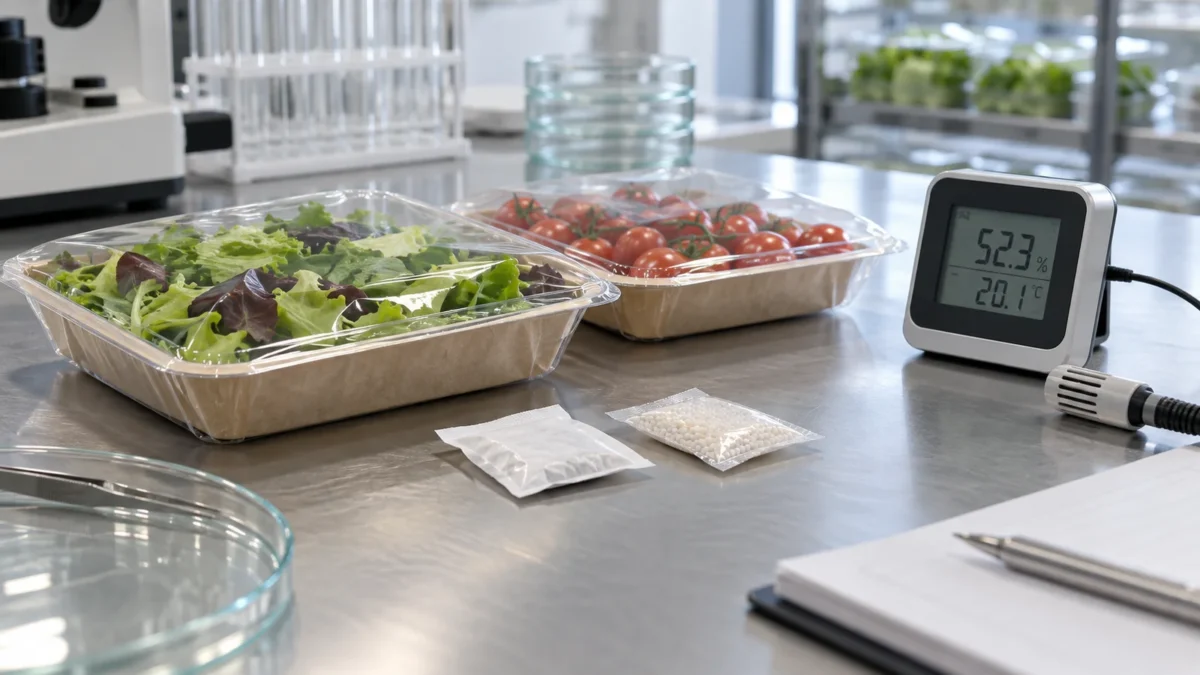
Active packaging changes a package from a passive barrier into a system that does something to the product environment. It can remove oxygen, absorb moisture, slow ethylene-driven ripening, release an antimicrobial, control humidity or protect metal parts with a volatile corrosion inhibitor.
That extra function can be valuable. It can also add a sachet, pad, coating, multilayer film, reactive additive or chemical component that did not exist in the simpler package. The correct sustainability question is therefore not “Does active packaging extend shelf life?” It is: does the protected-product benefit justify the added packaging complexity under the actual supply chain and end-of-life route?
That distinction matters because the same active technology can be useful in one application and unnecessary in another. Oxygen control that prevents oxidation in a high-value food may be worth more than the added scavenger. The same scavenger added to a product whose shelf life is limited by moisture or microbial growth may deliver little benefit while still complicating the package.
Start with the failure mode, not the active ingredient
| Product failure mode | Active function | Potential product benefit | Added packaging burden to verify |
|---|---|---|---|
| Oxidation / residual oxygen | Oxygen scavenger | Slower oxidation, colour/flavour degradation or oxygen-sensitive deterioration | Reactive chemistry, activation conditions, sachet or integrated layer, food-contact safety |
| Excess liquid / high humidity | Moisture absorber, pad or desiccant | Less condensation, drip, softening or moisture-driven degradation | Absorbent polymer/mineral, pad construction, disposal, risk of over-drying in some products |
| Ethylene-driven ripening | Ethylene scavenger / inhibitor | Slower ripening or senescence for selected fresh produce | Adsorbent/catalyst, sachet/film/coating, capacity and temperature/humidity dependence |
| Microbial spoilage | Antimicrobial release or active surface | Reduced growth of targeted spoilage/pathogenic organisms under validated conditions | Migration, dose control, sensory effects, regulatory authorisation and film-property changes |
| Moisture-sensitive medicines / electronics | Desiccant / humidity-control component | Maintain an internal humidity range compatible with product stability | Extra canister/sachet, package MVTR, desiccant capacity and handling |
| Atmospheric corrosion of metal parts | Volatile corrosion inhibitor | Temporary corrosion protection during enclosed storage/transport | Active chemical in paper/film, enclosure integrity, material compatibility and disposal |
The table is deliberately organised by failure mode. “Oxygen scavenger”, “desiccant” or “antimicrobial film” is not a specification until the product deterioration mechanism, environment and required service life are known. [S1] [S2]
Oxygen scavengers: useful only if oxygen is the limiting variable
Oxygen scavengers are one of the most established active-packaging technologies. They can be placed inside a package as a sachet or incorporated into a polymer, coating or closure. Their job is to remove residual oxygen or oxygen that enters after sealing. [S3]
A 2026 systematic review of oxygen-scavenging food packaging found that performance depends on conditions such as humidity, temperature, pH, scavenger chemistry and compatibility with the packaging polymer. That matters because an oxygen scavenger is not a universal “shelf-life layer.” Some systems require moisture to activate; others use metal oxidation, antioxidants or organic reactive groups. Capacity and reaction rate have to match the headspace, product oxygen sensitivity and oxygen ingress over time.
For meat, bakery, oils and other oxidation-sensitive foods, the target can be colour, flavour, lipid oxidation or microbial conditions. But if the primary failure mode is moisture loss, texture change or temperature abuse, removing more oxygen may not solve the shelf-life problem.
The current evidence review is available in Food Chemistry Advances.
Moisture control can mean absorbing liquid—or controlling relative humidity
“Moisture absorber” covers several different packaging jobs. [S5]
Fresh meat and produce trays may use absorbent pads to capture purge or free liquid. Dry foods can use desiccants to protect crispness or powder flow. Pharmaceutical bottles can include a desiccant because the product’s chemical or physical stability depends on controlling water vapour inside the container. Electronics and metal parts may use desiccants to reduce the humidity that contributes to corrosion or moisture-related failure.
These are not interchangeable uses. The 2026 active-food-packaging literature lists silica gel, molecular sieves, clays, starch and cellulose among moisture-control materials, but the relevant performance variable differs by product: liquid uptake, equilibrium humidity, moisture-vapour transmission, sorption capacity or rate.
Pharmaceutical packaging makes the boundary especially clear. USP General Chapter <671> uses moisture-vapour transmission testing to classify packaging-system performance for oral dosage forms. Pharmaceutical package selection can also combine container MVTR, product moisture sensitivity and desiccant sorption behaviour rather than assuming “more desiccant is better.”
Moisture control should therefore target a required humidity window, not simply the driest possible package. See the current USP <671> public preview.

Ethylene control is a produce-specific tool, not a generic freshness claim
Ethylene is a plant hormone involved in ripening and senescence. For climacteric produce such as bananas, mangoes, kiwifruit and some tomatoes, managing ethylene in storage or packaging can help slow unwanted ripening. That logic does not automatically apply to every fruit or vegetable. [S4]
Recent reviews describe several active routes: adsorption using porous materials such as zeolites or activated materials; chemical oxidation systems; photocatalytic materials such as titanium-dioxide-based systems; and inhibitors that alter ethylene response. These technologies can be delivered through sachets, filters, pads, coatings or active films.
The performance boundary is more difficult than “absorbs ethylene.” A 2026 review of ethylene-scavenging packaging highlights the need to match scavenger chemistry, carrier matrix, loading, mass-transfer rate, package architecture, temperature and relative humidity. It also identifies real-world validation as a remaining gap in parts of the research field.
That is why a laboratory reduction in headspace ethylene should be separated from a commercial claim that a package reduces produce loss through a full distribution chain.
Antimicrobial packaging has a dose-and-migration problem by design
Antimicrobial packaging can work by releasing an active substance, presenting an active surface or immobilising an antimicrobial on the packaging matrix. The objective may be to inhibit a specific spoilage organism or pathogen under defined food and storage conditions. [S1] [S6]
For releasing systems, migration is not an incidental issue—it may be part of the mechanism. A 2025 review of antimicrobial active films identifies film properties, food composition, environmental conditions and antimicrobial-agent properties as interacting factors controlling release. Too little release can make the system ineffective; uncontrolled release can create safety, sensory or regulatory problems.
In the EU, active food-contact materials are governed by the general food-contact framework and the specific Commission Regulation (EC) No 450/2009. The Regulation defines active materials as materials intended to extend shelf life or maintain/improve packaged food by deliberately incorporating components that release or absorb substances. It also requires food-contact safety and includes rules intended to prevent active packaging from misleading consumers—for example by masking spoilage.
This makes antimicrobial packaging fundamentally different from simply adding an inert barrier layer. The food, active substance, migration behaviour and package are one regulatory and technical system. See the current EU active and intelligent food-contact regulation.
Pharmaceutical desiccants show why active packaging is sometimes risk control, not marketing
Active packaging is not limited to food. Moisture-sensitive tablets and capsules can require packaging that maintains humidity below a product-specific threshold for the intended shelf life. [S8] [S9]
In this application, the active component may be a silica-gel or molecular-sieve canister placed inside an HDPE bottle. The desiccant does not make the drug “fresher”; it supports a validated container-closure system. USP <671> treats water-vapour transmission as a package-performance property, while pharmaceutical stability literature models moisture entering through the package together with moisture sorption by both the product and desiccant.
The design lesson is important for other active systems: capacity has to be sized against ingress and service life. A scavenger or desiccant that is exhausted halfway through distribution has not delivered the claimed package function.
Electronics need humidity control because moisture can become a reliability mechanism
Electronics and microelectronic assemblies add a different product-value equation. Humidity can contribute to corrosion, interfacial degradation and electrochemical migration. In high-value electronics, avoiding one field failure can outweigh a small amount of additional protective packaging. [S12]
That does not mean every electronic product needs a desiccant. Moisture-barrier bags, desiccants, humidity indicators and sealed secondary packaging have to be selected according to product sensitivity, storage duration and route. If the barrier is poor, a desiccant may saturate too quickly. If the product is not moisture-sensitive under the expected route, the extra component may add no useful protection.
Active protection should therefore be connected to a known reliability mechanism—not added because “electronics packaging normally uses desiccant.”
Corrosion-inhibiting packaging turns the wrap into part of the preservation chemistry
Metal machinery, spare parts, automotive components and export equipment can be protected using volatile corrosion inhibitors (VCIs). In these systems, the inhibitor can be incorporated into paper, film or another carrier. It volatilises within an enclosed package and interacts with the metal surface to reduce atmospheric corrosion. [S10] [S11]
Recent 2025 research on VCI films continues to show that protection depends on the inhibitor formulation and its ability to function in the vapour phase. Earlier mechanistic studies likewise show that enclosure, volatility, humidity and surface conditions influence performance.
The package therefore has to remain sufficiently enclosed for the active atmosphere to develop. A VCI paper wrapped loosely around an exposed machine part is not equivalent to a validated sealed or semi-sealed system. The technology is also metal- and chemistry-specific: evidence on carbon steel does not automatically establish performance on copper, aluminium or a mixed-metal assembly.
For a current research example, see the 2025 CORROSION study of VCI films.
The architecture determines where the complexity goes
| Architecture | Advantage | Main complexity |
|---|---|---|
| Loose sachet / canister | Active chemistry can be separated from the primary film or bottle | Extra component, accidental ingestion risk for food, filling-line step, removal/disposal |
| Absorbent pad | Places liquid-control function close to product | Multimaterial construction, contaminated after use, added tray component |
| Active coating | Function distributed across the package surface | Coating chemistry becomes part of recycling/migration assessment |
| Active multilayer film | Function integrated without loose component | Layer compatibility, manufacturing complexity and end-of-life separation |
| Active closure / insert | Can preserve a familiar bottle/jar format | Closure becomes more complex and may use additional materials |
An integrated active layer can reduce loose parts but make the main material harder to separate or recycle. A sachet can keep the primary film simpler but creates an additional component that must be inserted, labelled where required and discarded. There is no universal architecture winner. [S1] [S2]
Do not call the package sustainable until the food-or-product benefit is inside the boundary
Active packaging produces one of the clearest examples of why package-only environmental comparisons can mislead. [S13] [S14]
In a published LCA of antimicrobial active packaging for pastry cream, the active coating increased environmental impacts when researchers compared the empty packages alone. When the analysis expanded to the complete food-packaging system and incorporated the tested shelf-life extension and associated food-waste assumptions, the result reversed: the protected food benefit outweighed the extra packaging burden in that specific model.
A 2024 study of chicken packaging reached the same systems conclusion more broadly: when packaging systems create different shelf lives, food waste has to be included in the comparison. The authors also showed that estimates of food waste are uncertain and model-dependent, so shelf-life extension cannot simply be converted into a guaranteed waste-reduction percentage.
The correct test is therefore:
added packaging impact + active-component impact + end-of-life penalty < avoided product loss under a defensible real-world waste model.
That equation can favour active packaging for a high-impact perishable food. It can also reject active packaging when the product loss is already low, the active function is poorly matched, or the added material is substantial.
Separate five evidence levels before making a shelf-life claim
| Evidence level | What it can establish | What it cannot establish by itself |
|---|---|---|
| 1. Laboratory mechanism | Scavenging capacity, adsorption, migration, antimicrobial activity or corrosion inhibition under defined conditions | Commercial shelf life or supply-chain waste reduction |
| 2. Packaged-product shelf-life test | Effect on a specific product, package and storage condition | Performance through every distribution route or consumer behaviour |
| 3. Pilot / logistics trial | Performance in a defined supply-chain environment | Universal commercial result |
| 4. Commercial operating data | Waste, returns, claims or shelf-life outcomes in actual deployment | Independent causation unless the comparison is controlled |
| 5. Regulatory + end-of-life validation | Food-contact/legal status and recovery compatibility of the finished construction | Environmental superiority unless a system assessment is also performed |
This ladder prevents a common error: taking a material that scavenges oxygen in a laboratory and describing it as a commercially sustainable packaging solution before product performance, regulation and end-of-life have been established. [S15]
Active packaging earns its complexity when four conditions are met
A useful design review can finish with four gates. [S1] [S13]
- The failure mode is material. Oxygen, moisture, ethylene, microbes or corrosion must actually limit product quality, safety or service life.
- The active function is matched and sized. Capacity, reaction/release rate and activation conditions have to last through the required route.
- The product benefit is measured. Use packaged-product shelf-life, failure-rate or corrosion data—not the active material’s laboratory capacity alone.
- The added complexity is accounted for. Include food-contact safety, migration, extra layers/components, production steps, disposal/recycling compatibility and the environmental burden of the active system itself.
When those four conditions are met, active packaging can protect more product with a slightly more complex package. When they are not, the active feature may simply turn a simple pack into a harder-to-manufacture, harder-to-recycle package without solving the dominant product-loss problem.
The design target is not the most active package. It is the least complex package that reliably prevents the loss that actually matters.
Methodology and editorial note
This is a function-versus-complexity framework, not an independent active-material test. Food-contact, migration, product protection and avoided-loss claims require product-specific evidence; published LCA findings are limited to their modeled scenarios. Evidence and source scope checked 21 October 2026. The main image is a disclosed generic editorial illustration or original concept diagram, not a named company, real facility or tested product. Editorial Team human review remains pending after publication.
Sources and reference notes
- [S1] European Union / European Commission. Commission Regulation (EC) No 450/2009 of 29 May 2009 on active and intelligent materials and articles intended to come into contact with food. Articles 1–4; definitions and safety/labelling framework. Handoff access record: 21 October 2026.
- [S2] European Union. Regulation (EC) No 1935/2004 on materials and articles intended to come into contact with food. Article 2; active/intelligent definitions; provisions on misleading changes/information and non-edible components. Handoff access record: 21 October 2026.
- [S3] Arfan, Dirpan, Syarifuddin & Majumder; Food Chemistry Advances. Oxygen scavengers as active food packaging: A systematic literature review and network analysis. Highlights; abstract. Handoff access record: 21 October 2026.
- [S4] 2025/2026 ethylene-scavenger reviews. 2025/2026 ethylene-scavenger reviews. Abstract; review scope. Handoff access record: 21 October 2026.
- [S5] Active Food Packaging (Elsevier edited volume). Moisture absorbers in active food packaging. Abstract. Handoff access record: 21 October 2026.
- [S6] García-Anaya, Sepúlveda & Acosta-Muñiz; Food Research International. Contributing factors to the migration of antimicrobials in active packaging films. Highlights; abstract. Handoff access record: 21 October 2026.
- [S7] Zhang et al.; Food Chemistry. Migration of chemical substances from packaging materials to food. Highlights; abstract. Handoff access record: 21 October 2026.
- [S8] United States Pharmacopeia. <671> Containers—Performance Testing. Public preview / purpose and MVTR description. Handoff access record: 21 October 2026.
- [S9] Waterman & Macdonald; Journal of Pharmaceutical Sciences. Package Selection for Moisture Protection for Solid, Oral Drug Products. Abstract. Handoff access record: 21 October 2026.
- [S10] Khaleghi et al.; CORROSION / AMPP. Unlocking the Potential of Volatile Corrosion Inhibitor Films: A Comprehensive Study on Protective Efficiency. Abstract/public article summary. Handoff access record: 21 October 2026.
- [S11] Corrosion Science authors listed by publisher. Use of vapour phase corrosion inhibitors in packages for protecting mild steel against corrosion. Introduction / mechanism. Handoff access record: 21 October 2026.
- [S12] Sustainability review authors listed by publisher. Review on Corrosion in Electronic Packaging Trends of Collaborative between Academia–Industry. Abstract / introduction. Handoff access record: 21 October 2026.
- [S13] Journal of Cleaner Production authors listed by publisher. Assessing the environmental consequences of shelf life extension: Conventional versus active packaging for pastry cream. Abstract. Handoff access record: 21 October 2026.
- [S14] Tetteh et al.; Cleaner Environmental Systems. Environmental comparison of food-packaging systems: The significance of shelf-life extension. Highlights; abstract. Handoff access record: 21 October 2026.
- [S15] Resources, Conservation and Recycling authors listed by publisher. A framework and calculator for evaluating the impacts of shelf life extension and other food loss and waste reduction technologies. Highlights; abstract. Handoff access record: 21 October 2026.
The public corrections channel is currently inactive. Read our corrections policy.