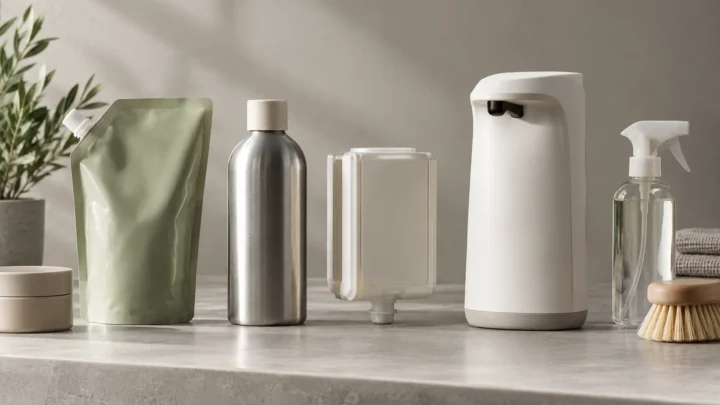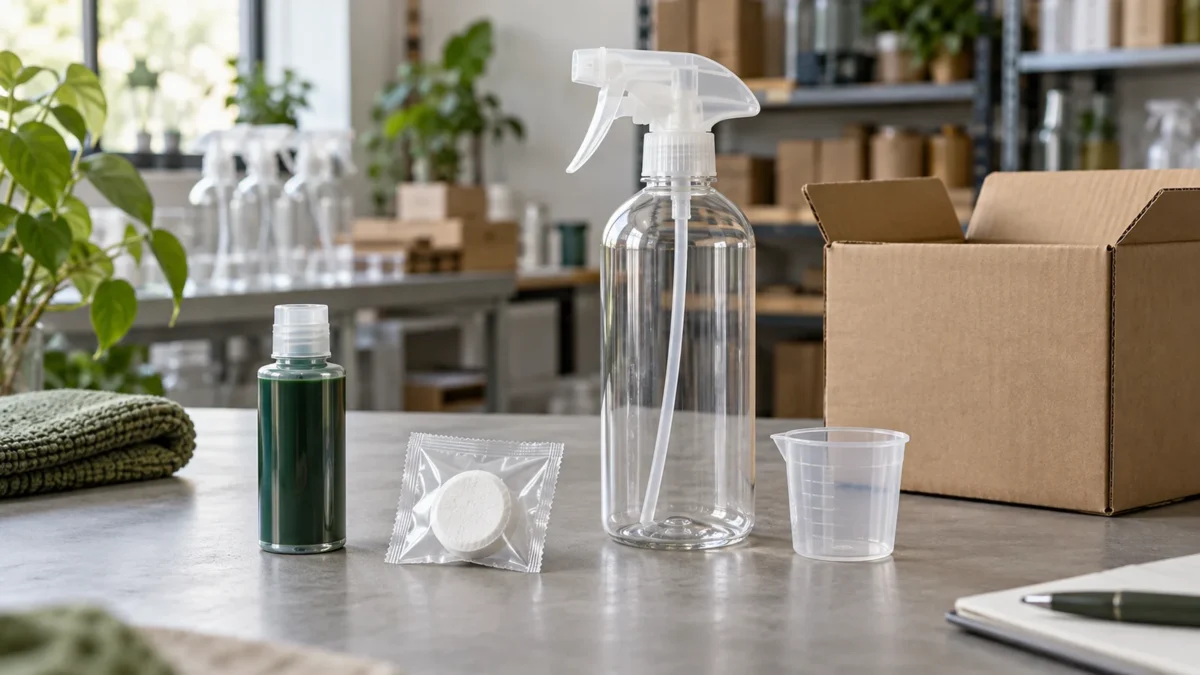
A conventional household cleaner often ships three things together: active ingredients, water and a dispensing package. A shampoo ships formula plus water plus a bottle and cap. A ready-to-use spray cleaner may move hundreds of kilometres even though much of the final product volume could technically be created at the point of use.
Concentrates, tablets, powders, cartridges and refill pods change that equation by redesigning the product before redesigning the package. Remove some water, increase the dose strength, isolate one dose or move the product-contact function into a replaceable cartridge, and the package can become smaller, lighter or reusable. But the package may also need better moisture barrier, more precise dosing, a stronger compatibility interface or new child-safety controls.
The relevant comparison is therefore not “big bottle versus small refill.” It is packaging and transported mass per delivered use.
Remove the water—and the packaging brief changes
| Product redesign | What leaves the supply chain | What the package now has to do | New failure mode |
|---|---|---|---|
| Liquid concentrate | Part of the water and package volume | Meter a smaller, stronger dose; support consumer dilution or direct dosing | Overdosing, under-dilution, wrong bottle or chemical exposure |
| Tablet / powder | Most or all transported water | Protect against moisture; deliver a defined dose; preserve dissolution performance | Clumping, premature dissolution, moisture uptake or consumer misuse |
| Cartridge / refill pod | Repeated replacement of the durable outer dispenser | Seal product, fit one mechanism, install cleanly and empty efficiently | Proprietary mismatch, residual product, valve/seal failure |
| Bulk concentrate | Many small retail packs and some transported water | Survive institutional handling; connect to dosing equipment; prevent cross-connection | Wrong dilution, wrong chemical line, operator exposure |
| Beverage concentrate | Part of shipped water and sometimes package volume | Control dose, flavour consistency and hygiene at dispensing | Incorrect mixing ratio or sanitation failure |
The design opportunity is obvious: a product that becomes four times as concentrated does not need a four-times-smaller package in every case, but it gives the packaging engineer the option to reduce volume, change the dispenser or increase the number of uses delivered per package. [S1] [S2]
The design risk is equally important: a more concentrated product can create higher consequences if the dose is wrong.
Concentration ratio is not the same as packaging efficiency
A “4× concentrate” sounds like a packaging result, but it is only a formulation ratio. Packaging efficiency depends on how the concentrated product is sold and used. [S1] [S5]
For example, a concentrated detergent may be packaged in a smaller bottle that is still discarded after one purchase. That reduces package size and transported mass but does not create reuse. The same concentrate could instead be supplied in a pouch that refills a retained bottle, or in a cartridge that remains sealed until it is inserted into a dispenser. Those three systems share a formulation idea but have different packaging inventories.
A useful comparison normalises the system to a functional unit such as 100 correct doses:
- grams of primary packaging used for those 100 doses;
- grams or kilograms of product transported;
- number of refill packs or cartridges consumed;
- share of a durable bottle/dispenser allocated to those uses;
- secondary and transport packaging;
- consumer-added water, where relevant;
- residual product left in the pack;
- dose errors that increase actual consumption.
This is why less packaging mass by itself is not proof of lower total environmental impact. The 2026 Journal of Cleaner Production study of a detergent concentrate pouch explicitly compared three boundaries: packaging only, packaging plus transported product volume, and the full product system. Its authors found that the apparent benefit changes depending on which boundary is being measured.
See the peer-reviewed 2026 Circular-LCA case study.
Liquid concentrates move precision into the dose
Once water is removed, dosing becomes more important. A ready-to-use trigger spray may tolerate a broad consumer action: spray until the surface is wet. A concentrate can require a measured capful, a fixed cartridge, a marked bottle fill line or an automatic dilution device. [S3]
If the product is designed to be diluted at home, the package has to make the ratio difficult to misunderstand. That may involve:
- a pre-measured concentrate volume matched to one reusable bottle;
- a bottle with a clear water fill line;
- a concentrate pack that cannot easily be mistaken for the ready-to-use product;
- a dosing chamber or metering closure;
- instructions that remain legible after the durable bottle has been used repeatedly.
Unilever’s Cif and OMO concentrate systems are useful company-reported examples of this architecture: a small concentrate is diluted into a larger reusable bottle at home. The company has described this model as a way to transport less water and use less plastic. Those figures are manufacturer claims about defined systems, not universal performance data for concentrates.
The more important engineering point is that the bottle and concentrate are designed as one dosing pair.

Tablets and powders remove water but increase the barrier requirement
Dry products can remove most transported water, but water often returns as the package’s main enemy. [S10]
Many powders and tablets are hygroscopic or contain components whose physical or chemical performance changes when they absorb moisture. Moisture can cause clumping, soften a tablet, alter flowability, change dissolution or reduce stability. The packaging problem therefore shifts from “hold a liquid without leaking” to “control water-vapour ingress throughout storage and repeated opening.”
That can require a tighter film, sealed sachet, lidded container, desiccant or a package that minimises headspace exchange after opening. The correct barrier is product-specific. Evidence from other moisture-sensitive tablet systems consistently shows that package water-vapour transmission and storage relative humidity can materially change product stability; those studies demonstrate the packaging mechanism, not a detergent-specific universal WVTR target.
Removing water can therefore reduce shipping mass while increasing the need for high-barrier packaging. That trade-off has to be measured rather than hidden.
Single-dose formats solve dosing—and can create another package
One tablet, sachet or soluble pod can define the consumer dose very clearly. That can reduce overpouring and make the reusable dispenser simple: add one dose, add water if required, then use. [S7]
But unit dosing also creates a packaging question. Individually wrapped tablets, multi-dose moisture-barrier pouches and water-soluble films all use different material systems. If every dose needs a high-barrier sachet, the product may remove water from freight while increasing packaging pieces per use.
The comparison again belongs at the delivered-use level:
How many grams of packaging are required to deliver one correct dose in usable condition through the claimed shelf life?
For soluble consumer laundry detergent capsules in the EU, packaging safety is not optional. The CLP Regulation contains specific additional rules for liquid consumer laundry detergents in soluble single-use packaging, including requirements for the outer package and soluble packaging. More generally, certain hazardous substances or mixtures supplied to the public trigger child-resistant fastening or tactile-warning requirements based on their hazard classification.
The current ECHA overview is available at Child-resistant fastening and tactile warnings.
Concentrates can make child safety more important, not less
A smaller package can contain the chemical function of a much larger ready-to-use product. For household cleaners, institutional chemicals and other hazardous mixtures, this can increase the consequence of accidental exposure. [S6] [S7] [S8]
EU CLP rules require hazardous-chemical packaging to prevent unintended escape and remain resistant to its contents. Where specified hazard classifications apply, child-resistant fastenings are required; tactile warnings apply under a broader set of hazard classes. These requirements depend on the actual classification and composition—not on whether the product is marketed as a refill or concentrate.
The 2024 CLP amendment also introduced specific rules for hazardous substances and mixtures supplied through refill stations. Those provisions have applied from 1 July 2026. Among other things, the refill station must apply risk-mitigation measures, prevent uncontrolled use by children, provide trained assistance and ensure the refilled package meets applicable labelling and packaging requirements. Certain higher-hazard classifications are excluded from refill-station supply under the new section.
This creates a practical boundary for “bulk refill” narratives: a concentrated cleaning chemical is not automatically suitable for an unattended consumer refill station merely because a reusable bottle exists.
Cartridges and pods move complexity from the bottle into the interface
A cartridge system can keep a premium outer body, actuator or dispensing mechanism in service while replacing only the product-contact reservoir. This is common in beauty concepts because pumps, decorative shells and airless mechanisms can be more complex than the inner refill. [S4]
The cartridge has to solve four problems at once:
- Connection: the refill must lock into the durable dispenser reliably.
- Sealing: the product cannot leak before installation or through repeated actuation.
- Compatibility: formulation, seals and plastics must remain stable for the intended contact period.
- Emptying: excessive residual product can erase some of the apparent material efficiency.
L’Oréal’s current 2026 refill portfolio shows how this concept is being commercialised across skincare, fragrance, makeup and haircare. Its September 2026 refill overview includes skincare refills where the durable outer presentation is retained and the next purchase uses less glass, metal and other packaging materials than repurchasing the complete package. Those reductions are company-specific claims; they do not establish a universal cartridge advantage.
See L’Oréal’s current refill overview.
The reusable dispenser has to outlive the refill architecture
Product concentration often makes the dispenser more important. A reusable spray head must survive repeated contact with the diluted formulation. A pump must continue to prime and dose accurately. A beauty case must keep its latch and actuator geometry. An institutional dilution system has to maintain its calibration. [S5]
This creates an amortisation question. A heavier, more complex durable dispenser can make sense if it completes enough refill cycles. If consumers discard it after the first refill—or if the trigger, pump or seal fails early—the system carries the burden of both the durable pack and the replacement packs without achieving the intended reuse.
For beauty packaging, a 2022 open-access LCA comparing reusable, recyclable and dematerialised cosmetic packaging found that design choices that improve reuse can conflict with simple lightweighting. That result is highly scenario-specific, but the study reinforces the correct question: robustness has to be assessed together with achieved reuse, not treated as unnecessary material by default.
Institutional cleaning makes dosing equipment part of the package
Hotels, hospitals, commercial kitchens, factories and building-service operations often use concentrated chemicals through wall-mounted or cabinet dosing systems. In these settings, the refill pack can be a bottle, bag, cartridge or larger container connected to a dilution device. [S3]
The packaging function extends beyond containment. The connection must help prevent the wrong chemical from being attached to the wrong line, minimise operator exposure and enable the dispenser to draw the correct concentrate volume.
This is where proprietary connectors can have a safety function, even though they reduce interoperability. A universal package connection may simplify sourcing but increase the risk of cross-connection. A keyed cartridge may improve control but lock the user to one system. The right design depends on chemical hazard, site controls and procurement model.
Consumer mixing creates a new quality-control step outside the factory
When a product is diluted at home, the final formulation is partly created by the consumer. [S3]
Water quantity, water quality, mixing order, bottle cleanliness and residual old product can all change the final mixture. For many cleaners the effect may be limited; for more sensitive personal-care or cosmetic formulas, it can be decisive. That is why many beauty refill systems replace a sealed inner product-contact pack rather than asking the consumer to mix a concentrate into a used jar.
Packaging design should therefore decide explicitly where the final formulation is created:
| System | Final formulation created | Packaging priority |
|---|---|---|
| Factory-filled concentrate used directly | Factory | Accurate dose from small package |
| At-home dilution | Consumer | Ratio control, mixing instructions, durable bottle, compatibility |
| Tablet/powder + water | Consumer | Moisture barrier before use; dissolution and water-fill guidance |
| Sealed cartridge / pod | Factory | Interface, seal, product protection and complete emptying |
| Automatic institutional dilution | Dispensing equipment | Keyed connection, calibrated dose, operator safety |
Transport savings should be measured as delivered function
Removing water can reduce shipped mass and cube, but the magnitude depends on the formula and supply chain. A 2026 report from the Center for the Circular Economy describes concentrated home-care and personal-care products as a source-reduction route because a smaller amount of product and packaging can deliver the same function, while also noting that adoption remains limited and depends on intuitive consumer use. [S1]
That is useful industry-system evidence, but the packaging calculation still needs project data. For each 100 uses, record:
- finished product mass leaving the factory;
- primary and secondary packaging mass;
- cartons/pallets or e-commerce packaging;
- freight distance and mode;
- consumer-added water, if any;
- number of refill or concentrate units;
- durable dispenser allocation over achieved cycles.
A small concentrate shipped by air can have a different result from one moving by dense palletised road freight. A powder in a large moisture-barrier composite package may use more packaging than a simple liquid concentrate. “We removed water” is the start of the calculation, not the conclusion.
Packaging intensity per delivered use is the metric that connects the system
Concentrates and cartridges are easiest to compare when package mass is divided by the function delivered. [S1]
For a simple model:
Packaging intensity per use = (durable package mass ÷ achieved uses) + refill package mass per refill ÷ doses per refill + allocated secondary/transport packaging.
The formula is intentionally basic. Real studies can add product losses, recycled content, end-of-life, transport emissions, washing or user behaviour. But it prevents one common mistake: comparing the 20 g refill pouch with the 80 g bottle while ignoring that the bottle may be used five times—or only once.
The same logic applies to concentration ratio. A 10× concentrate that requires a heavy barrier bottle and produces frequent dosing errors may not outperform a 4× concentrate in the real system. Functional performance comes first.
Product redesign can reduce packaging only when the new use system works
Removing water is powerful because it attacks packaging demand upstream. A smaller product can need a smaller bottle, occupy less warehouse space, fit more units on a pallet and make a reusable dispenser practical. Tablets and powders can go further by transporting almost no formulation water. Cartridges can preserve a high-value pump or outer case rather than replacing it every purchase. [S1] [S2]
But each move creates a new requirement. Concentrates need accurate dosing. Dry formats need moisture protection. At-home dilution needs clear ratios and compatible reusable bottles. Hazardous cleaning concentrates may need child-resistant packaging or may face restrictions at refill stations. Cartridges need reliable interfaces and actual repeat use.
The design decision should therefore start with the functional unit: what package and transport system delivers 100 correct uses safely, with the least necessary material and complexity?
When that question is answered first, concentrates, cartridges and refill pods become more than smaller packages. They become evidence that packaging reduction can begin with redesigning the product itself.
Methodology and editorial note
This article compares concentration and refill formats as systems. The 100-correct-dose unit is our editorial comparison tool, not an official LCA functional unit. Company examples are attributed; no universal packaging or environmental saving is inferred. Evidence and source scope checked 21 October 2026. The main image is a disclosed generic editorial illustration or original concept diagram, not a named company, real facility or tested product. Editorial Team human review remains pending after publication.
Sources and reference notes
- [S1] Annalisa Karin Nolte, Milad Goudarzi, Kathrin Greiff; Journal of Cleaner Production. Integrating circularity indicators with life cycle assessment for plastic packaging: A refill-and-reuse system case study. Highlights; abstract; stated system-boundary design. Handoff access record: 21 October 2026.
- [S2] Center for the Circular Economy at Closed Loop Partners. Enabling source reduction through concentrated formulas. Public report landing-page summary. Handoff access record: 21 October 2026.
- [S3] Unilever. Why don’t you make all your packaging reusable?. At-home convenience / Cif ecorefill / Dove concentrate / OMO concentrate sections. Handoff access record: 21 October 2026.
- [S4] L’Oréal Groupe. Pioneering the refill revolution. Scaling Refills Across Categories; Génifique skincare example. Handoff access record: 21 October 2026.
- [S5] Resources, Conservation & Recycling Advances; authors listed by publisher. Reusability and recyclability of plastic cosmetic packaging: A life cycle assessment. Abstract/highlights. Handoff access record: 21 October 2026.
- [S6] European Chemicals Agency (ECHA). Child-resistant fastening and tactile warnings — Specific labelling and packaging situations. Hazard criteria table / explanatory text. Handoff access record: 21 October 2026.
- [S7] European Union. Regulation (EC) No 1272/2008 on classification, labelling and packaging of substances and mixtures (CLP), as amended. Article 35; Annex II Part 3 sections 3.1–3.3. Handoff access record: 21 October 2026.
- [S8] European Union. Regulation (EU) 2024/2865 amending Regulation (EC) No 1272/2008. Article 35(2a); Annex II Part 3 section 3.4. Handoff access record: 21 October 2026.
- [S9] European Chemicals Agency. Application date for certain specific CLP provisions introduced by Regulation (EU) 2024/2865. Article 35(2a); Annex II Part 3 section 3.4. Handoff access record: 21 October 2026.
- [S10] Allinson, Dansereau & Sakr; International Journal of Pharmaceutics. The effects of packaging on the stability of a moisture sensitive compound. Abstract. Handoff access record: 21 October 2026.
The public corrections channel is currently inactive. Read our corrections policy.