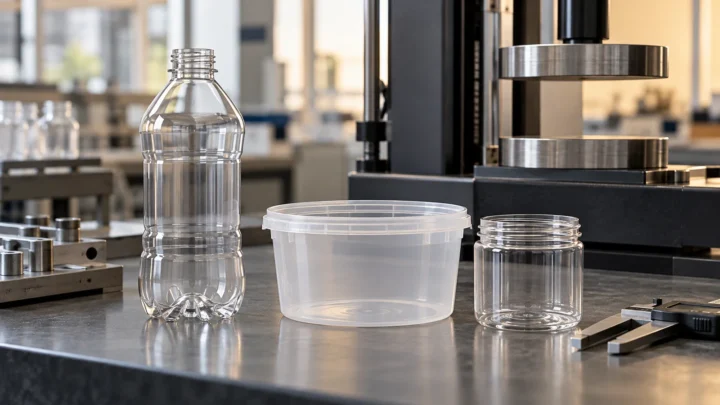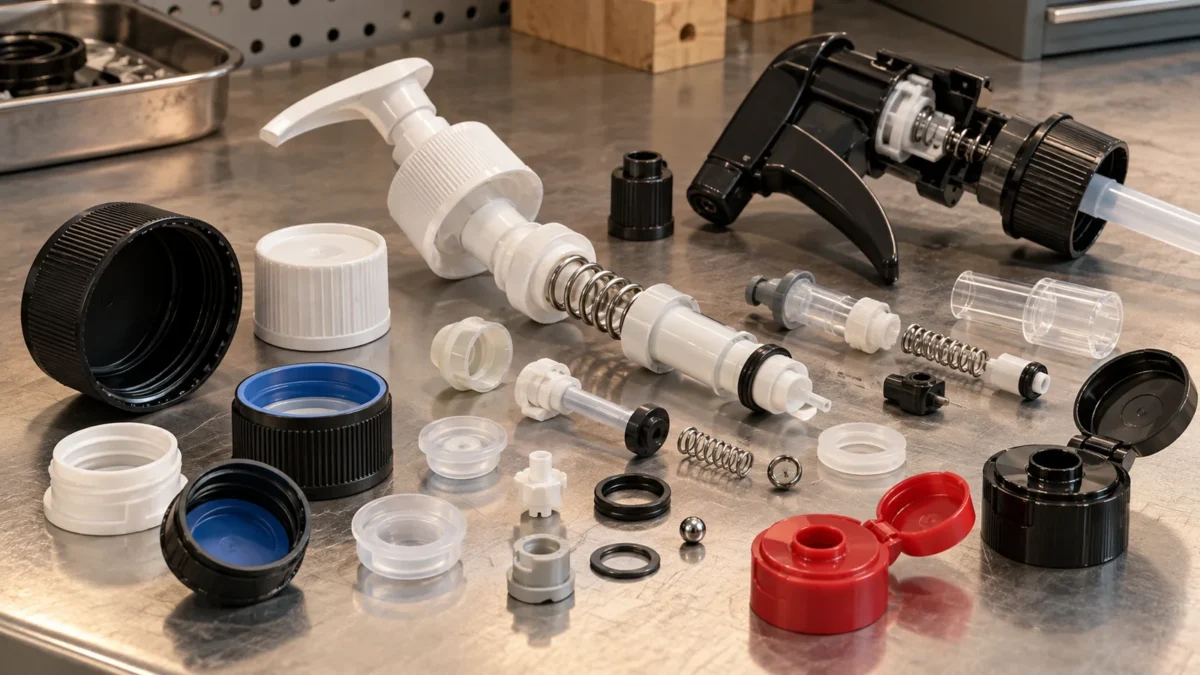
A bottle can become simple long before its closure does.
The body may be one polymer, one color and one molded part. The closure can contain a cap shell, hinge, liner, valve, spring, ball, dip tube, piston, gasket, tamper feature and decorative component—each performing a different job.
That is why rigid-packaging redesign increasingly runs into what might be called the last-component problem.
The main container becomes lighter, more recyclable or refillable. Then the closure has to preserve seal integrity, dosing, opening force, tamper evidence, child resistance, chemical compatibility and consumer usability without contaminating the intended recovery stream.
The smaller component can become the harder engineering problem.
The closure carries more functions per gram
A rigid package body mainly has to contain, protect and survive distribution. [S1]
A closure may have to do all of the following:
- create the primary seal;
- maintain internal pressure or prevent leakage;
- survive repeated opening and closing;
- dispense a controlled dose;
- vent or prevent backflow;
- provide tamper evidence;
- resist accidental opening;
- remain usable with wet or slippery hands;
- tolerate product chemistry;
- stay compatible with the package’s intended recycling stream.
That concentration of functions is why a closure that looks visually insignificant can determine whether the whole package works.
| Closure type | Typical hidden functions | Common redesign tension |
|---|---|---|
| Screw cap | Thread fit, torque, liner/seal, tamper ring | Seal reliability vs low material / recycling compatibility |
| Flip-top cap | Living hinge, snap fit, dispensing orifice, repeated cycling | Same-polymer design vs hinge fatigue and opening feel |
| Snap lid | Rim engagement, peel/open force, leak resistance | Stiffness and fit vs thin-wall design |
| Pump | Spring return, piston, ball/valve, dose chamber, dip tube | Metal/glass elimination vs metering reliability |
| Trigger sprayer | Spring, piston, nozzle, check valve, chemical pathway | Multi-part mechanics vs mono-material recovery |
| Child-resistant closure | Two-step opening or force/coordination requirement | Safety performance vs component simplification and adult usability |
A bottle and its cap do not necessarily belong to the same recycling stream
PET beverage bottles illustrate the point clearly. [S1] [S7]
In European PET recycling, the bottle body is normally intended to remain in the PET fraction while many closure components are designed to separate during grinding and washing.
The European PET Bottle Platform therefore evaluates the cap as part of the bottle system rather than pretending that “PET bottle” describes every component.
Its current design guidance treats low-density PE and PP closure systems as compatible choices because they can separate from PET in the relevant float-sink process. It also evaluates liners, seals, valves, labels, adhesives and other attached components separately.
The important lesson is:
the best closure material is not always the same material as the bottle body; it is the material that behaves correctly in the complete recovery process.
Density is useful only when the component actually separates
A low-density polyolefin cap can be useful in PET recycling because PET and the closure material can separate after size reduction. [S1]
But that mechanism depends on the closure being released into the process.
A dense or incompatible component that remains mechanically attached can create a different problem. So can metal, silicone, cross-linked elastomers or heavily filled materials depending on the exact construction and recycling protocol.
This is why closure redesign has to ask two questions:
- What is the component made from?
- What physically happens to it during sorting, grinding, washing and separation?
Polymer identity alone does not answer the second question.
HDPE and PP containers have the opposite design incentive
For an HDPE shampoo or detergent bottle, the preferred logic can be different. [S1]
RecyClass design guidance for rigid HDPE and PP packaging generally favors keeping closure systems within compatible polyolefin families, with same-material components preferred where practical.
The reason is straightforward: a large PP closure on an HDPE container can enter the HDPE recycling stream with the package and change the composition of the recyclate.
The effect becomes more important when the closure is a large share of package weight.
So the same design slogan cannot simply be copied from PET bottles to HDPE containers.
In PET, controlled density separation can be part of the solution.
In HDPE or PP, matching the main polymer family may be the stronger strategy.
The pump is the closure problem in its most concentrated form
A dispensing pump is not really a cap. [S3] [S4]
It is a small machine attached to the package.
A conventional pump may include:
- an outer actuator;
- a piston;
- a spring;
- one or more check valves;
- a ball;
- a housing;
- a dip tube;
- a gasket or sealing element.
Historically, metal springs and glass or metal valve components have been common because they provide reliable mechanical behavior.
From a recycling-design perspective, those components create a challenge.
They can introduce materials that do not belong in the primary plastic stream and that may be difficult to remove cleanly.
This is why all-plastic and polyolefin-based pump architectures have become an important development direction.
An all-plastic pump can work—but the approval boundary matters
RecyClass has evaluated pump technologies designed to remove conventional metal springs and glass balls. [S4]
One example, the Infinity Pump, uses plastic components for both the spring and ball. Independent testing found the technology compatible with the European HDPE recycling stream under specified conditions, including a limit on the pump’s share of total package weight.
That is meaningful engineering evidence.
It is not permission to write:
“all-plastic pump = recyclable package.”
RecyClass approvals themselves make the boundary clear: a technology approval assesses the tested component under defined conditions. The final bottle, decoration, closure, adhesive and total composition still determine the recyclability classification of the complete package.
A recyclable component does not automatically make a recyclable system.
Trigger sprayers show the same direction
Household cleaners add another layer of difficulty. [S6]
A trigger sprayer must move repeatedly, prime reliably, resist product chemistry, generate a usable spray pattern and prevent leakage.
It can also contain one of the most recycling-unfriendly small components: a metal spring embedded deep inside the mechanism.
RecyClass’s 2026 review of more than 500 recyclability tests highlighted plastic-based trigger-sprayer components replacing metal springs as one area where packaging innovation has improved compatibility with recycling streams.
But the same rule applies.
The trigger must be assessed as part of the complete package and relevant recycling stream. Replacing one metal component is progress, not proof of total circularity.
Liners, seals and valves are easy to forget because they are hidden
A cap that looks mono-material from the outside may contain an internal liner. [S1]
A dispensing closure may use a valve made from an elastomer. A beverage closure may include a seal. A pump can contain flexible elements that behave differently from the rigid housing during recycling.
Those components matter because they can:
- remain attached to the closure;
- separate into the wrong fraction;
- change density behavior;
- survive washing;
- contaminate recycled resin;
- affect odor, color or mechanical properties.
That is why modern design-for-recycling guidelines list liners, seals and valves as their own component category rather than hiding them inside the word “cap.”
Tethered caps prove that regulation can redesign the closure itself
Europe’s tethered-cap requirement is a clear example of closure design being changed by regulation rather than by resin selection alone. [S9] [S10] [S11]
Under the EU Single-Use Plastics Directive, covered single-use beverage containers with plastic caps and lids may be placed on the market only if the caps and lids remain attached during the intended-use stage.
The requirement applies to the specified beverage-container scope, not to every cap on every rigid package.
It created a new mechanical design problem:
the cap still has to open, remain attached, stay out of the drinking path as intended, tolerate repeated movement and maintain the required strength and safety.
Harmonised standard EN 17665:2022+A1:2023 provides test methods and requirements for demonstrating that the attachment feature remains strong, reliable and safe.
The sustainability change therefore happened through mechanism design, not just material substitution.
A tether that solves litter retention can create a new usability constraint
This is a recurring pattern in closure redesign. [S11]
Improving one part of the system creates another design variable.
A closure that stays attached may:
- need a stronger hinge or tether;
- change the opening angle;
- require different cap-removal torque;
- interact differently with filling or capping equipment;
- alter consumer handling.
That does not mean tethered caps are a bad design.
It means the engineering evidence has to include intended-use behavior rather than only resin weight or recovery logic.
Child resistance is a case where simplification cannot outrank safety
Healthcare, household chemical and selected specialty packages can require child-resistant reclosable closures. [S12]
ISO 8317 sets performance requirements and test procedures for such packages and explicitly considers both resistance to opening by children and accessibility for adults.
That creates another closure-design boundary.
A push-and-turn, squeeze-and-turn or other child-resistant mechanism may require geometry, moving relationships or material stiffness that is more complex than a simple screw cap.
Recyclability improvement cannot be achieved by removing a component if that change undermines the safety function.
The correct hierarchy is:
safety and intended function first; then simplify the design within that boundary.
Refill can change what happens to the expensive closure
Beauty, personal-care and household products create another possible strategy. [S1]
Instead of redesigning a pump to be thrown away with every bottle, the system can try to keep the complex pump in service while replacing only a refill container, cartridge or pouch.
That can reduce how often the pump itself is discarded.
But it converts the closure problem into a reuse problem.
The pump has to survive repeated cycles, resist product buildup, maintain dosing accuracy and remain hygienically acceptable. Consumers also have to keep and reuse it rather than discarding it with the empty pack.
As Articles 55 and 56 showed for reusable packaging more broadly, theoretical durability is not the same as achieved reuse.
A refillable dispenser only creates the intended material-saving mechanism if the dispenser actually stays in use.
Changing the container material does not eliminate the closure
Paperization and fiber substitution can make the closure problem more visible. [S1]
A paper or molded-fiber body may still need:
- a plastic snap lid;
- a threaded fitment;
- a pump;
- a dispensing spout;
- a liner;
- a valve;
- a moisture-resistant seal.
The body may move toward one recovery route while the closure remains designed for another.
That does not automatically make the package invalid. It does mean the components, separation behavior and consumer disposal instructions have to be considered explicitly.
“Fiber body” is not a closure strategy.
Why the smallest formats are often the least forgiving
Small cosmetic jars, travel packs, tubes and concentrate bottles can give the closure an unusually large share of total package mass. [S1]
They also have less room for dimensional error.
A small thread mismatch can leak. A thin snap bead can stop engaging. A miniature pump still needs a spring force and valve system even if the bottle contains only a few tens of milliliters.
This makes the component-to-product ratio important.
Eliminating two grams from a 500 ml body may matter less to the recycling composition than changing a four-gram multi-material dispenser on a much smaller pack.
That is why closure redesign can deliver disproportionate gains in small beauty and personal-care formats.

The closure redesign hierarchy
| Question | Why it comes before the next one |
|---|---|
| 1. What safety and containment function is non-negotiable? | Leak, pressure, child resistance, tamper evidence and chemical compatibility cannot be traded away casually. |
| 2. How many functions can be removed? | Deleting an unnecessary liner, overcap, spring or decorative part can be more effective than material substitution. |
| 3. Can the remaining parts use a compatible polymer family? | Same-stream components can simplify rigid-plastic recycling where the relevant protocol supports them. |
| 4. If materials differ, will they separate correctly? | PET bottle recycling may deliberately rely on density separation for the closure. |
| 5. Does the closure still work through the full use cycle? | Torque, hinging, pumping, spraying and resealing are repeat-use mechanical functions. |
| 6. Is the complete package compatible with the target recycling stream? | A component approval does not certify the final package. |
| 7. Could the complex closure be reused instead? | Refill can retain a high-function dispenser, but only if achieved reuse is real. |
The last-component rule
Rigid packaging redesign increasingly reaches a point where the body is no longer the hardest part. [S1] [S8] [S1]
The remaining challenge is the small component that performs too many functions to remove casually.
For a beverage bottle, that may be a tethered pressure-cap system.
For a shampoo bottle, it may be a flip top or pump.
For household cleaner, it may be the trigger sprayer.
For skincare, it may be a precise dispensing pump.
For healthcare, it may be a child-resistant closure that has to remain usable by adults.
The winning redesign is therefore not necessarily the package with the fewest components.
It is the one that asks of every component:
Does this part still have a necessary job, can that job be delivered with less material or fewer material families, and what will physically happen to the part when the package reaches its real recovery system?
When the container body becomes simple, the closure is where those questions become hardest.
Methodology and editorial note
Current public RecyClass and standards material was used for component-level design questions. A technology approval applies to its tested conditions, not every finished pack. No complete-package recyclability or safety verdict is offered. Sources checked 20 October 2026. The main image is an AI-generated editorial illustration of a generic packaging scene; it does not depict a named product, facility, company or test.
Sources and reference notes
- [S1] RecyClass. Design for Recycling Guidelines / Online Tool. RecyClass current 2026 rigid-plastic DfR guidelines. Company statements are attributed; scientific/technical claims are limited to the stated test or review scope. Accessed 20 October 2026.
- [S3] RecyClass. RecyClass HDPE Evaluation Protocol 2026. RecyClass HDPE Evaluation Protocol 2026. Company statements are attributed; scientific/technical claims are limited to the stated test or review scope. Accessed 20 October 2026.
- [S4] RecyClass. Apackaging Group receives a RecyClass Recyclability Approval for “Infinity Pump”. RecyClass Infinity Pump approval. Company statements are attributed; scientific/technical claims are limited to the stated test or review scope. Accessed 20 October 2026.
- [S6] RecyClass. RecyClass surpasses 500 recyclability tests supporting industry readiness for PPWR. RecyClass 500 recyclability tests, 2026. Company statements are attributed; scientific/technical claims are limited to the stated test or review scope. Accessed 20 October 2026.
- [S7] European PET Bottle Platform. Design Guidelines for PET bottles in contact with food and non-food products. European PET Bottle Platform design guidelines. Company statements are attributed; scientific/technical claims are limited to the stated test or review scope. Accessed 20 October 2026.
- [S8] CEN-CENELEC. EN 18120: Europe sets a new benchmark for recyclable plastic packaging. EN 18120:2026 design-for-recycling series. Company statements are attributed; scientific/technical claims are limited to the stated test or review scope. Accessed 20 October 2026.
- [S9] European Parliament & Council / EUR-Lex. EU SUP Directive tethered-cap requirement. EU SUP Directive tethered-cap requirement. Company statements are attributed; scientific/technical claims are limited to the stated test or review scope. Accessed 20 October 2026.
- [S10] European Commission / EUR-Lex. Harmonised tethered-cap standard reference. Harmonised tethered-cap standard reference. Company statements are attributed; scientific/technical claims are limited to the stated test or review scope. Accessed 20 October 2026.
- [S11] public standard preview / harmonised-reference context. EN 17665 scope sample. EN 17665 scope sample. Company statements are attributed; scientific/technical claims are limited to the stated test or review scope. Accessed 20 October 2026.
- [S12] ISO. Child-resistant packaging — Requirements and testing procedures for reclosable packages. ISO 8317 child-resistant packaging. Company statements are attributed; scientific/technical claims are limited to the stated test or review scope. Accessed 20 October 2026.
The public corrections channel is currently inactive. Read our corrections policy.