Short answer: Paper is not automatically more sustainable than plastic, and plastic is not automatically the lower-impact choice. The answer depends on the packaging function, material mass, production route, barrier needs, product protection, transport, reuse, collection and the actual recycling or disposal system. Paper often offers renewable or recovered fiber and established paper-recycling routes; plastic often achieves the same barrier or structural function with less material. Either advantage can disappear when coatings, food waste, low collection access or poor package design enter the system.
A useful comparison therefore starts with the same packaged product and the same required service. Comparing one kilogram of paper with one kilogram of plastic, or one empty paper tray with one empty plastic tray, can produce the wrong conclusion if they do not protect the product equally.
The packaging LCA reading guide explains functional units and study boundaries.
Life-cycle evidence increasingly points to the same principle: material identity matters, but the result often turns on package weight, product protection, reuse and end-of-life assumptions. UNEP’s review of supermarket food packaging specifically treats the question as an application-level life-cycle comparison rather than a universal paper-versus-plastic ranking. [R1]
Why there is no universal winner
Paper and plastic are not single materials.
“Paper packaging” can mean corrugated board, solid bleached board, kraft paper, molded fiber, coated cups, laminated cartons or fiber trays. “Plastic packaging” can mean PET, HDPE, PP, PE film, multilayer laminates, expanded polymers or bio-based versions of conventional polymers.
The finished package can also contain both. A paper cup may use a PE, PLA or aqueous barrier. A paper tray may use a plastic or biopolymer coating. A plastic tray may carry a paper sleeve and adhesive label. Those components can change mass, barrier performance, recycling compatibility and recovery route.
| Decision factor | Paper / fiber packaging | Plastic packaging |
|---|---|---|
| Feedstock | Can use virgin wood fiber, recycled fiber or agricultural fiber. | Usually fossil-derived, but some polymers can be partly or fully bio-based. |
| Material efficiency | Can be efficient in boxes, wraps and structural fiber formats but may need more mass for some barrier/rigidity functions. | Often provides high strength, toughness and barrier at low wall thickness and low mass. |
| Moisture / gas barrier | Base cellulose is porous and hydrophilic; demanding uses often need coatings or laminates. | Polymer selection can provide strong moisture and/or gas barrier, although no polymer is optimal for every function. |
| Recycling route | Repulpability depends on the full construction, contamination and mill process. | Recyclability depends on resin, format, labels, additives, sorting and local reprocessing infrastructure. |
| Environmental persistence if littered | Uncoated cellulose can biodegrade under suitable conditions, but coatings and additives alter the finished item. | Conventional plastics can persist for long periods if leaked into the environment. |
| Product protection | Strong for many dry, rigid and secondary-packaging applications; high-barrier uses may require added layers. | Often strong for moisture-sensitive, high-barrier, transparent and lightweight applications. |
Editorial synthesis; qualitative comparisons are evidence questions, not measured product rankings. [R1] [R4] [R6] [R7] [R8]
Start with the functional unit, not the material name
Life-cycle assessment compares systems using a functional unit: the service that must be delivered.
For packaging, a useful functional unit might be:
- deliver 1,000 litres of beverage without leakage;
- protect 1,000 takeaway meals for a defined delivery time;
- transport a fixed quantity of produce with a specified damage rate;
- provide a defined shelf life for a kilogram of food;
- carry a defined shopping load for a stated number of trips.
A 2024 meta-analysis of packaging LCAs found that studies frequently compare packaging format and material, but that studies evaluating the product and packaging together remain relatively scarce. The authors also identified methodological differences that can explain apparently conflicting LCA results. [R2]
That limitation is important. Packaging exists to protect something. If the comparison ignores the packaged product, it may overvalue a small reduction in packaging impact while missing a much larger change in product loss.
Production: paper and plastic have different burdens
Paper production
Paper and board production begins with fiber. Virgin fiber requires forestry, transport, pulping and papermaking; recycled grades require collection, sorting, repulping and cleaning. Papermaking is water-intensive as a process and requires substantial drying energy, although mill energy systems and recovered-fiber content vary widely.
Paper’s renewable-carbon advantage is therefore not the same as “zero impact.” Forest management, fiber yield, recycled-fiber quality, mill energy, basis weight and converting all affect the result.
Plastic production
Conventional plastic packaging usually begins with fossil feedstocks that are converted into polymers and then extruded, thermoformed, blown, injection-molded or converted into films. Plastic production creates greenhouse-gas and resource impacts, and plastic leakage creates a persistence problem not captured well by many conventional LCA indicators.
At the same time, plastics can deliver high mechanical or barrier performance at low mass. This material efficiency is one reason a plastic pack can perform well in some conventional LCA categories even when the feedstock is fossil-based.
UNEP’s packaging work cautions against assuming that a non-plastic alternative automatically has a lower environmental footprint. [R1]
Package weight can reverse the result
A common mistake is to compare impacts per kilogram of material rather than per packaged function.
If a plastic tray weighs much less than the paper-based alternative needed to provide similar stiffness, moisture resistance and sealing, the lower mass can reduce material-production and transport burdens. In another application, a simple paper wrap may replace a more complex rigid plastic package and use less total material.
The direction is not fixed.
UNEP’s correct 2020 shopping-bag report record states that paper, cotton and other alternatives do not necessarily outperform plastic bags across all environmental categories. That is an application-specific observation, not a universal ranking of paper and plastic packaging. [R3]
The practical rule is to compare package systems at equivalent service, not equal material mass.
Transport favors light, space-efficient packaging—but not always plastic
Transport impact depends on package weight, cube efficiency, nesting and how much product fits in the shipment.
Plastic films, pouches and thin-wall containers can be extremely material- and space-efficient before filling. Some rigid paper or molded-fiber formats are heavier or bulkier. However, corrugated boxes can ship flat, many paper food containers nest efficiently, and molded-fiber designs can sometimes eliminate extra cushioning components.
For reusable systems, empty return logistics become another variable.
So transport should be modeled from real pack-out data:
- units per carton;
- cartons per pallet;
- pallets per vehicle or container;
- empty-package shipment volume;
- damage rate;
- return logistics if reusable.
Barrier performance is where plastic often has an engineering advantage
Cellulose is naturally hydrophilic and porous. Food packaging may need resistance to water, water vapor, grease, oxygen and aroma, and untreated paper often cannot supply all of those functions by itself.
The BioResources review of water-borne coatings explains why paper barriers and repulpability depend on chemistry and construction. A coating can improve a use property while introducing a separate recovery question. [R4]
Plastic packaging can provide those barriers at relatively low thickness, but polymer choice matters. PE is a strong moisture barrier but not a universal oxygen barrier; PET, EVOH and multilayer systems solve different problems. High performance can also create recycling complexity when incompatible layers are combined.
The comparison is therefore not “paper has no barrier, plastic has barrier.” It is:
How much material and complexity are required to deliver the exact barrier the product needs?
Product protection can matter more than packaging mass
Food is the clearest example.
FAO states that packaging helps keep food fresh and safe, extends shelf life and can reduce food loss and waste. It also notes that the environmental burden of lost food includes all the resources used to produce it. [R5]
If switching from plastic to paper shortens shelf life, increases leakage or raises produce damage, the extra food waste may offset the packaging benefit. The reverse can also occur: an overengineered plastic pack can use more material than necessary when a simpler fiber system would protect the product adequately.
A credible comparison should therefore include:
- damage rate;
- leakage or seal failure;
- shelf life;
- moisture loss or gain;
- food waste;
- consumer handling;
- distribution duration.
Paper recycling: coatings and contamination decide the route
Paper and board have established recycling systems in many markets, but “paper-based” is not the same as “recyclable everywhere.”
Cepi’s Version 3 recyclability laboratory method evaluates paper and board through stages representing a conventional recycling mill, including pulping, screening and sheet formation. [R6] 4evergreen’s Recyclability Evaluation Protocol then distinguishes conventional, flotation-deinking and specialised recycling processes. [R7]
This matters for coated packaging. PE, aluminium, barrier polymers, wet-strength chemistry, inks, adhesives and food residue can change fiber yield, rejects and recycled-fiber quality.
A successful laboratory repulpability result also does not prove that the item is collected locally or routed to a compatible mill.
Use the recyclability evidence framework to keep laboratory compatibility separate from operating recovery.
Plastic recycling: resin identity is only the beginning
Plastic recycling is similarly construction-specific.
A PET bottle, PP tub, PE film and multilayer pouch do not share one recycling stream. Labels, pigments, closures, adhesives, fillers and package size can affect sorting and reprocessing.
APR’s testing documents for plastic packaging explicitly evaluate not only the base resin but also labels, additives, coatings, multilayers, closures and other components for compatibility with the target recycling process. [R8]
This is why a technically recyclable plastic does not automatically become recycled in practice. Collection, sorting and reprocessing infrastructure remain necessary.
Paper does not automatically mean plastic-free
Many high-performance paper packages use polymer as part of the finished construction.
Examples include:
- PE-lined paper cups;
- PLA-lined paper cups;
- dispersion- or aqueous-coated paperboard;
- paper trays with polymer seal layers;
- cartons with plastic and aluminium layers;
- paper packs with plastic windows, lids or closures.
Those constructions may still have a useful paper-recycling route, but the word “paper” alone does not settle the answer.
For a concrete coated-fibre format, see PE, PLA and water-based paper cups. The molded-fibre guide examines geometry and process choices.
The same logic applies in reverse: a package that is mostly plastic can include paper labels or sleeves that materially affect sorting. Sustainability assessment has to follow the complete construction.
Plastic has a persistence problem that conventional LCA can underrepresent
Plastic litter can persist and fragment in terrestrial and aquatic environments. This is a real disadvantage of poorly managed plastic systems and one reason policy attention is focused on plastic leakage.
UNEP’s supermarket-packaging review notes that the persistence of plastic and the ecological and human-health effects of plastic pollution are not yet fully characterized. [R1]
That creates a methodological issue: conventional LCAs are generally stronger at quantifying energy, climate and resource flows than at fully representing litter, microplastic formation, wildlife impacts and long-term environmental persistence.
This does not justify treating every paper replacement as better. It means decision-makers should not interpret a narrow carbon result as a complete environmental verdict.
Paper has its own land, fiber, water and energy questions
Paper’s biodegradability and renewable feedstock can make it visually intuitive as an environmental alternative, but those attributes do not erase upstream burdens.
Questions include:
- virgin versus recycled fiber;
- forest-management and sourcing requirements;
- pulp yield and chemical recovery;
- mill energy source;
- water use and treatment;
- basis weight;
- coating quantity;
- number of recycling cycles and fiber-quality requirements.
Paper is therefore not “impact-free because it grows back.” Renewable feedstock is one variable within a larger system.
Where paper often makes sense
Paper or fiber packaging is often a strong candidate when:
- the product does not require an extreme moisture/gas barrier;
- a simple coating can provide the required function without making recovery impractical;
- paper collection and compatible mills are established;
- the format can replace unnecessary plastic without a large weight increase;
- flat-pack or fiber-based transport formats work efficiently;
- the package benefits from printability, rigidity or molded-fiber geometry.
Examples can include corrugated shipping boxes, dry-food cartons, wraps, some trays and appropriately designed foodservice fiber packaging.
Where plastic often makes sense
Plastic can remain the better engineering candidate when:
- very low package weight is important;
- high moisture resistance is essential;
- transparency matters;
- toughness or impact resistance is required;
- a thin film can replace a much heavier rigid pack;
- the format has a credible recycling stream or reuse system;
- product preservation prevents significant loss or waste.
That does not mean the existing plastic design is optimal. Mono-material design, downgauging, recycled content, reusable formats and better labels/closures can still materially improve it.
Use case matters more than the headline material
| Application | Paper/fiber opportunity | Plastic opportunity | Key decision evidence |
|---|---|---|---|
| Dry e-commerce shipping | Corrugated and paper mailers can provide strong recyclability and flat-pack efficiency. | Flexible plastic mailers can use very little material and resist rain. | Package mass, damage rate, weather exposure, collection access. |
| Hot takeaway meal | Paperboard or molded fiber can provide rigidity and heat handling. | PP can provide moisture resistance, lid sealing and low mass. | Food temperature, oil/water exposure, lid fit, delivery time, local recovery. |
| Chilled ready-to-eat food | Coated paper trays can reduce visible plastic and offer printability. | PET/PP trays can provide moisture resistance, visibility and tight lidding. | Condensation, shelf life, seal integrity, tray/lid construction, recycling route. |
| High-barrier shelf-stable food | Fiber structures may require multiple barrier layers. | Plastic or multimaterial systems can deliver high barrier at low thickness. | Oxygen/moisture target, shelf life, package mass, recovery route. |
| Protective industrial packaging | Corrugated or molded fiber can provide structural protection and fiber recovery. | Foams and engineered plastics can provide light cushioning or repeated use. | Drop/vibration test, reuse cycles, part mass, logistics and end-of-life. |
Editorial synthesis; qualitative comparisons are evidence questions, not measured product rankings. [R1] [R4] [R5] [R6] [R7] [R8]

What should a buyer compare?
| Question | Why it changes the conclusion |
|---|---|
| What product is being protected? | The environmental burden of product loss can exceed small differences in package mass. |
| What is the functional unit? | Equivalent service is required for a fair comparison. |
| What is the complete construction? | Coatings, lids, labels, adhesives and laminates can change performance and recovery. |
| How much material is used? | Mass can dominate production and transport results. |
| What barrier is actually required? | Over-specification adds material; under-specification can increase product waste. |
| What recycling route exists? | Technical compatibility without collection/sorting access is not recycling in practice. |
| Is reuse realistic? | Return rate and rotations can change the result more than the base material. |
| What impact categories are being compared? | A climate-only result does not represent water, land use, litter, toxicity or resource trade-offs. |
Editorial synthesis; qualitative comparisons are evidence questions, not measured product rankings. [R1] [R2] [R4] [R5] [R6] [R7] [R8]
Methodology and editorial note
This article is an editorial synthesis of official life-cycle reviews, packaging/recycling guidance and peer-reviewed research. It does not present an original LCA and does not rank paper and plastic using incompatible studies. No universal carbon, water or recycling-rate comparison is given because results vary by package type, geography, functional unit and methodology.
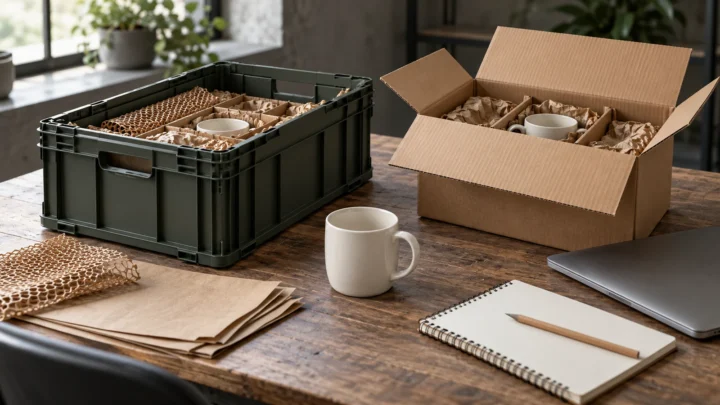
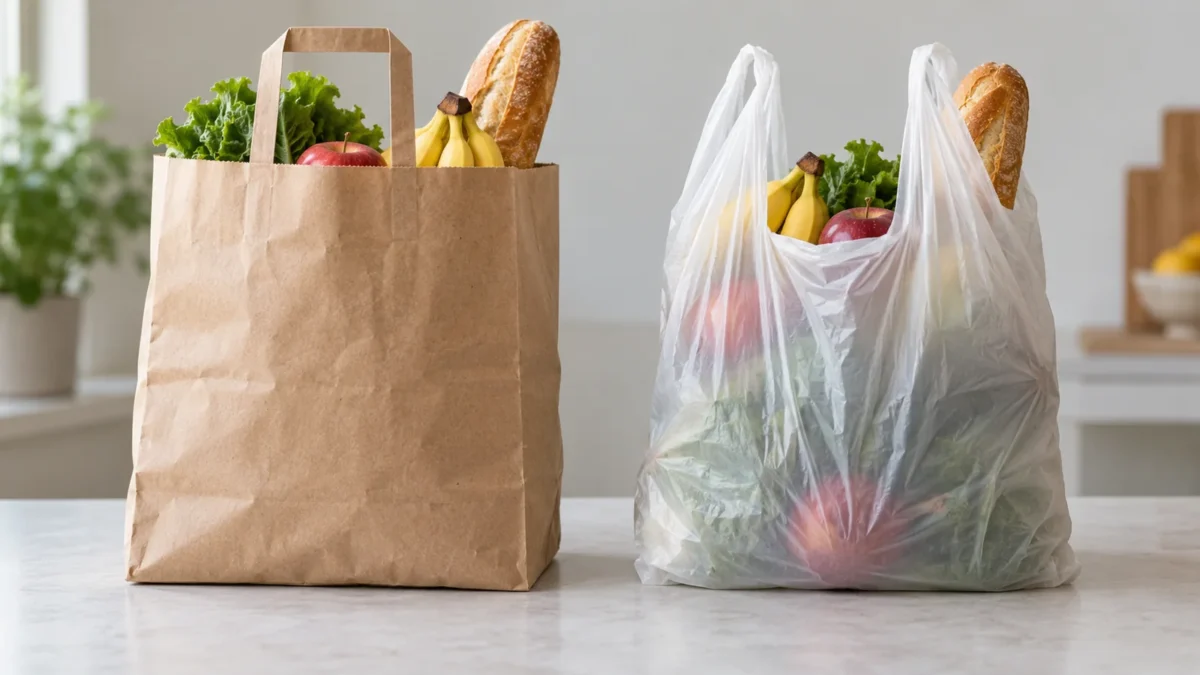
Sources checked 17 October 2026. The main image is an AI-generated editorial illustration; the explanatory figure is an original editorial diagram. Neither is a photograph of an identified product or facility, a laboratory result or an independent environmental assessment.
Official sources and reference notes
- [R1] UNEP. Single-use Supermarket Food Packaging and its Alternatives: Recommendations from Life Cycle Assessments. December 2022. Application-level LCA framing; single-use plastic alternatives do not produce one universal environmental answer; full value-chain comparison is required. Public record/abstract or identified section extracts only; no unexamined experimental details used. Accessed 17 October 2026.
- [R2] Bher & Auras. Life cycle assessment of packaging systems: A meta-analysis to evaluate the root of consistencies and discrepancies. 15 October 2024. Packaging LCA literature often compares materials/formats; methodological differences drive discrepancies; packaging+product joint studies are scarce. Public record/abstract or identified section extracts only; no unexamined experimental details used. Accessed 17 October 2026.
- [R3] UNEP. Single-use Plastic Bags and their Alternatives: Recommendations from Life Cycle Assessments. 2020. Specific carrier-bag example that paper/cotton/other alternatives do not necessarily outperform plastic in all impact categories; reuse changes the outcome. Public record/abstract or identified section extracts only; no unexamined experimental details used. Accessed 17 October 2026.
- [R4] Umeileka, C. C. & Hubbe, M. A. Repulpability and biodegradability of paper-based packaging products with water-borne barrier coatings: A review. BioResources 21(4), 2026; DOI 10.15376/biores.21.4.Umeileka. Water-borne coating definitions; PE reference construction; repulpability, dispersibility, yield and coating-related process limitations. Relevant public text checked; see the stated scope. Accessed 17 October 2026.
- [R5] FAO. Reduce, reuse, recycle: a mantra for food packaging. 29 September 2021. Packaging protects food, extends shelf life and reduces loss/waste; food-loss burden belongs in packaging decisions. Relevant public text checked; see the stated scope. Accessed 17 October 2026.
- [R6] Cepi. Paper and Board — Recyclability Laboratory Test Method — Part I: Recycling mill with Conventional process. 3, February 2025. Paper technical recyclability assessment via pulping, screening and sheet formation. Relevant public text checked; see the stated scope. Accessed 17 October 2026.
- [R7] 4evergreen. Recyclability Evaluation Protocol. Version 1 / 2025 updated edition. Different fibre-based packaging recycling processes require process-specific assessment. Relevant public text checked; see the stated scope. Accessed 17 October 2026.
- [R8] Association of Plastic Recyclers. Benchmark Testing for Polypropylene Rigids — PP-B-01. Revision 1 April 2026. PDF pp3–5, scope, assessed components and disclaimer; mechanical compatibility is distinct from optical sorting and market acceptance. Relevant public text checked; see the stated scope. Accessed 17 October 2026.
The public corrections channel is currently inactive. Read our corrections policy.