Available online on 20 November 2026, an in-press study in Carbohydrate Polymers reports that two cellulose coatings on kraft paper behaved differently when their sequence changed. Supattra Klayya and colleagues report moisture, oxygen and grease results for one particular arrangement. [1]
The publisher labels the article an in-press journal pre-proof. The public abstract supplies the reported endpoints and conditions. The full methods, including coating weights, repeat counts and measurement uncertainty, remain outside this review.
The interesting variable is the layer sequence
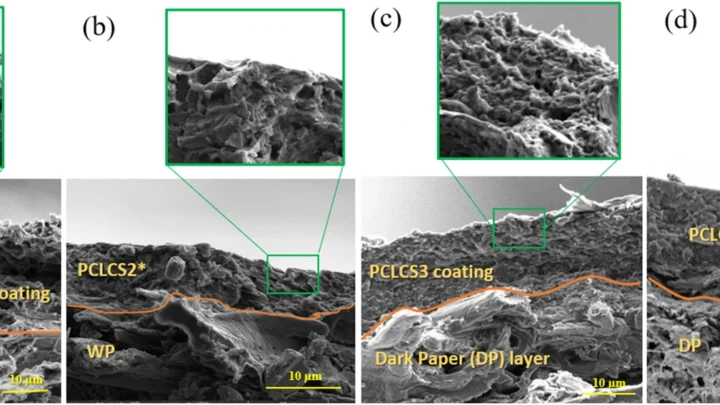
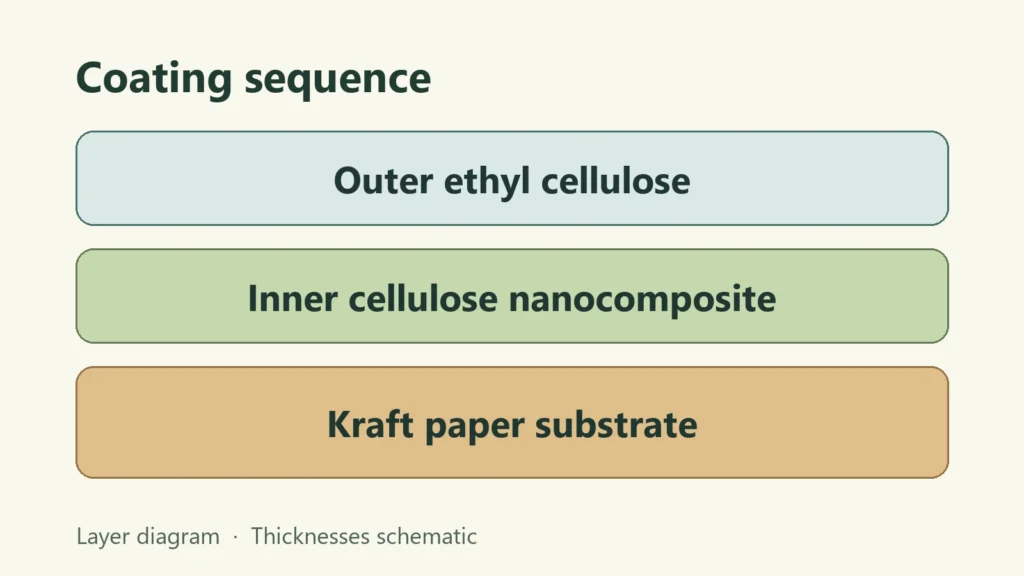
Ethyl cellulose (EC) is a cellulose derivative. The authors compared single-layer and two-layer coats using EC and an EC-based nanocomposite containing lactic acid-modified nanofibrillated cellulose. In the reported KP/NC/EC sequence, the nanocomposite touches the kraft paper and EC forms the outer layer. [1]
Why does this matter? A porous paper substrate is not the same surface as a dense preformed film. An applied coating can partly penetrate the paper rather than remain entirely above it. The first layer can change the surface encountered by the next layer. If that surface is different, two designs containing similar ingredients may form different continuous barriers.
The authors report a thickness-adjusted analysis in which the measured resistance exceeded the prediction obtained from adding the contributions of the separate monolayers. They associate the NC-first sequence with more distinct layering and reduced penetration on the basis of microscopy. [1] These are the study’s reported observations and interpretation, not findings from a production trial conducted by this publication.
What the barrier results establish
The abstract gives the following endpoints for the optimised construction. Values must be kept with the stated units and test conditions.
| Reported endpoint | Result in public abstract | Boundary |
|---|---|---|
| Water vapour transmission rate | 1.97 g/m²/day | 25°C, 80% RH |
| Oxygen transmission rate | 4.12 cm³/m²/day | 23°C, 0% RH |
| Grease resistance | Kit rating 12 | Reported rating; detailed protocol not inspected |
Source: Klayya et al., Carbohydrate Polymers, article 126057, DOI 10.1016/j.carbpol.2026.126057. Values refer to the reported experimental construction, not a finished commercial package. Full test methods, coat weight, replication and uncertainty were not verified from the abstract.
Oxygen and water vapour move through a coating differently and the study measured them under different conditions. OTR at 0% relative humidity gives a dry-condition result. Verify oxygen transmission at the humidity the finished package will face. See the guide to OTR, WVTR and grease barrier for how the endpoints differ.
This is a common trap when comparing renewable barriers with established plastic laminates. A comparison may place two transmission values next to each other while leaving the test condition, specimen thickness and layer construction unexplained. Such a comparison cannot establish that one material is suitable for the same product and shelf-life requirement as another.
From a flat sheet to a converted package
The abstract also describes cracker storage experiments in which fracture force was retained better under the reported conditions. That is relevant to the protection of a crisp dry food. It should not be converted into a universal shelf-life extension, a microbiological safety claim or evidence that the same coating works for oily, wet or hot-filled foods. [1]
A converter needs to ask what happens when the coated sheet is folded, creased, sealed, rubbed or formed. A continuous surface on a flat specimen may change at a crease or cut edge. Depending on the selected pack, those local areas may be more important to product protection than the average transmission rate measured through a flat sample.
A sensible next experiment would retain the layer construction and compare specimens before and after the intended converting process. Oxygen barrier should be assessed at the humidity relevant to the intended product and storage route, and package-level sealing and protection should be tested separately. This is a proposed industrial qualification sequence, not an assertion that these additional experiments have been carried out by the authors.
Recovery results need their own interpretation
The authors report approximately 87% fibre recovery relative to the original paper-substrate mass in a laboratory ethanol-assisted repulping procedure. They also report weight loss after a 180-day soil burial experiment. [1]
The denominator matters. The recovery result is not expressed as a percentage of the entire finished package mass. And a laboratory recovery process that uses ethanol is not, by itself, evidence of compatibility with a conventional paper mill. The soil experiment likewise does not demonstrate compliance with a particular industrial- or home-compostability standard. Neither result should be turned into an unconditional recycling or biodegradability claim.
A commercial development programme would need evidence from the actual recovery route being considered. That may require the complete converted construction, including any additional seal layer, print and adhesives, rather than a bare coated sheet. Food-contact evidence would also be needed for the actual formulation, product type, duration and temperature of contact.
What to verify before requesting a commercial trial
| Development gate | Evidence needed |
|---|---|
| Barrier repeatability | Matched specimen construction, coat mass, relevant humidity and repeated independent measurements |
| Converting | Barrier continuity and seals after representative folding or forming |
| Manufacturing | Stable coating and drying conditions, line yield and variability across runs |
| Intended food contact | Relevant finished-construction composition and compliance evidence |
| Recovery | Defined process and evidence for the complete package; local acceptance where claimed |
Our editorial assessment is that layer sequence is a promising process variable, not an incidental detail. It gives developers another way to explore barrier performance without assuming that increasing coat mass is the only solution. The opportunity is most credible when the layer structure can be reproduced at production scale and when performance remains adequate after conversion and use.
The next decision is whether to advance to a converting trial. Set the required barrier at the intended humidity, then check it at folds and seals in the finished pack. See the broader nanocellulose coating guide for formulation and processing variables beyond layer order.
Sources
Found an error? Read our corrections policy and contact the editors.