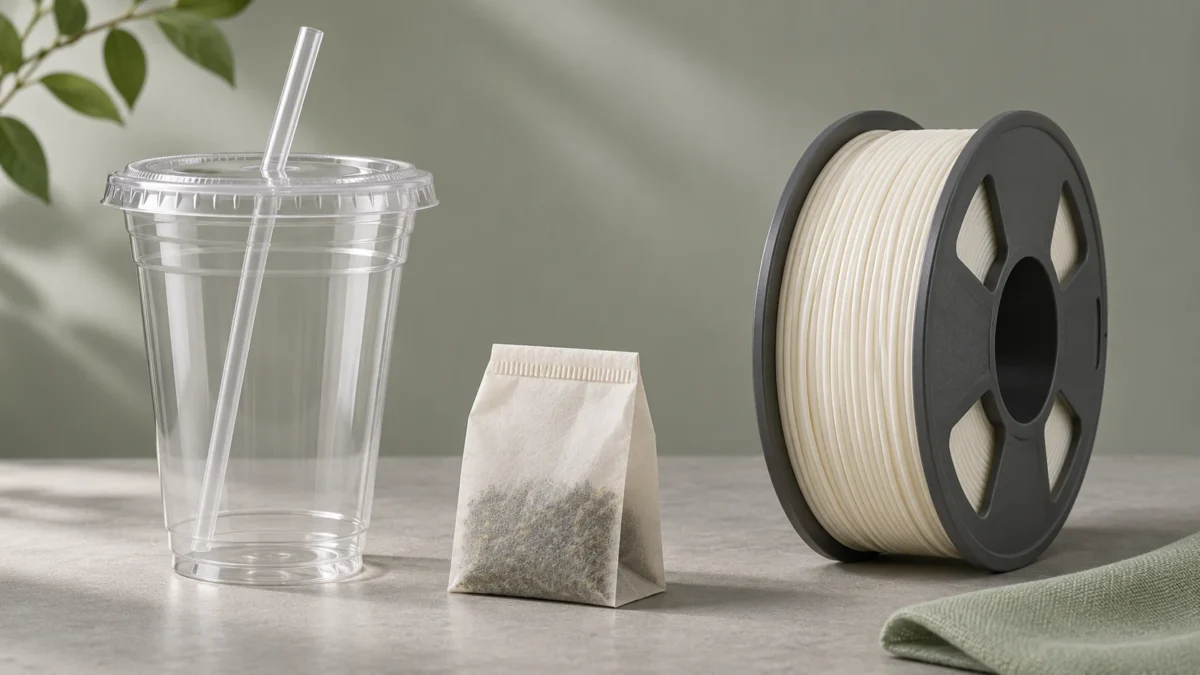
In a November 2026 investor briefing, Chinese resin producer Zhejiang Hisun Biomaterials said 3D printing accounted for about half its revenue in the first nine months of the year. In Britain, the tea merchant Ringtons says it uses the same family of polymers to seal the paper in its tea bags. One company can identify an important source of income. The other can identify exactly where polylactic acid (PLA) goes in a product that scarcely looks like plastic. Together they illustrate why PLA is easy to find in industry and harder to measure. Hisun investor record, 2 November 2026 · Ringtons’ material disclosure
Where is the evidence of demand strong enough to guide a purchase or an investment? This review traces PLA into seven industries. It finds commercial sales in printing, documented use in foodservice, and a named apparel launch. A farm trial and a building-insulation experiment answer different questions about performance. The records give a packaging buyer a way to judge a new proposal, while leaving open how global PLA sales divide among industries.
How the applications were investigated
We selected cases in which a producer, customer, regulator or research team identified both the material and its role. For each case we recorded the finished article or component, the place and date where available, what the source observed, and the decision still open. The review uses public records available by 14 November 2026. Cases were selected for the detail of their evidence. There were no interviews, buyer questionnaires or physical product tests, and the number of examples in each sector carries no statistical weight.
How much PLA is produced, and who buys it?
European Bioplastics and nova-Institute put 2025 global capacity for their basket of biobased plastics at 2.31 million tonnes per year. PLA accounted for 26.4%. Multiplying those rounded figures gives approximately 610,000 tonnes of annual PLA capacity. In the same report, packaging accounted for 41.3% of capacity across all the covered polymers. Applying that percentage to PLA alone would assign customers to resin which the underlying figure never tracked. European Bioplastics, 2025 market update, pp. 1–2
Output is a separate quantity. In a wider study of biobased polymers, nova estimated that producers made 4.5 million tonnes in 2025 and attributed about 9% to PLA. That implies roughly 400,000 tonnes of PLA produced. The two publications draw on related research and cover different baskets of polymers. Their rounded inputs support an order-of-magnitude estimate. A precise utilisation rate or a breakdown of finished-product sales would require more detailed, consistently defined data. nova-Institute, 2025 production estimates
Two developments in 2026 sharpen the distinction. In April, NatureWorks announced the opening of its Nakhon Sawan plant in Thailand. The site links sugarcane-derived lactic acid, lactide and polymer production and has roughly 75,000 tonnes of annual capacity. In November, Hisun reported more than 60,000 tonnes of PLA resin sold across its business in January–September. Its estimate of about 50% for 3D printing concerns company revenue. Multiplying tonnes sold by that revenue share would give a misleading estimate of printing resin volumes. For a converter sourcing sheet, both the grade available and the quantity committed to its contract remain open questions. NatureWorks’ plant announcement · Hisun investor record, p. 2, question 3.
Where PLA is used, component by component
| Industry | What contains PLA? | What the record establishes |
|---|---|---|
| Food packaging | Drinkware at a stadium patio and the seal in a retail tea bag | A documented foodservice pilot at Purdue in 2014 and a brand’s account of adoption across its tea bags. |
| 3D printing | Filament for extrusion printers | Prusa shipped filament with printers in 2018. Hisun linked printing to a substantial share of its own revenue in 2026. |
| Apparel | PLA fibre blended into the outer fabric and hood lining of a fleece jacket | A named Japanese retail launch and a component-level material specification for autumn/winter 2025. |
| Agriculture | A film blended from PBAT and PLA | A two-season Washington field trial compared weed control with polyethylene coverings and bare soil. |
| Automotive | Spare-tyre cover and floor mats | Toyota identified the parts and the Japan-market Raum model that used PLA-based material in 2003. |
| Medical devices | The anchor body in an orthopaedic fixation device | A 2009 US clearance record identifies poly(L-lactic acid) in one component and polyethylene in the sutures. |
| Building insulation | A porous PLA aerogel specimen | A 2026 experimental paper reports fabrication and thermal testing. Installed wall area and sales remain unknown. |
Packaging buyers face two decisions at once
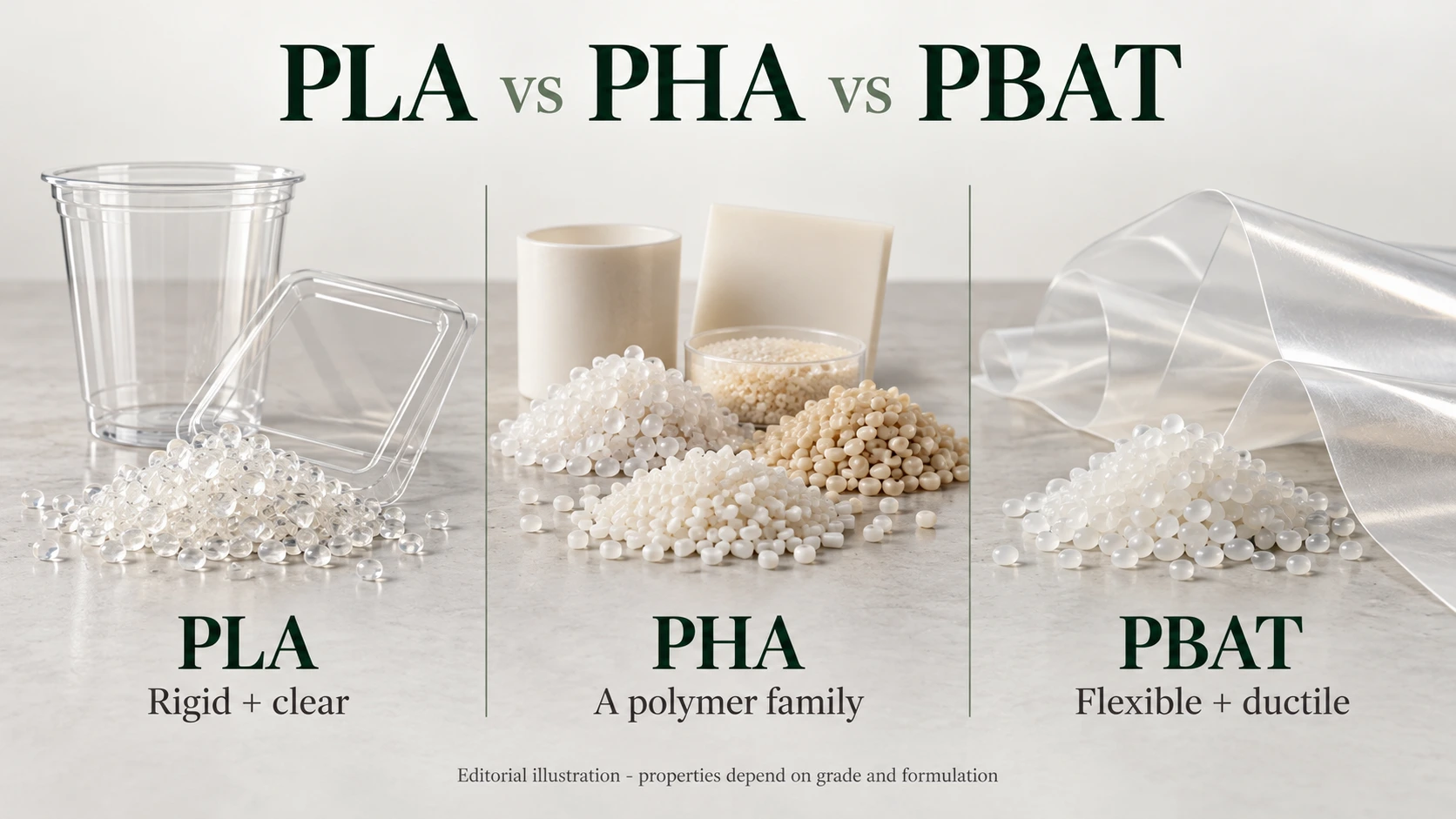
A tea bag and a clear drink cup give the polymer quite different jobs. For the underlying material differences, see our comparison of PLA, PHA and PBAT. Ringtons uses PLA to bind the tea-bag paper during heat sealing. The paper holds the tea and lets water pass through. The seal has to hold during brewing. That example gives a converter a reason to investigate PLA as a binder. It provides no hot-fill rating for a freestanding cup, where the wall and rim must carry the weight of the drink and keep the lid in place.
At a café, choosing PLA cold cups starts with the drink and its lid. A flat sip lid works for iced coffee, while a domed lid leaves room for whipped cream on a smoothie. For bubble tea served with sealing film, test the cup rim and film together on the shop’s sealing machine. Other foodservice applications of PLA include forks, knives and spoons moulded from crystallised PLA (CPLA). For hot meals, check the finished utensils at the intended serving temperature. A fork should pierce a roast potato without its tines bending, and a spoon should hold its shape after sitting in hot soup.
What happens after service can change the purchase decision even when the cup performs well. At Purdue University’s Ross-Ade Stadium, a 2014 pilot confined the trial to the South End Zone Patio. The project coordinated concession purchases with a named composter, paired recycling and compost bins, used photographs of the actual items on signs, and had volunteers guide spectators. The resin supplier reports 98.2% landfill diversion at the final home game. That figure covers the patio’s combined waste streams. A cup-specific capture figure would require cups issued, cups collected and rejected material to be tracked separately. NatureWorks’ Purdue case study
At two University of Wisconsin–Madison facilities, researchers documented what happened when guests had recycling and landfill streams available. Across eight waste audits, 52% of the audited PLA cups went into the locally designated landfill stream. That percentage measures bin choice. It answers a different question from Purdue’s diversion figure, so comparing them as campus performance scores would be misleading. Together the cases show why the concession operator and the waste contractor both belong in a cup purchasing decision. Wisconsin researchers’ account of the waste audits
Why printers and textile mills specify different grades
Prusa reported in September 2018 that it had already shipped its own silver PLA filament with some MK3 printers. Its material guide describes low warping, a useful property when a model has to keep its shape as deposited layers cool. The same guide flags brittleness and limited resistance to heat. That combination helps explain demand for concept models and detailed display pieces. A part that must flex repeatedly or carry a load in a hot enclosure needs a test under those conditions. Prusa’s filament launch · Prusament PLA material guide
In apparel, the decisive work can happen at the dyehouse. Bioworks describes roughly three years of work with Goldwin and textile partners on dyeability and durability before the fabric reached autumn/winter 2025 collections. The specification for The North Face Extreme Pile Hoodie Jacket lists 17% PLA in the outer fabric and hood lining, alongside 65% polyester and 18% acrylic. The main lining is entirely polyester. The disclosure establishes a retail application and tells a buyer which material to order. Extending the 17% figure to the whole garment would require the weights of its individual parts. Bioworks’ launch and garment specification, pp. 2–3
For a packaging developer, the textile example has a close counterpart in coated paperboard. A reference to a PLA lining identifies one layer. It leaves open the weight of the board, the lining thickness, the lid material and the compatibility of the assembled pack with its intended collection system. Those are the details to request when comparing a coated pack with a single-material container.
Trials, historical products and specialised uses
On a Washington strawberry and lettuce research plot, growers needed a mulch that would suppress weeds across a crop rotation. Wang and colleagues compared a 25.4-micrometre PBAT/PLA film, a polyethylene film, woven polyethylene weedmat and uncovered ground in 2020–21. The three covers gave equivalent weed suppression under the tested conditions. By the end of the experiment, more soil was visible through the deteriorating blend. Exposed soil area measures loss of cover. To establish how much polymer carbon microorganisms converted, a different measurement would be needed. The trial gives growers evidence about that film’s working life and crop performance. Washington field study, methods and results
Toyota’s record shows how readily a genuine application can acquire an exaggerated market history. The company reported that the spare-tyre cover and floor mats of the Japan-market Raum used PLA-based plastic in 2003. Its later announcement about extensive use of biobased materials in the Sai also discusses bio-PET. A historical materials list supports the Raum case. A claim about today’s automotive PLA consumption would need current model specifications, vehicle volumes and component weights. Toyota’s account of the Raum and Sai
In medical devices, even parts supplied together can have different material requirements. The US Food and Drug Administration’s 2009 record for ConMed Linvatec’s Presto anchor identifies a poly(L-lactic acid), or PLLA, anchor body with colourant and nonabsorbable polyethylene sutures. The device was cleared for a defined purpose in soft-tissue fixation. The record establishes the composition and US clearance of that particular device. It supplies neither a current sales count nor a basis for substituting an ordinary packaging resin. FDA 510(k) file K092898
Building insulation sits at an earlier stage in the evidence. The accessible university-repository abstract reports that Lledó and colleagues made a PLA aerogel sample with a face approximately 8 by 12 centimetres and investigated its thermal performance. An insulation manufacturer evaluating that result still needs to know whether panel production is repeatable at saleable dimensions and whether an installed system meets the intended building requirements. Those would be material developments even if the underlying polymer never changed. Our packaging technology readiness tracker explains how to distinguish these stages. University of Valladolid research record
What would make more PLA packaging viable?
Local collection rules already split the potential market. For food consumed on the premises, Seattle Public Utilities directs food businesses towards reusables or locally approved compostable packaging. Portland, Oregon, excludes even labelled compostable containers from its compost stream and makes a specific exception for qualifying collection bags. A chain buying one cup for stores in both cities therefore has two different disposal decisions. Before printing an instruction on the cup, it needs to confirm the exact item and the collection service at each location. Seattle foodservice instructions · Portland compost instructions
Sorting technology could change the options in some places. In the Netherlands, the PROSPER project ran trials with municipal packaging waste mixed with biobased items, including PLA cups and trays. In the second trial, the team reported 93% purity in the separated PLA stream. Purity describes the composition of the material coming out of the sorter. It does not say what proportion of discarded cups entered the plant, how much PLA the sorter missed or how much a reprocessor turned into saleable resin. Those quantities determine the value of the system to a city or a packaging buyer. Circular Bio-based Europe Joint Undertaking, August 2026
Three records would change the outlook most. A resin producer reporting tonnes sold by end use would show which industries absorb new capacity. A converter publishing repeat orders against a named grade and specification would distinguish sustained demand from an initial launch. A venue and processor reporting cups issued, material received, rejects and final output over a season would let a buyer price the recovery service alongside the cup. Until those records are available, a buyer can still choose with confidence for a narrower job: specify what the PLA does in the finished item, and verify who takes responsibility for it after use.
Sources / References
- Zhejiang Hisun Biomaterials — investor-relations record 2026-05, 2 November 2026, p. 2: January–September resin sales and Q3 revenue share. Company filing hosted by Sina.
- Ringtons — Talking Plastic, tea-bag paper binder and heat-seal disclosure; undated, checked 14 November 2026.
- 20 Applications of PLA (Polylactic Acid): Uses, Industries, Material Limits & Commercial Readiness
- European Bioplastics / nova-Institute — Bioplastics Market Development Update 2025, December 2025, pp. 1–2: capacity, material chart and market-segment denominator.
- nova-Institute — Global Bio-based Polymer Market, 12 February 2026: 2025 production and polymer shares; broader basket than the EUBP series.
- NatureWorks — Nakhon Sawan commercial opening announcement, 29 April 2026: integrated plant and annual design capacity.
- 10 PLA Cup Applications for Drinks, Desserts & Cold Food
- NatureWorks — Purdue University Pilots Zero Waste, 2014 South End Zone Patio trial; final-home-game results across compostable and recyclable waste streams.
- University of Wisconsin–Madison, Nelson Institute — Types of single-use plastic cups influence recycling accuracy: account of eight waste audits at two facilities. University summary, not a new audit by Degradable Packaging.
- Prusa Research — Launching Prusament, 20 September 2018: PLA filament shipped with some MK3 printers and launch availability.
- Prusa Polymers — Prusament PLA material guide: low warping, brittleness and limited heat resistance of the named filament; checked 14 November 2026.
- Bioworks — PlaX / Goldwin launch, 19 November 2025, pp. 2–3: Extreme Pile Hoodie Jacket component-level fibre composition.
- Wang et al. — 2022 field study, Frontiers in Sustainable Food Systems, DOI 10.3389/fsufs.2022.942645; experimental design, weed-growth results and conclusions for the tested PBAT/PLA mulch.
- Toyota Motor Corporation — corporate announcement, 11 October 2011, historical paragraph on May 2003 Raum PLA-based floor mats and spare-tyre cover.
- US Food and Drug Administration — 510(k) K092898, 2009 decision and summary: Presto PLLA anchor body and separate polyethylene sutures; composition and device-specific clearance.
- Lledó et al. — Towards scaled-Up PLA aerogels as building thermal insulators, Construction and Building Materials 534 (2026), 146879, DOI 10.1016/j.conbuildmat.2026.146879. University of Valladolid repository abstract only; specimen face and laboratory stage.
- Seattle Public Utilities — Food Packaging Requirements: onsite service, approved compostable options and current exemptions; checked 14 November 2026.
- City of Portland — compost collection guidance, prohibited foodware and qualifying collection-bag exception; checked 14 November 2026.
- Circular Bio-based Europe Joint Undertaking — Sorting out the future of bio-based plastics recycling, August 2026: PROSPER prepared-feed trials and second-trial PLA stream purity.
Found an error? Read our corrections policy and contact the editors.