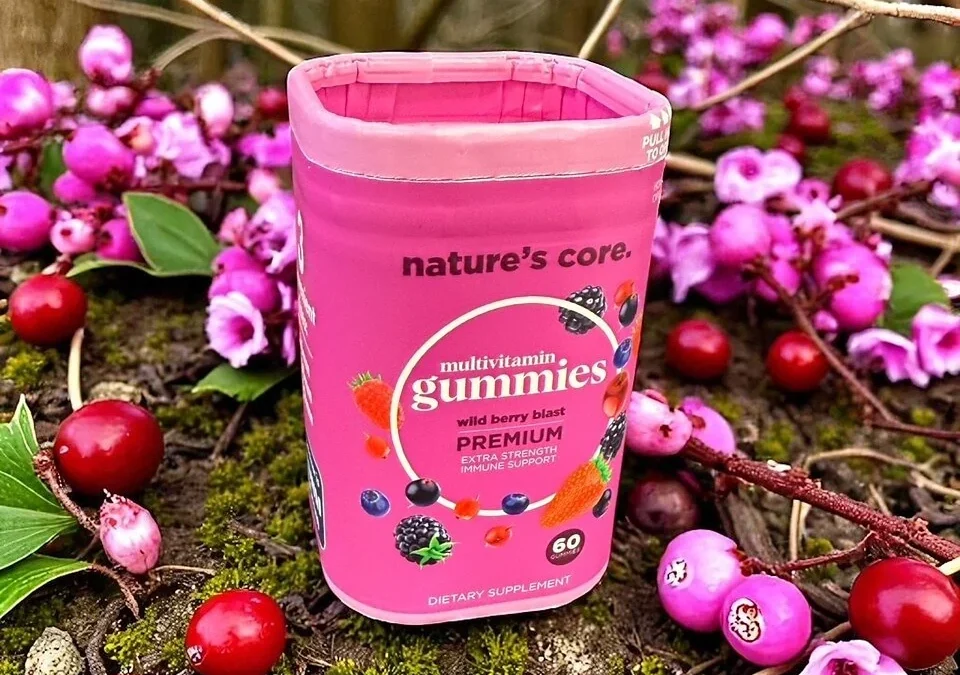
Graphic Packaging announced on November 4, 2026, that North American supplement brands can buy Boardio paperboard canister packing through Combined Technologies, Inc. (CTI) in Bristol, Indiana. CTI lists the format among its contract-packing services, with an integrated lid and barrier options. A brand that already outsources filling can now evaluate a paper-based rigid pack through a service contract. [1] [2]
A format on shelves gains another route to market
Vital Proteins reported in 2024 that a club-store SKU of its collagen peptides was already on sale in a paperboard canister with a pull-tab lid. A separate retail precedent for Boardio itself is the Mentos gum canister documented by PAC Global. The November announcement identifies no retail SKU filled at CTI. [1] [3] [4]
Our view is that co-packing changes who has to commit to the filling and forming equipment. A brand can seek a run on a shared line before committing to its own equipment. The brand still owns the product decision, including the barrier grade, run size, finished-pack acceptance criteria and cost of moving a SKU to a new packing site.
What this changes for brands and contract packers
Our assessment is that shared packing capacity gives brands a way to qualify the format before buying equipment. It shifts the commercial decision toward the terms of a repeat run. Ask the packer to quote a qualification lot and the next commercial lot separately, with the same barrier grade, acceptance criteria and delivery point. A pilot that passes shelf-life checks can still be difficult to scale if the minimum order ties up too much inventory or the repeat lead time misses the retailer’s replenishment window.
Qualify the sealed pack and the opened pack separately
Start with the failure that matters to the formulation. For a powder that clumps in humidity, compare the incumbent and the proposed filled canister through the intended storage and distribution conditions. Inspect the closure, body seam and base after handling. A good result on a flat piece of board leaves those interfaces untested.
Run a second comparison with repeated opening and scooping on a realistic use schedule. Powder on the rim and humid air entering at each opening can affect the experience even when the unopened pack meets its target. Ask for acceptance limits tied to the product, such as visible clumping or a change in how it pours, and agree which failures trigger a hold or rejection at the packer.
Price the accepted filled canister
Compare bids per accepted filled canister delivered to the same point. Include the body and closure, minimum run, changeover, start-up losses, rejects and freight. Ask who pays if the pack needs a higher barrier grade or a second run after qualification. For a small brand, avoiding a machine purchase can make the format possible while the minimum run or yield still makes a particular SKU uneconomic.
Keep a material comparison alongside the cost model. Request component weights for the exact body, closure and any liners, and compare them with the actual pack being replaced. Check the local recovery route for that complete construction. A fiber-majority body, a percentage reduction in plastic and local collection acceptance answer different questions.
Where the opening is strongest
The best initial candidates are likely to be established dry powders with predictable order volumes, a defined shelf-life target and a packing partner able to run both a qualification lot and the follow-on orders. Keep the incumbent format in the comparison where it already meets a demanding moisture target or serves short production runs. A named SKU shipping through CTI, followed by repeat orders and pack-specific performance, would show more about adoption than the number of barrier options available today.
The likely first wave is selective SKU conversion. Brands can compare a repeat order with the incumbent using delivered cost, accepted yield and time to replenish. A contract packer that can repeat the same finished specification on schedule would make the service more useful to a second brand. If qualification stays expensive or slow for each formulation, the format could remain concentrated in a few higher-volume lines.
Related reading includes how another dry-food pack starts with a barrier brief and why paper-packaging barrier and recycling evidence are separate.
Update history
9 November 2026. Added the commercial tests for moving from a co-packing trial to repeat orders.
Sources
- Graphic Packaging Holding Company — Graphic Packaging and Combined Technologies Inc. Help Nutraceutical Brands Stand Out On-Shelf with Boardio Paperboard Packaging
- Combined Technologies, Inc. — Contract Packaging & Food-Grade Packaging Services
- Vital Proteins — Vital Proteins Debuts New Paper-Based Canister for Its Collagen Peptides
- PAC Global — Graphic Packaging International
Found an error? Read our corrections policy and contact the editors.