A paper label can change its imaging chemistry without changing its paper base. Two documented approaches show why that distinction belongs in a packaging specification: Osaka Sealing Printing is taking a partly lignin-derived developer into a planned retail trial, while Koehler describes a physical imaging process that dispenses with chemical developers. These are different design routes, not interchangeable claims of a safer or recyclable finished label.
The lignin route changes part of the thermal material
OSP’s 29 October release says Seven-Eleven Japan plans to test Treeloop Thermal labels on about 15 meal and rice products in roughly 300 stores around Chiba and Narita. The stated period is 3 November to 7 December 2026. This is an announced application trial; results are not yet available. [1]
Its10–20% natural-derived substitution figure refers to the thermal-material portion excluding paper. OSP describes replacing part of the developer with a kraft-lignin-derived material and says BPA and BPS are not used as developers. The percentage is not a whole-label biomass share, and the developer statement is not a test result covering every substance in the label.
That denominator changes what a buyer can compare. A paper-heavy construction can already contain a large fibre share while a relatively small coating performs the imaging function. Increasing renewable input in that coating answers a different question from changing the fibre content, adhesive or release liner.
The physical route changes how the mark appears
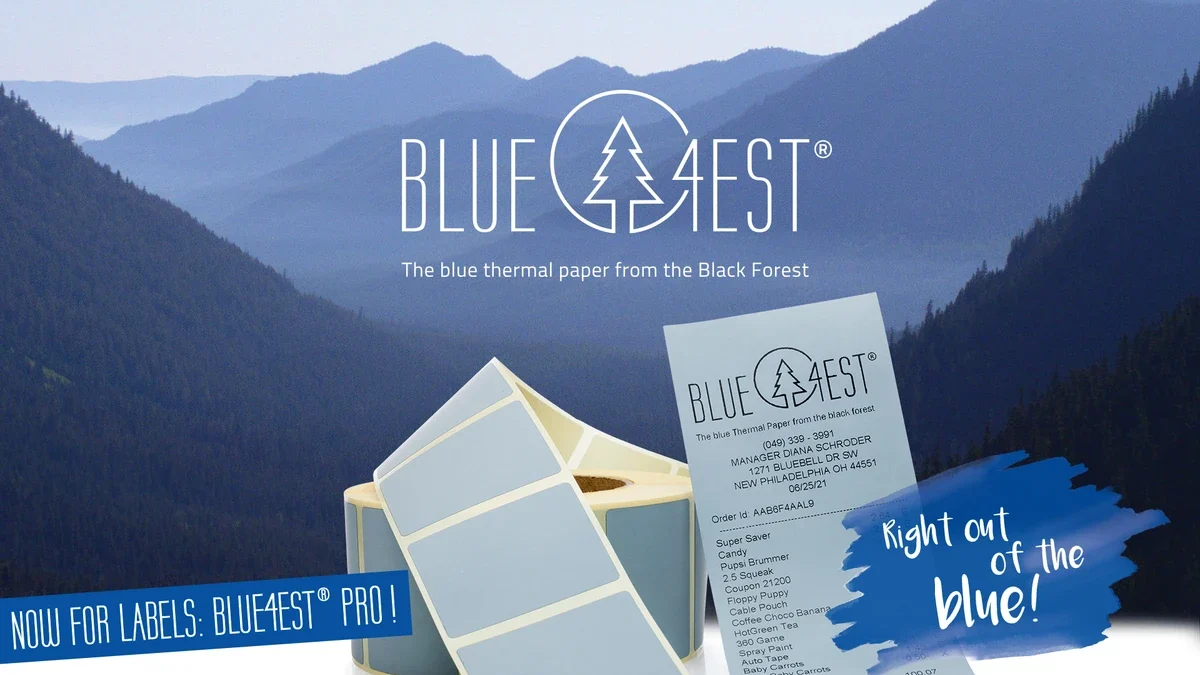
Koehler’s Blue4est Pro example dates from 2022. The manufacturer describes an opaque functional layer becoming transparent under heat, allowing an underlying black layer to become visible. It says this route avoids chemical developers and adds a protective layer for label use. It should not be presented as a product launched today. [2]
Removing the chemical-developer step does not mean removing all functional layers from a self-adhesive label. The facestock, imaging surface and protection still need to work with the adhesive, liner and printing operation. A developer-free facestock claim therefore cannot specify the complete applied label on its own.
The approval record must follow the changed layer
The useful comparison is what changed in the functional construction and what must still be demonstrated on the finished pack. It is not a ranking based on the words bio-based, developer-free or paper.
| Route | What the stated change addresses | Record still needed for the application |
|---|---|---|
| Partly lignin-derived developer | Selected inputs in the non-paper thermal material | Exact denominator and label construction; trial outcome for the intended product |
| Physical imaging without chemical developers | The mechanism forming the visible mark | Accepted print setting and scan/readability result on the actual applied label |
| Either complete label | A facestock claim alone covers only part of the assembly | Adhesive, liner, storage and recovery evidence for the specified configuration |
For a barcode label, the operational acceptance question is whether the printed and applied label remains readable through its intended handling and storage. A change in colour or layer architecture should be tied to that result rather than approved through a feedstock percentage alone. No scan-rate dataset from a common test is available here, so these routes cannot be ranked for reader performance.
Two routes are evidence of options, not an adoption rate
The recent Japanese trial adds an application signal to an older commercial alternative. Together they show that thermal-label redesign can target the imaging function as well as the substrate. They do not establish which route is winning, a market-wide conversion rate or equivalent performance under matched conditions.
The next decision is to define the label configuration and its read/scan acceptance condition before changing supply. Recycling remains a separate assembly question, as explained in our analysis of labels and packaging recovery. The Treeloop trial’s actual operating results would be the next evidence capable of advancing this comparison.
Sources
- Osaka Sealing Printing / OSP Holdings — Seven-Eleven Japan / OSP Treeloop Thermal label trial. 29October2026 release: trial description and Treeloop Thermal explanation.
- Koehler Paper — Koehler Paper introduces Blue4est Pro label. 11April2022 release: physical imaging principle and protective layer.
Koehler press photo. Blue4est Pro product presentation from 2022; full composition resized and converted to WebP. It is not a photograph of the Treeloop retail trial.
Found an error? Read our corrections policy and contact the editors.