Elopak’s third-quarter revenue growth gives carton buyers an incomplete picture of Americas supply. Its 27 October 2026 report shows group revenue up 6.5% and Americas revenue up 5.9% year on year, while describing broadly stable regional carton revenue and constrained board availability. [1]
The purchasing question is whether a particular programme can obtain board and cartons on schedule. A growing equipment or service business cannot answer that question for a new dairy launch.
The Americas growth sits outside the carton row
| Revenue | Q3 2026 | Q3 2025 |
|---|---|---|
| Cartons and closures | 85.5 | 84.9 |
| Equipment | 6.1 | 3.1 |
| Aftermarket | 5.2 | 3.6 |
| Segment total | 97.5 | 92.0 |
Elopak attributes the regional increase primarily to equipment and aftermarket revenue. It says mitigation secured board and continued carton deliveries, but available supply was prioritised to existing customers after the Nippon Dynawave disruption. [1]
The table separates product sales from the wider customer relationship. Its selected product rows omit other revenue and intersegment sales, so they are not a complete reconciliation to the total. Nor are euro sales a carton-unit count. A procurement forecast should not apply the segment growth rate to its own pack volumes.
An incumbent call-off and a new launch need different commitments
The allocation statement makes the distinction operational. For an existing customer, continued deliveries support checking the supplier’s confirmed call-off schedule against the customer’s own consumption. They do not establish that every requested uplift is covered. For a new programme, the unresolved issue is incremental allocation: which board route, pack specification and delivery window have actually been committed?
The report links equipment commissioning to customer onboarding ahead of Little Rock’s planned third production line in the second half of 2027. [1] A launch plan therefore needs two dated milestones: a working filling installation and the material allocation to feed it. Treating those milestones as interchangeable could leave a technically ready filler without an evidenced supply plan. This report alone does not show that any named customer’s launch will be delayed.
For readers evaluating the expansion milestone, the site’s capacity-stage guide explains the distinction between installation, qualification and effective output. Here, the specific constraint disclosed by Elopak is board allocation, rather than proof that a future line is already supplying additional customers.
Insurance recovery is a separate track from supply recovery
Elopak says insurance recoveries partly offset disruption costs, with further recoveries expected and a timing lag. [1] That can affect reported earnings without releasing an additional carton allocation. Buyers should track the two separately rather than use a better financial quarter as a substitute for a delivery commitment.
The next decision-changing evidence would be a confirmed programme allocation or a documented change in supply priority, followed by actual qualified output from the planned expansion. Until then, the report supports a differentiated sourcing conversation with the supplier. It supplies neither a quantified residual board deficit nor a customer-specific availability guarantee. These are company-reported results, not an independent survey of carton demand.
Sources / References
- Elopak, Third quarter 2026 report, released 27 October 2026; pages 2, 6 and 8. Original report accessed 28 October 2026. Financial results and operating explanations are the issuer’s disclosures.
Photograph credit
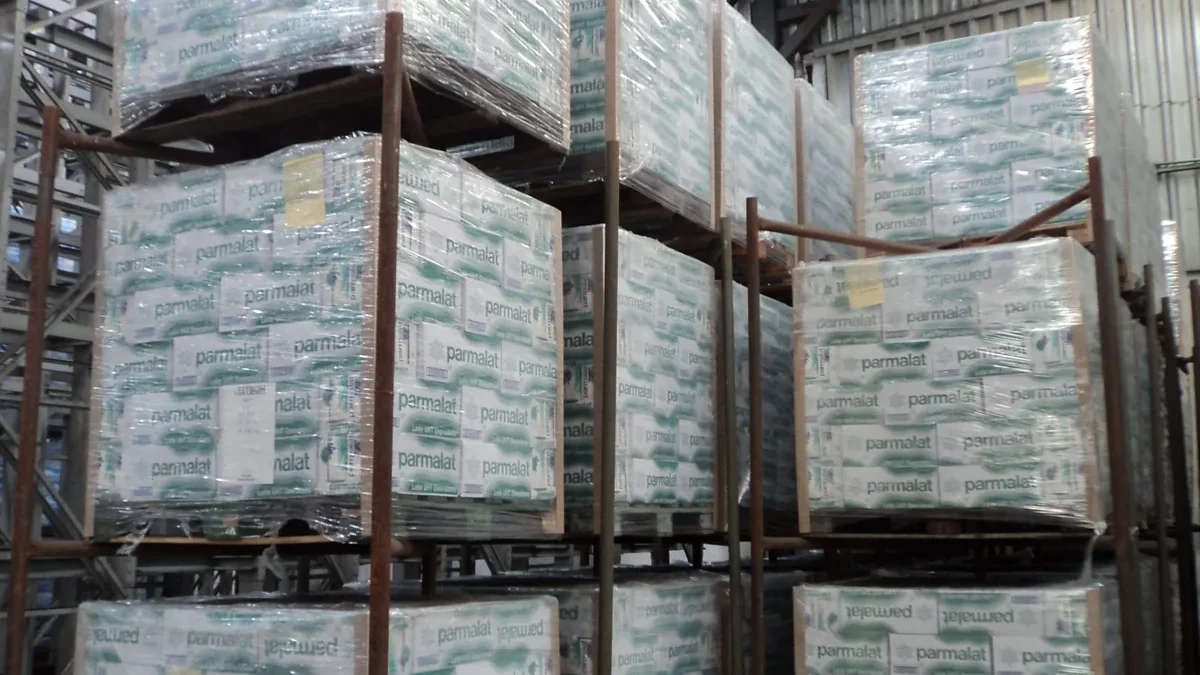
Parmalat milk cartons in Governador Valadares, Brazil, 29 October 2011. Photo: HVL / Wikimedia Commons, CC BY 3.0. Full composition retained; resized and converted to WebP. Archival carton-storage context; the photograph does not identify an Elopak production site or evidence current board availability.
Found an error? Read our corrections policy and contact the editors.