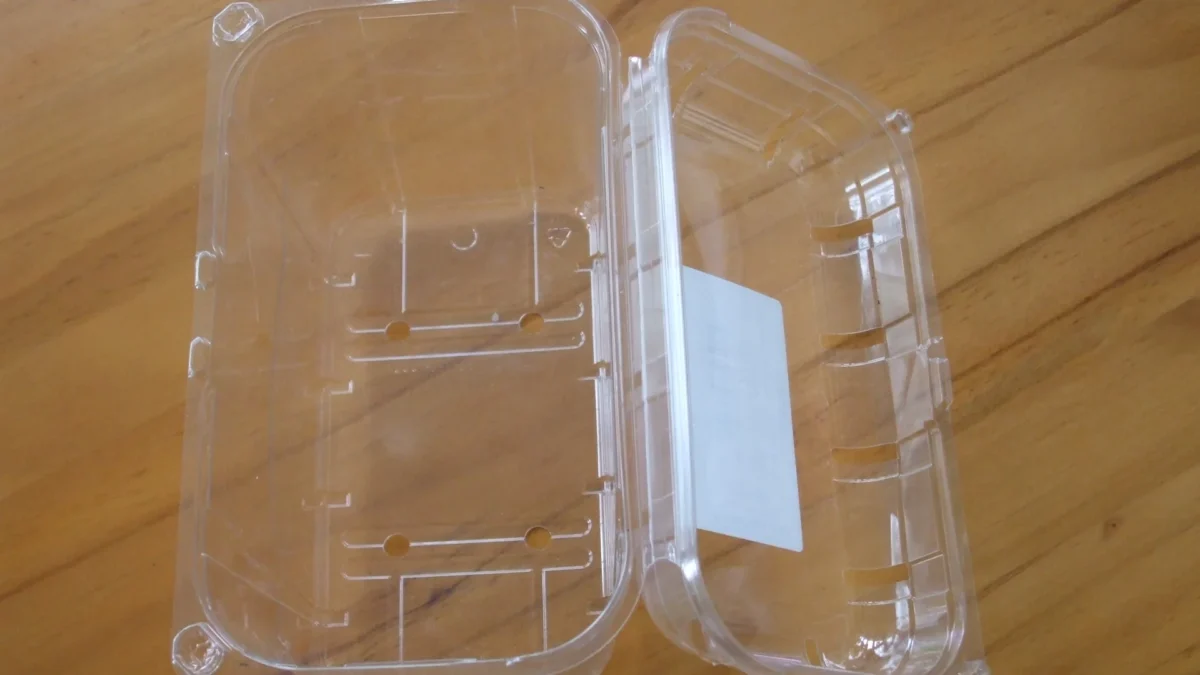
Thermoforming and injection molding make plastic packaging in fundamentally different ways. Thermoforming heats an existing thermoplastic sheet, shapes it against tooling with vacuum or pressure, and trims the formed part. Injection molding melts polymer, injects it into a closed mold cavity, cools the part, and ejects it. Both can make food containers; their relative suitability depends on geometry, material, tolerances, production volume, and the cost of accepted packaging—not on a blanket rule that one method is always cheaper.
A shallow PET tray and a precision PP snap-fit lid may have very different manufacturing requirements. Even two visually similar PP cups may be made by either process. The useful buyer question is therefore: Can the supplier produce the same functional package consistently, and what will each qualified route cost over the intended program?
Thermoforming vs injection molding: comparison at a glance
| Decision factor | Thermoforming | Injection molding |
|---|---|---|
| Starting material | Extruded thermoplastic sheet or roll stock | Polymer pellets or another feedstock suitable for injection molding |
| How the part forms | Heated sheet deforms against a mold, commonly using vacuum, positive pressure and sometimes plug assist | Molten polymer fills a closed mold cavity under pressure |
| Common packaging examples | Shallow food trays, tubs, blister cavities, some cups, clamshell bodies | Snap-fit lids, closures, precision features, tubs and some thin-wall cups |
| Geometry considerations | Draft, draw depth, corner thinning, flange and trim design; mostly sheet-derived shells | Gate, flow path, cooling, shrinkage, ejection, ribs, living hinges where the material/design permit |
| Tooling considerations | Forming tools, plugs and trimming tools; sheet handling also matters | Closed cavity/core tooling, runners/gates and ejection; cavity count affects output |
| Main material losses to measure | Trim skeleton, startup scrap, off-spec forming, rejected parts; possible reprocessing only where qualified | Runners or sprues where present, startup purges, rejected shots and molded-part defects |
| Typical quality risks | Uneven wall distribution, weak corners, distorted flanges, incomplete forming, inaccurate trimming | Short shots, sink, flash, warpage, gate defects and dimension variation |
| Not established by process choice | Finished food-contact compliance, suitability for the intended food/use, real-world recyclability, carbon advantage, or total system cost | |
Thermoplastic sheet forming and injection molding use different feedstock and tooling from fiber forming. See the wet and dry molded-fiber guide for the fiber processes.
How plastic thermoforming works
In thermoforming, an extruder or purchased-sheet supplier first provides sheet in a specified polymer grade, width and gauge. The converter heats it until it can be shaped without rupturing. A mold defines the package cavity or surface; vacuum, compressed air or a combination helps push or draw the softened sheet into the desired form. Plug assist can be used to improve material distribution in deeper shapes. The formed sheet cools sufficiently to retain shape and the parts are separated from the surrounding web.
The sequence matters because the formed package inherits both sheet-making variation and forming variation. The sheet may be thick at one point and thin at another after stretching; a nominal incoming gauge does not certify the finished tray’s minimum corner thickness. For a deep container, the designer should specify a maximum draw depth, corner radii, material distribution target, flange dimensions and trimming tolerance that are realistic for the chosen line.
The trim skeleton is part of the economics
After a tray is cut out, material remains between the individual parts in the web. That trim skeleton, together with startup losses and rejected parts, must be counted when comparing material yield. Some operations can grind and reuse appropriate clean process scrap in controlled production; that possibility is not permission to assume any scrap may enter a food-contact product. Grade changes, contamination, thermal history, customer requirements and applicable rules can limit reprocessing.
A single-cavity prototype forming tool also does not predict a production line’s actual cost. Heating zones, tool cavities, trim registration, stacking, denesting and approved sheet width all affect qualified output per hour.
How plastic injection molding works
Injection molding usually starts with resin pellets fed into a heated barrel where a screw melts, mixes and meters the polymer. The machine injects the melt into the space between mold halves. The plastic cools or solidifies, the tool opens and the part is ejected; the cycle then repeats. Tooling may contain one or many cavities. Finished features can be formed in the same operation, within the constraints of mold filling, shrinkage and ejection.
The closed mold can support engineered details such as sealing lands, threads, alignment features or snap connections. But those details have their own manufacturing risks. A thin hinge may need a specific polymer and gate arrangement; a circular lid may warp when cooling is uneven; a thick rib can create a visible sink mark. These are design-and-process questions, not proof that every injection-molded package is dimensionally better than every thermoformed one.
In injection molding, runners, sprues, purge material and rejected shots can contribute to waste. Some mold designs use hot runners and different gate arrangements, so it is inaccurate to assume a fixed runner-loss percentage for every plant. Ask for the actual shot weight, saleable part weight, cavity count, cycle and quality yield.
Which packaging formats suit each process?
| Package format | Route worth evaluating | Acceptance test that matters |
|---|---|---|
| Transparent produce or bakery tray | Thermoformed PET or another qualified sheet construction | Corner thickness, stacking, distortion and fit of sealing film or lid |
| PP food-service cup | Either thermoforming or injection molding | Weight, rim geometry, deformation, nesting and lid fit at production speed |
| Snap-fit closure or detailed cap | Injection molding often deserves early evaluation | Retention force, repeated operation, dimensional stability and seal |
| Multi-compartment rigid tray | Thermoforming where sheet forming supports the depth and walls; injection molding where features require it | Minimum wall thickness at partition corners, stack stability and seal interface |
| Blister cavity for a device or product | Thermoforming is one common route; other blister constructions exist | Product-specific cavity protection, material specification and sealing validation |
| Container with integral hinge or molded thread | Injection molding, subject to design feasibility | Hinge fatigue or thread function over intended use |
In a 2009 case study, Piaras de Cléir of Kraft Foods Global compared the physical properties of a 235 mL polypropylene cup made by injection molding with one made by trim-in-place thermoforming. When both routes can make the required shape, compare finished parts for the properties the application needs, including rim fit and light protection where relevant. [2]
Tooling, lead time and design changes: what buyers actually pay for
Brentwood, a manufacturer that offers both processes, describes lower tooling costs as a common advantage of thermoforming. Ask for the actual forming and trimming tools on the proposed line and compare them with the actual injection tool. Tool material, cavity count and qualification requirements can change the comparison. [3]
For a meaningful quote, specify whether tooling includes the forming mold, trim die, plug assist, temperature controls, cavity/core inserts, hot runner, ejection features, spare parts, trial runs and qualification samples. A supplier quoting an existing standard mold is not competing on the same basis as a supplier building custom multi-cavity tooling.
Tool change economics also matter. A branded tray with several artwork versions may share one forming geometry, while a change in lid fit, wall profile or rim geometry may require altered tooling. For injection molding, gate or cooling changes after first trials can be costly. For thermoforming, changing sheet grade or gauge can alter draw behavior and trim quality even when the mold stays the same.
Worked example: when could the cost ranking reverse?
Fixed tooling cost and variable cost should be evaluated together over a defined production horizon. The following figures are invented teaching assumptions. They are not supplier quotes, observed market prices or typical thermoforming/injection molding cost benchmarks. Both options are assumed to have passed identical package-performance requirements. The hypothetical variable costs include the respective input materials, processing and expected production losses per accepted unit; identical downstream logistics are excluded from both.
| Input / outcome | Thermoforming | Injection molding |
|---|---|---|
| Fixed tooling cost | $4,000 | $22,000 |
| Variable cost per accepted package | $0.095 | $0.070 |
| Total for 200,000 accepted packages | $23,000 | $36,000 |
| Cost per 1,000 at 200,000 accepted packages | $115 | $180 |
| Total for 1,000,000 accepted packages | $99,000 | $92,000 |
| Cost per 1,000 at 1,000,000 accepted packages | $99 | $92 |
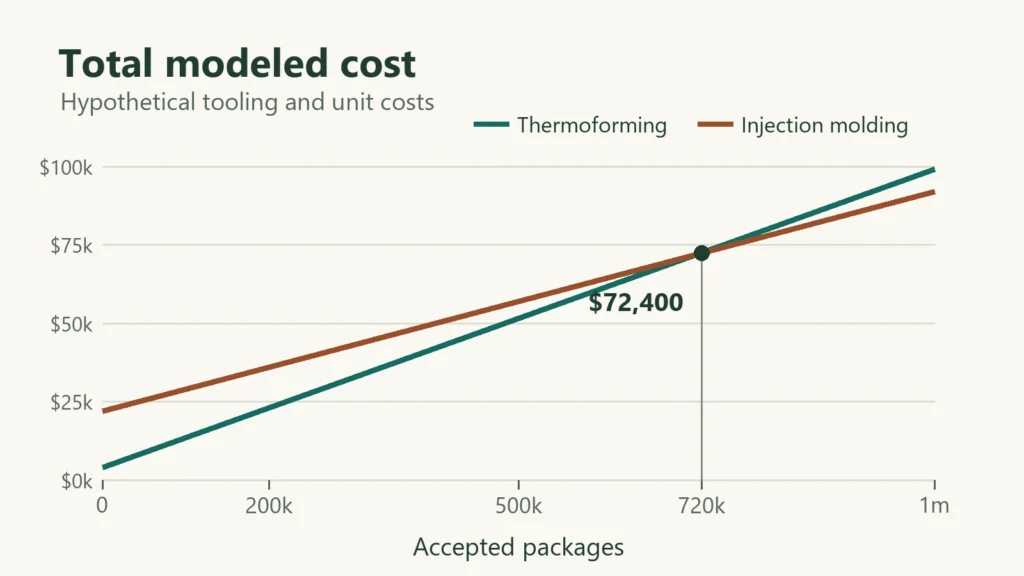
The modeled total is fixed tooling + (accepted quantity × variable cost per accepted unit). Under these assumptions, the theoretical crossover is ($22,000 − $4,000) ÷ ($0.095 − $0.070) = 720,000 accepted packages. Below that quantity thermoforming is less costly in this model; above it injection molding is less costly. A different mold life, sheet cost, reject rate, cavity count, tool charge or lid-fit specification could move or eliminate that crossover.
There is an additional accounting trap: if the quoted part price already includes tooling amortization and production scrap, do not add those same amounts again. Compare equivalent cost boundaries, with supplier-paid and buyer-paid items clearly separated.
Quality controls: measure the finished package, not just machine specifications
A press brochure may list cycle time and cavity count. Those figures are not the same as the number of usable, correctly packed pieces delivered. For a tray or cup, request an actual production trial and ask the converter to record:
- Dimensional capability: rim diameter or profile, flange flatness, height, fit with the actual lid or film and variation across cavities or time.
- Material distribution: finished part weight and wall-thickness map, especially at stretched corners and sealing areas.
- Functional performance: seal integrity where relevant, stacking/denesting, impact resistance under stated conditions and performance after realistic temperature exposure.
- Yield: material input, setup waste, trim or runner mass, rejected pieces, accepted pieces and rework rules.
- Traceability: material grade, recycled-content route where relevant, additive or colorant declaration, lot and process settings.
A tray that meets nominal length and width but cracks at its thinnest corner is not equivalent to a qualified tray. Conversely, a beautifully molded lid that does not fit the mating container is not a successful part. Test the assembled packaging system rather than awarding a process on its visual finish alone.
Does thermoforming or injection molding create less plastic waste?
Neither process label tells the full waste story. Thermoforming can leave an extensive trim skeleton; injection molding can generate runners, purges and rejected parts. A trim-heavy layout may still produce a light, effective package. A low-runner injection line may still consume more material per finished package if the geometry requires thicker walls. The comparison needs actual kilograms of polymer entering the process per 1,000 accepted finished packages.
Track clean internal process scrap separately from post-consumer recycled plastic. For food contact, the FDA identifies potential contaminants and unsuitable source material as concerns when evaluating recycled plastics. Check the source and permitted use of each material stream before treating it as usable input in the yield model. [4]
It is also incorrect to infer a lower environmental footprint merely from a lower mold price or shorter cycle. A defensible environmental comparison needs matching package function, material mass, production energy, product protection, transport and realistic end-of-life treatment. A thinner container that causes more food or product damage may shift the overall result.
Buyer decision checklist: the same RFQ for both processes
- Describe the finished pack: drawings, nominal volume, filling conditions, product type, mating lid or film, storage temperatures and acceptable dimensional ranges.
- Specify the material: polymer grade, colour/clarity, approved additives and any recycled-content requirements with their own supporting evidence.
- Define output: first order, annual accepted quantity, SKU variants, expected production life, tool ownership and replacement assumptions.
- Request complete cost boundaries: sheet or resin, molding, trim/regrind, tooling, QA, secondary packing, freight and rejected-unit handling.
- Request production evidence: actual samples, wall-thickness map, cavity-by-cavity dimensions, assembly fit, seal/stack testing and accepted-output yield.
- Confirm changes: who pays for tooling corrections, when the part design is frozen and how production changes are approved.
The decision rule: start with the package’s physical and functional requirements. Obtain qualified samples from the processes that can meet them. Then compare the total program cost per accepted package, with tooling life and waste accounted for exactly once. Thermoforming and injection molding are competing manufacturing routes, not automatic statements about sustainability or quality.
Sources
Found an error? Read our corrections policy and contact the editors.