
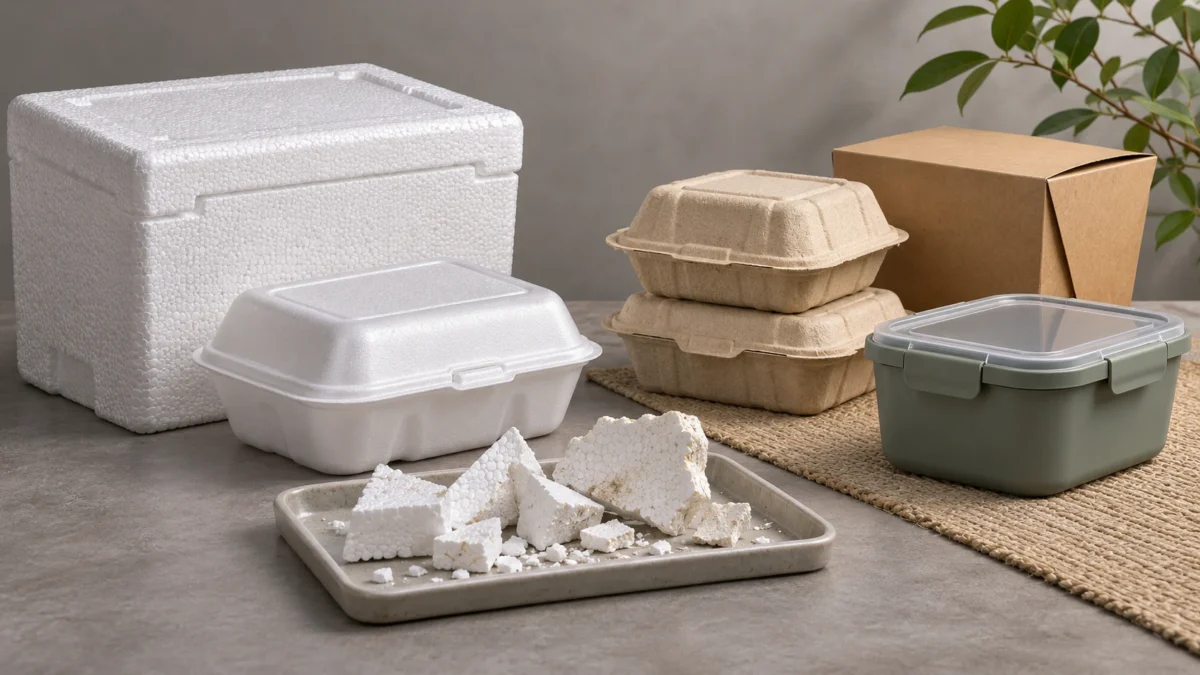
A white foam takeaway box looks like a simple product. It weighs little, buffers heat, cushions food and costs little to manufacture at scale. Yet in several major markets, precisely this kind of single-use food packaging is now restricted. The conflict is not that polystyrene suddenly stopped working. It is that its performance during a short service life has become harder to reconcile with litter, collection economics and evolving packaging rules.
Scope, method and evidence limits
This is desk-based editorial comparative research, with a source cutoff of 13 November 2026. It combines official provisions and agency assessments with attributed manufacturer descriptions. The geographical comparison is selective, not an exhaustive legal inventory. No original experiment, representative market survey, universal lifecycle ranking or measured market-share forecast was performed. Scientific summaries are identified where only an abstract was examined; future pathways are scenarios. Where the cited legal text and guidance diverge, both are identified without treating the guidance as an amendment to legislation.
This report examines how polystyrene foam became widely used, what survives in 2026, which hazards are established and which remain uncertain, and how businesses should evaluate replacements. Its scope is packaging, especially foodservice containers and protective foam—not building insulation, which has different lifetimes, functions and rules. It is a desk-based synthesis of official, scientific and industry sources, not a new laboratory study or a market-size forecast.
One polymer family, five packaging forms: OPS is not foam
Before considering a ban or a substitute, the material must be identified correctly. OPS usually means oriented polystyrene, a typically transparent, stretched sheet used for thermoformed food packaging and lids. It should not be treated as a synonym for the familiar white foam box. Japanese manufacturer JSP identifies PSP (extruded polystyrene foam sheet), OPS and HIPS as distinct polystyrene food-container materials. Mitsubishi Chemical likewise describes OPS as a transparent, thermoformable biaxially oriented sheet.
| Material | Structure and process | Typical packaging role | Critical distinction |
|---|---|---|---|
| OPS — oriented polystyrene | Stretched, substantially unfoamed PS sheet | Clear lids, display packaging, food trays | Transparency does not make it EPS or XPS foam |
| EPS — expanded polystyrene | Expanded beads fused into moulded articles | Protective cushioning, insulated fish boxes, some cups and containers | Very low density; often difficult to transport economically as waste |
| XPS — extruded polystyrene foam | Polymer expanded during extrusion | Foam foodservice trays, plates and clamshells; insulation in other applications | Frequently confused with EPS in everyday descriptions |
| PSP — polystyrene foam sheet | Industry term, especially in Japan, for extruded foamed PS sheet | White supermarket trays and formed food containers | Commonly an application/form designation of extruded PS foam, not a separate polymer |
| HIPS — high-impact polystyrene | Rubber-modified, generally solid PS | Rigid trays, tubs and other formed parts | Neither OPS nor foam simply because it is a PS resin |
Source basis: JSP’s material descriptions and Mitsubishi Chemical’s OPS product/production account; typical forms, not specifications for every grade. See references R1 and R3.
These names matter legally. A restriction covering expanded polystyrene does not automatically cover every solid OPS article, while rules addressing extruded foam can capture products informally described as “styrofoam.” Product descriptions, resin codes and pictures alone may be insufficient to establish the structure. Buyers should request a bill of materials and a process-level material declaration for the finished item, including its lid and any coating.
How foam polystyrene became a packaging default
The original engineering case was powerful. Foam can achieve useful thermal insulation and cushioning with a small mass of resin because much of the structure is air. BASF dates the emergence of its Styropor expanded-polystyrene product to 1951 and describes it as approximately 98% air. That figure describes BASF’s cited foam, not the guaranteed composition of every modern EPS or XPS article.
Over subsequent decades, polystyrene technologies served several distinct packaging problems. Bead-moulded EPS protected fragile goods and insulated seafood shipments; extruded foam sheet could be thermoformed quickly into inexpensive trays and foodservice containers; oriented PS sheet gave retailers a clear lid with low material weight. Producers liked processability and manufacturing speed. Food outlets liked thermal performance, disposability and a price that did not require return logistics.
But the success of disposable foam also exposed its weak point: most foodservice articles are used for minutes or hours and then enter a fragmented waste system. When lost outdoors, lightweight foam can travel easily, fracture and remain in the environment. In the 2010s and 2020s, policy increasingly targeted this mismatch between short service life and persistent litter. The important change was not a universal scientific verdict that every PS application is unacceptable; it was the growth of product-specific restrictions where alternatives were considered available.
Milestones in the transition
| Date | Documented milestone | What it demonstrates |
|---|---|---|
| 1951 | BASF begins Styropor production | The historical industrial case for lightweight insulation and cushioning |
| 2019–2021 | EU Single-Use Plastics Directive establishes restrictions on specified EPS food and beverage items, implemented from 2021 | Defined disposable formats face targeted market restrictions |
| 2022 | New York State foam foodservice and loose-fill restrictions take effect on 1 January | Some US states move independently of federal food-packaging rules |
| 2022–2023 | Canada phases in restrictions covering specified foodservice ware containing EPS or XPS foam | Both foam production routes can fall within one policy |
| 2025 | Oregon restricts specified polystyrene-foam foodware and foam packing peanuts from 1 January | State restrictions continue to spread in particular product categories |
| 2026 | EU Packaging and Packaging Waste Regulation (PPWR) begins applying on 12 August | Packaging decisions face broader design and waste-management obligations |
| 2029 / 2030 — unresolved | PPWR Article 71 gives 12 February 2029 for Article 67(5); Commission guidance section 16 gives 1 January 2030 for the XPS extension | The legal text and guidance give different dates; this comparison does not establish a single compliance deadline |
Source basis: BASF’s historical account, SUPD Article 17/Annex Part B, PPWR Articles 67/71, Commission guidance section 16, and the Canadian/New York/Oregon records below. Dates are jurisdiction-specific.
The timeline is selective and not a complete global legislative inventory. It describes different legal instruments, affected products and jurisdictions; the entries should not be interpreted as a single worldwide prohibition.
Where the market stands in 2026: retreat in foodservice, continued use elsewhere
The present market cannot be reduced to “foam is banned” or “foam is still everywhere.” Single-use foodservice foam is under clear pressure in several jurisdictions, while applications such as industrial cushioning, temperature-controlled shipping and durable insulation face different performance requirements and legal treatment. Japan also illustrates continuing material diversity: JSP describes PSP, OPS, EPS, PP and PET as active food-container or packaging material families, alongside work on recycling and heat-resistant grades.
A second distinction concerns solid OPS. It can be displaced by PET or clarified PP in particular food-packaging applications, but this is not evidence of a universal collapse. In 2021 Mitsubishi Chemical reported a heat-resistant OPS sheet designed to facilitate recycling of manufacturing scrap. That is evidence of a supplier development, not proof of widespread post-consumer OPS recycling.
One should also resist a tempting statistical shortcut. OECD’s Global Plastics Outlook estimated that 353 million tonnes of plastic waste were generated globally in 2019, with 9% ultimately recycled after recycling losses. This is a global all-plastics figure: it is not an EPS recycling rate, an OPS recycling rate, or a 2026 market estimate. The report is relevant because it identifies a systemic collection problem against which material-specific recycling claims must be tested.
Regulatory snapshot: geography and product form change the answer
European Union. Article 5 and Annex Part B of Directive (EU) 2019/904 restrict specified single-use EPS food containers, beverage containers and cups. They do not prohibit every EPS application or solid OPS lid. There is a material timing discrepancy in the sources for the XPS extension: PPWR Article 67(5), read with Article 71, expressly adds XPS and gives 12 February 2029 as its application date; the Commission’s June 2026 guidance, section 16, says 1 January 2030. This report does not reconcile those dates into a definitive compliance deadline. The discrepancy is a finding about the two cited documents, not a product-specific compliance determination. Buyers should obtain the operative legal text and applicable national requirements for their exact product rather than plan on the guidance date alone.
Canada. Federal rules cover particular ready-to-consume foodservice articles—such as clamshells, lidded containers, plates, cups and bowls—if they contain EPS or XPS foam or certain other listed materials. Relevant prohibitions on manufacturing and importing for Canadian sale began in 20 December 2022, and the Canadian-sale restriction began in 20 December 2023, subject to the actual text and exceptions. The litigation concerns the federal listing underpinning the rules; the January 2026 Federal Court of Appeal judgment was subsequently taken to the Supreme Court. However, the Supreme Court of Canada granted leave to appeal on 15 October 2026; that litigation remained a review trigger at this report’s cutoff. The regulations were still described by the government as in force, not as finally insulated from future challenge.
United States. The operative picture is fragmented. New York State began restricting covered EPS foam disposable foodservice items and polystyrene loose-fill packing material in 2022, and added specified non-encased EPS cold-storage containers from 1 January 2026. Oregon’s restrictions on certain foam foodware and loose-fill material took effect 1 January 2025. The definitions and exclusions differ; they cannot be assumed to describe every US state. New York lists product-specific exemptions. Oregon DEQ says it cannot grant industry exemptions; its transport-material boundary excludes protective PS other than foam packing peanuts from that specific sales prohibition.
Japan. Continuing manufacturer supply is not a regulatory approval. Japan’s Consumer Affairs Agency describes the positive-list framework for synthetic-resin food-contact materials, including the end of the initial transition on 31 May 2025. This is a food-contact framework, not evidence of a nationwide foam-packaging phase-out or acceptance in local recycling. A finished article still needs its relevant composition and use conditions checked.
| Market | Product / framework | Timing and limitation |
|---|---|---|
| EU | SUPD specified EPS formats; PPWR XPS extension | Specified EPS formats are already restricted. For the XPS extension, compare Article 71 (2029) with guidance section 16 (2030); no reconciled deadline is asserted here. |
| Canada | Defined ready-to-consume EPS/XPS foodservice ware under SOR/2022-138 | Manufacture/import and sale dates differ; appeal allowed 15 October 2026, not a final merits judgment. |
| New York | Covered foam foodservice items, loose fill, specified cold-storage containers | 2022 and 2026 changes; raw-food and other exclusions must be read separately. |
| Oregon | Defined foam containers and packing peanuts | 1 January 2025; no discretionary industry exemptions; protective transport PS boundary differs. |
| Japan | Synthetic-resin food-contact positive-list framework | Initial transition ended May 2025; not a blanket foam ban or proof of recycling access. |
Source basis: references R5–R12. Official provisions and agency guidance have different legal roles; the EU date discrepancy is reported rather than reconciled.
Environmental damage: persistence, fragmentation and collection economics
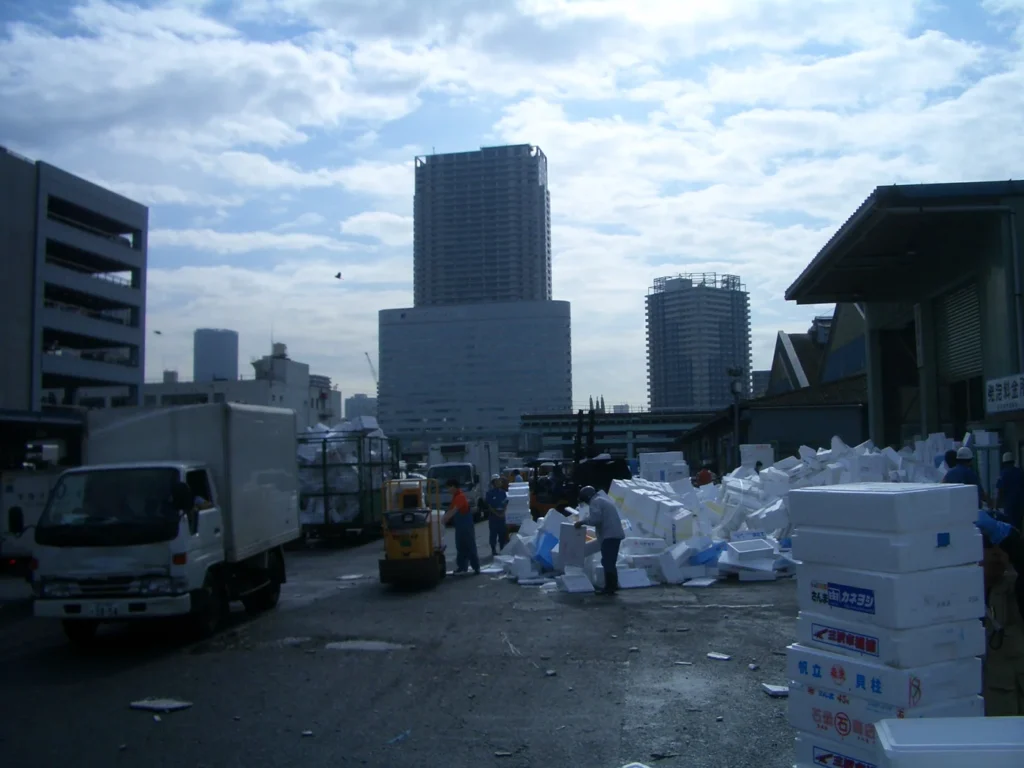
Foamed polystyrene’s main environmental concern is not one sensational ingredient. It is the combination of persistence, dispersal and weak recovery in many disposal settings. In littered environments, lightweight pieces can escape bins, collection vehicles and coastal activities. Waves, abrasion and ultraviolet exposure progressively break some large articles into smaller fragments. Smaller particles are harder to recover than intact boxes or protective blocks.
A 2020 Environmental Science & Technology study by Song and colleagues examined EPS in an outdoor weathering experiment lasting 24 months. It observed fragmentation and the production of micro- and nanoplastic particles under its study conditions. These findings demonstrate a pathway for pollution, not a universal fragmentation rate applicable to all climates, products or disposal methods. A peer-reviewed review of foamed PS in marine environments also describes transport, ingestion by marine animals and the interaction of foam debris with chemicals, while emphasizing the importance of source and setting. The description here is limited to the published abstract; full experimental methods were not examined for this review.
Recyclable in principle is not the same as recycled in practice. Clean, consolidated polystyrene can be reprocessed; thin, dispersed and food-soiled foam adds labour, sorting and transport burdens. Some programs operate collection, densification and reprocessing channels, particularly for concentrated industrial or commercial streams. These successes are real but do not establish acceptance at every household curbside or create an automatic closed loop back into food contact.
Mechanical recycling research is examining routes back into food-contact polystyrene. This report does not assign a general recovery yield or food-contact approval to such routes: incoming material, sorting losses, decontamination validation and the applicable regulatory process must be established for each system. In particular, evidence for solid post-consumer PS cannot automatically be applied to mixed, food-soiled foam.
This distinction changes what sustainability reporting should ask: How much material is collected? How is it sorted? What fraction reaches a genuine end market? Which fraction is rejected? And does the intended municipality or commercial operator actually accept that precise packaging construction?
Human health: three claims that should never be conflated
1. Styrene’s carcinogenic hazard. The International Agency for Research on Cancer (IARC) classified styrene, the monomer used to produce polystyrene, as Group 2A—probably carcinogenic to humans in its Volume 121 evaluation. This is a hazard classification drawing on evidence across exposure contexts. It does not mean that every finished polystyrene food container has been shown to cause cancer through ordinary use. Occupational exposure, manufacturing emissions, residual monomer and migration from finished articles are separate questions.
2. Migration from food-contact materials. EFSA’s June 2025 reassessment concluded that the available evidence did not show genotoxicity from oral styrene exposure in the evaluated in-vivo evidence and that use of styrene in food-contact materials respecting the 40 micrograms per kilogram of food specific migration limit proposed for EFSA’s evaluation was not considered a safety concern. This conclusion has its own tested route and conditions; it is neither a finding that all containers are safe under all uses nor a declaration that styrene has no carcinogenic hazard. The evaluated 40 µg/kg figure should also be understood as the condition of that scientific assessment, not a statement of the current statutory limit or approval of any finished container. Council document 14678/26 (20 October 2026) contains a draft amendment proposing a styrene migration limit. Its blank adoption identifiers and relative transition dates do not establish that it is already operative law. The document is cited as a dated draft, not as proof of adoption, entry into force or the present legal threshold. This section reports EFSA’s assessment and its stated conditions, rather than independently determining the safety or regulatory compliance of a packaging product.
3. Microplastics and food. Foam exposed to physical and environmental stress can release particles, but the existence of particles alone does not quantify a person’s disease risk. The US FDA states that current scientific evidence does not demonstrate that measured micro- or nanoplastic levels in foods pose a human-health risk, while also acknowledging important data and analytical gaps. A precautionary rationale for reducing avoidable litter should not be misrepresented as settled evidence of a particular illness caused by a foam takeaway box.
Food-contact decisions must therefore examine the finished construction, intended food, contact time and temperature, migration test conditions and applicable jurisdiction. Marketing labels such as “food grade,” “non-toxic” or “microwave safe” are not adequate substitutes for this evidence. The same scrutiny must apply to fibre, coatings and bioplastic alternatives.
Does a replacement actually outperform foam?
There is no universal winner. A heavy replacement can require more material or transport energy. A poorly designed paper coating may undermine recovery. A compostable item might enter landfill because its local collection system does not accept it. A rigid plastic can perform well in one closed collection program and poorly in a litter-prone open system. UNEP’s work on substitution specifically warns against regrettable substitutions that transfer burdens between environmental impacts.
The correct comparison starts with the same packaging service: for example, one delivered hot meal with equivalent containment, temperature management, leak prevention and acceptable food-waste outcomes. Mass, production, energy, transport, repeat-use cycles and realistic end-of-life routes then become comparable. Material change alone is not evidence of a better whole-system result.
Replacement matrix for packaging buyers
| Replacement route | Strongest candidate applications | Main evidence or engineering checks | Important limitation |
|---|---|---|---|
| Moulded fibre / bagasse | Takeaway boxes, trays, plates and some cushioning | Wet strength, hot oil, lid fit, food-contact tests, additives and coatings, accepted end-of-life route | “Plant-based” does not guarantee compostability, PFAS-free status or lower lifecycle impact |
| Paperboard with barrier coating | Cups, tubs, wraps, some meal boxes | Barrier type and mass, leakage, grease, repulpability and local sorting | Paper–plastic composites may not behave like plain paper in collection or regulation |
| PP or clarified PP | Heat-demanding trays, reusable rigid containers, selected clear lids | Heat profile, lid seal, actual recycling stream, cycle life | Fossil-based plastic may persist if littered; clarity and processing must be verified |
| PET / rPET | Clear cold-food lids, salads, bakery display and selected trays | Food-contact grade, thermoforming, seal, accepted PET stream, recycled-content provenance | Not a universal hot-food substitute; tray-to-tray recovery depends on local systems |
| Certified compostable constructions such as PLA-based items | Selected cold applications or controlled organics programs | Finished-item scope, service temperature, relevant certification and operator acceptance | Bio-based is not synonymous with home compostable or biodegradable in the open environment |
| Reusable containers | Closed venues, campus dining, repeat-delivery loops | Return rate, loss rate, washing energy and water, food safety, number of turns | Requires a real collection and cleaning system; low return rates can undermine the case |
| Paper/corrugated cushioning, engineered fibre or other protective systems | Electronics and non-food industrial transit | Shock/drop testing, moisture protection, packing density, damage rates | Failed protection or extra volume can erase anticipated gains |
Editorial screening matrix based on packaging service requirements and UNEP’s substitution framework (R19). No matched product tests or comparative environmental scores were produced.
This matrix is screening guidance, not a material ranking. It deliberately excludes invented carbon footprints and unsupported unit-price claims. A procurement decision should be based on matched performance trials and a transparent lifecycle assessment where impact claims are central.
2027–2030: three plausible directions, not one forecast
Path A — contraction of disposable foam foodware in regulated markets. Existing restrictions already affect defined foodservice formats. The EU XPS extension adds a further planning issue, but the two cited EU documents give different dates, as detailed above. Further restrictions elsewhere remain possibilities unless and until adopted.
Path B — material substitution without circularity. Some sellers may shift to coated fibre, heavier PP or PET, or biodegradable-looking products without verifying collection and performance. This path can improve legal market access and sometimes litter outcomes without necessarily improving every climate, water-use or waste metric. UNEP’s lifecycle work argues for comparing functional systems rather than just material labels.
Path C — narrower but more sophisticated PS use. Foam and solid PS may retain defensible uses in protective, temperature-sensitive or industrial channels where alternatives have a higher risk of product damage and clean waste is collected in bulk. Recycling research and producer initiatives could improve particular loops. This is a scenario, not a prediction of market share, recycling volume or guaranteed regulatory acceptance.
A useful signal to watch after 2026 will be the 2027 review of the EU Single-Use Plastics Directive, referenced in the Commission’s 2026 guidance. Other material triggers include post-consumer recovery data, actual collection access, revised food-contact controls, and reliable LCAs with comparable functional units. These are better evidence of the direction of travel than unsourced headlines claiming the “end of Styrofoam.”
What this means for manufacturers, retailers and policymakers
For a packaging manufacturer, the immediate work is product-level mapping, not indiscriminate replacement. Separate OPS, PSP/XPS and bead-moulded EPS in the catalogue; identify which SKUs are food-contact versus protective packaging; then attach a destination-specific compliance note to the exact item and its lid. That avoids both selling a restricted foam format and wrongly discarding a solid PS product that may have a different legal status.
For food brands and importers, test the service before approving a substitute. Record fill temperature, hot holding time, oil resistance, leak failures, food condition after delivery, stacking and warehouse damage. Compare the finished alternatives, not empty material samples. Ask recyclers and composters whether they actually accept the item—including ink, liner and lid—not whether the resin or fibre can theoretically be processed.
For retailers and procurement teams, the practical opportunity is to move away from vague “eco-friendly” claims toward evidence packages: material identity, test scope, legal classification, actual waste-route acceptance and a fair baseline comparison. Where takeaway reuse is feasible, evaluate the logistics and number of completed rotations rather than treating reusability as a label.
The policy lesson is also specific. Banning a highly litter-prone item can address leakage, but does not automatically create a collection network for its replacement. Effective transitions require standards, practical collection pathways and realistic treatment of leakage and food waste. Industry needs fewer generic promises and more verified system outcomes.
Conclusion: the future is application-specific
Polystyrene foam succeeded because it solved real packaging problems at low weight. Those advantages remain. The case against its most disposable uses is increasingly about where the item goes after use, the environmental effects of escape and fragmentation, and the cost of maintaining a viable recovery system—not a claim that the chemistry has stopped functioning or that every PS format is illegal.
The strongest replacement strategy is therefore neither “keep all foam” nor “replace all foam with paper.” It is to eliminate unnecessary single use, comply with product-specific rules, redesign packaging for its actual service, and document a credible recovery pathway. Where a substitute cannot protect the product or enter a functioning end-of-life system, the sustainability claim remains unproven.
Sources / References
- JSP — Business Environment: food-container material families (manufacturer description). Accessed 13 November 2026.
- BASF — 1951 / Styropor: company historical account. Accessed 13 November 2026.
- Mitsubishi Chemical — Development of a Heat-Resistant Polystyrene Sheet with Superior Recycling Potential (2021); manufacturing scrap. Accessed 13 November 2026.
- OECD — Global Plastics Outlook (2022), key findings; 2019 all-plastics waste and recycling. Accessed 13 November 2026.
- European Union — Directive (EU) 2019/904, Article 5, Article 17 and Annex Part B (7)–(9). Accessed 13 November 2026.
- European Union — Regulation (EU) 2025/40, Articles 67(5) and 71; published 22 January 2025. Accessed 13 November 2026.
- European Commission — Notice C/2026/3084, Guidance document for PPWR, 10 June 2026, section 16. Accessed 13 November 2026.
- Justice Canada — Single-use Plastics Prohibition Regulations, SOR/2022-138; sections 1, 2, 6 and 13; registered 20 June 2022. Accessed 13 November 2026.
- Supreme Court of Canada — Case 42277, docket and leave judgment, 15 October 2026. Accessed 13 November 2026.
- New York State DEC — Polystyrene Foam Ban: covered formats, 2026 cold-storage change and exemptions. Accessed 13 November 2026.
- Oregon DEQ — Foodware Containers and Polystyrene Foam: 1 January 2025 requirements and transport-material FAQ. Accessed 13 November 2026.
- Japan Consumer Affairs Agency — Positive-list system for food apparatus, containers and packaging, effective June 2025 framework. Accessed 13 November 2026.
- Song et al. (2020) — Rapid Production of Micro- and Nanoplastics by Fragmentation of Expanded Polystyrene Exposed to Sunlight. DOI: 10.1021/acs.est.0c02288. Abstract only. Accessed 13 November 2026.
- Turner (2020) — Foamed Polystyrene in the Marine Environment: Sources, Additives, Transport, Behavior, and Impacts. DOI: 10.1021/acs.est.0c03221. Review abstract only. Accessed 13 November 2026.
- IARC Monographs Vol.121 (2019) — Styrene, Styrene-7,8-oxide, and Quinoline, Evaluation 6.3–6.4. Accessed 13 November 2026.
- EFSA (10 June 2025) — Re-assessment of styrene genotoxicity in plastic food-contact materials; official plain-language summary. DOI: 10.2903/j.efsa.2025.9473. Accessed 13 November 2026.
- Council of the European Union — Document 14678/26 / D118036/02, 20 October 2026; draft styrene migration-limit amendment. Accessed 13 November 2026.
- US FDA — Microplastics and Nanoplastics in Foods; current-evidence statement. Accessed 13 November 2026.
- UNEP (May 2023) — Topic Sheet: Materials and Products Substitutions; public repository summary. Accessed 13 November 2026.
Related reading
Found an error? Read our corrections policy and contact the editors.