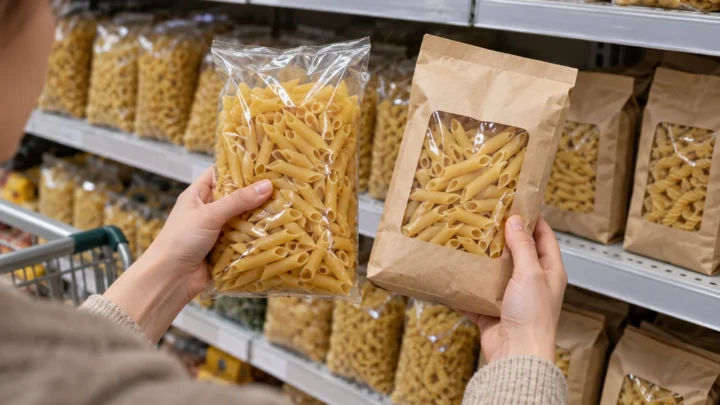
The easiest version of the 2026 packaging story is that large retailers and restaurant groups are moving from plastic to paper.
The evidence does not support a story that simple.
Records published or updated from April to October 2026 describe several different buyer responses, some of which occurred in earlier reporting years. Amazon pushed more automated fulfillment from plastic mailers toward paper. Walmart increased recycled content but still reported virgin plastic above its baseline. Pizza Hut redesigned a polypropylene food container rather than abandoning plastic. Starbucks lowered and reframed some of its packaging ambitions. Sainsbury’s missed an earlier plastic-reduction target and replaced it with a broader recyclability, recycled-content and EPR-oriented strategy.
That is more useful than a headline about one material “winning.”
Our reading of these selected cases is operational: buyers are balancing material choice with equipment, product protection, recovery systems and cost. This is an editorial interpretation of company records, not a representative buyer survey.
At Amazon, the change is happening on the packing line
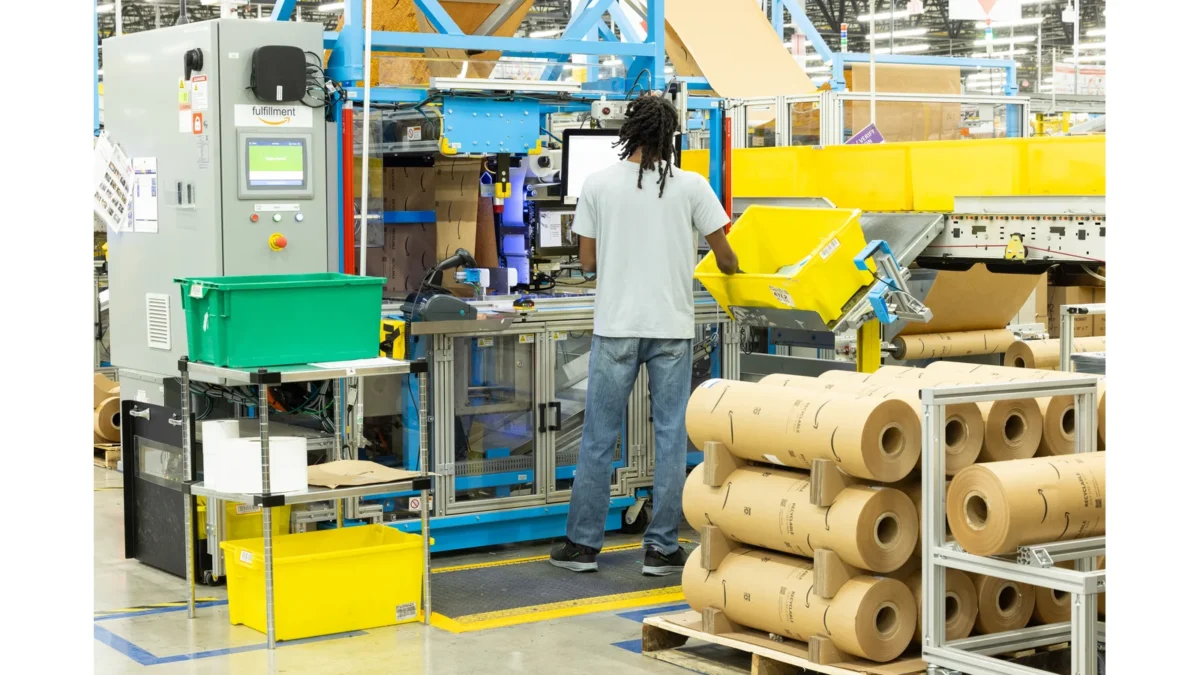
Amazon’s 2026 packaging update is unusually concrete because the change is tied to machinery.
In North America, automated machines that previously produced plastic bags are being retrofitted to make right-sized paper bags. Amazon said those changes helped avoid 288 million plastic bags in 2025, while the share of North American shipments containing single-use plastic delivery packaging fell from 37% in 2024 to 27% in 2025. [S1]
The next generation of the machine, described in August and September 2026, can handle larger items and is intended to increase the number of products eligible for paper packaging by about 20%. [S1]
This is not a packaging pledge waiting for a future date. It is a process conversion already moving through fulfillment operations.
It also shows why material substitution is rarely just a substrate decision. The paper had to survive automated forming, sealing, labeling and distribution. Amazon’s materials team described developing extensible paper with enough toughness to replace plastic in applications where ordinary kraft paper would fail. [S1]
The important market signal is therefore not simply “paper replacing plastic.”
It is:
paper substitution is scaling where the material and the packing equipment can be engineered as one system.
Walmart’s numbers are a useful antidote to tidy progress stories
Walmart’s FY 2026 reporting shows genuine movement and genuine friction in the same data set.
Estimated post-consumer recycled content in North American private-brand plastic packaging increased from 8.2% in FY 2025 to 12.0% in FY 2026. Globally, the estimate increased from 7.6% to 10.7%. [S2]
Within Walmart’s supplier-reported estimates, that is an increase of 3.8 percentage points in North America and 3.1 points globally. FY 2026 is Walmart’s fiscal reporting period, not a claim that all these purchases occurred in calendar 2026.
But other indicators did not move in the same direction.
Walmart reported that 64.3% of global private-brand packaging was recyclable, reusable or industrially compostable in FY 2026. Its reported private-brand virgin plastic packaging remained 4.12% above the FY 2021 baseline rather than achieving the company’s earlier reduction ambition. [S2]
The company itself says packaging decisions continue to balance waste reduction with product protection, food safety, cost, regulation, recycled-material availability, supplier capability and packaging technology. [S2]
That sentence is more informative than a perfect progress chart.
It shows a large retailer increasing PCR procurement without being able to convert every packaging metric into a simultaneous improvement.
Starbucks did something companies rarely celebrate: it rewrote the target
Starbucks’ July 2026 Impact Report deserves attention because the company changed the packaging goals it is now publishing.
Its earlier framework called for customer-facing packaging to be 100% reusable, recyclable or compostable by 2030, sourced from 50% recycled materials, and made using 50% less virgin fossil-fuel-derived material. [S4]
The current July 2026 statement retains a goal to design 100% of customer-facing packaging for reuse, recycling or composting by the end of 2030. It also sets a 5% reduction in virgin plastics in all packaging versus FY 2019 and 25% recycled content, dependent on availability. These are targets, not achieved outcomes. [S3]
This should not be reduced to a single “Starbucks cut its goal by X%” calculation. The wording and denominator changed: the older goals referred to customer-facing packaging and virgin fossil-fuel-derived sources, while the current wording refers more broadly to packaging, recycled content and virgin plastics.
But the direction is clear enough to report.
The published packaging ambition was recalibrated.
At the same time, Starbucks reported an operational reuse gain: reusable-cup use increased 77% when customers chose to sit and stay in its coffeehouses. It also kept the goal of designing 100% of customer-facing packaging to be reusable, recyclable or compostable by 2030. [S3]
The useful signal is not “retreat” or “progress” alone.
It is that a major foodservice buyer is separating a long-term circular-design ambition from lower near-term material targets that it considers more executable.
Pizza Hut’s reported packaging move was not a fiber conversion
At Pizza Hut U.S., the notable packaging change went in a different direction.
Yum!’s 2025 reporting, published in June 2026, says Pizza Hut U.S. introduced a redesigned wing bowl and describes it as recyclable. Its claim to be the first large U.S. quick-service restaurant to incorporate food-contact recycled PP is the company’s own statement, not an independently verified ranking. [S5]
The public APR interview description identifies removal of carbon black and inclusion of 10% recycled content. It discusses the project with Pizza Hut’s packaging manager; the description alone does not verify a complete monomaterial bill of materials. [S6]
The design won a 2026 Association of Plastic Recyclers award. [S6]
This matters because the project does not fit a “plastic out, fiber in” narrative.
The reported construction remains polypropylene. A monomaterial design, a sorting-compatible colorant and recycled content can improve a recovery pathway; none establishes that every bowl is locally accepted, actually recycled or independently food-contact validated. [S5] [S6]
Yum!’s 2026 reporting also says Habit Burger & Grill shifted selected plastic packaging to fiber-based formats. [S5]
Within one restaurant group, the direction therefore differs by application:
- some formats move toward fiber;
- another remains polypropylene but is redesigned for recyclability and recycled content.
That is closer to how packaging portfolios actually change.
Sainsbury’s changed the scorecard after missing the old one
Sainsbury’s 2026 reporting offers another useful case because it includes an explicit miss.
The retailer had aimed to reduce own-brand and branded primary plastic packaging by 50% by 2025.
Its 2025/26 disclosure says own-brand food plastic packaging had fallen by 9,536 tonnes, or 15.1%, from the 2018 baseline. General merchandise and clothing packaging was down 44% from its 2020 baseline. [S7]
Those are meaningful reductions.
They are also below the original 50% headline target.
During the year, Sainsbury’s refreshed its packaging strategy. The new long-term ambitions include:
- 100% recyclable or reusable packaging where material is available;
- 30% post-consumer recycled content in own-brand primary plastic packaging across food and general merchandise/clothing;
- 100% recycled or certified virgin paper and pulp packaging;
- continued reduction of unnecessary packaging and packaging weight.
The company explicitly linked the reset to recyclability, sustainability and UK EPR legislation. [S7]
That is a shift in management logic.
The earlier KPI was dominated by tonnes of plastic removed. The new framework pays more attention to what the remaining packaging is made from, whether it is recyclable and how it will perform under EPR rules.
Not every 2026 disclosure describes a 2026 physical change
This distinction is easy to lose in a current-trends article.
McDonald’s reported in May 2026 that it had substantially achieved 95.8% of its goal to source primary guest packaging from renewable, recycled or certified materials as of the end of 2025. [S8]
McDonald’s excludes non-structural packaging components from that measure and says some material is attributed using mass balance. The 95.8% sourcing metric does not mean 95.8% physically recycled content or an actual recycling rate. [S8]
That is useful evidence of where the portfolio stood.
It is not the same thing as a new packaging rollout between April and October 2026.
Similarly, an annual report published in 2026 may describe changes completed in 2025.
This tracker therefore separates:
disclosed in 2026 from physically changed in 2026.

What the portfolio changes have in common
Put the cases side by side and the material story fragments.
| Buyer | Reported change or target | Direction | Evidence status | What not to infer |
|---|---|---|---|---|
| Amazon | Automated plastic-bag systems converted toward made-to-fit paper; new machine generation expands eligible product range | Plastic → paper in selected fulfillment packaging | Company-reported rollout; 2025 outcome data | Paper can replace plastic in every application [S1] |
| Walmart | PCR share increased while virgin plastic remained above baseline and broader circular-packaging metric remained incomplete | More recycled content, mixed portfolio progress | Estimated fiscal-year portfolio data | All packaging metrics are improving together [S2] |
| Starbucks | 2030 packaging goals recalibrated; reuse still expanding | Target reset + reuse | Future goals and FY 2025 result, disclosed July 2026 | Simple like-for-like percentage rollback [S3] |
| Pizza Hut / Yum! | Wing bowl redesigned in PP with recycled content and recyclability focus; selected Habit formats moved to fiber | Application-specific material strategy | 2025 report published June 2026; April interview | QSRs are uniformly abandoning plastic [S5] |
| Sainsbury’s | Packaging strategy reset after missing 50% plastic-reduction target | Plastic tonnage KPI → recyclability, PCR, certified fiber and EPR | FY 2025/26 strategy and historical baselines | Earlier reduction target was achieved [S7] |
Selected company disclosures dated or updated April–October 2026. Reporting year, publication date and physical rollout date differ. Corporate targets, sorting-compatible design and reported outcomes are not independent evidence of realized recycling.
The common pattern in this selected set is not one material.
It is a method.
These records show major buyers making packaging decisions through several constraints at once:
- machine compatibility;
- product protection;
- food-contact performance;
- recycled-material availability;
- recyclability infrastructure;
- EPR and regulation;
- customer behavior;
- cost.
Paper is growing—but “paperization” is not the whole story
Amazon’s fulfillment changes and Habit’s selected fiber conversions support a real paper/fiber substitution trend.
But Pizza Hut’s recycled-PP bowl points the other way: an application can stay plastic because performance and foodservice operations favor that material, while the design is changed to improve sorting and circularity.
Walmart’s data add another layer. Increasing PCR content can be a larger near-term lever than replacing a package outright.
For packaging suppliers, this matters.
The opportunity is not simply to offer a paper version of every plastic SKU.
The opportunity is to solve the buyer’s actual constraint with a format that can survive operations, compliance and recovery.
Targets are becoming less useful unless buyers show the operating mechanism
Starbucks and Sainsbury’s both illustrate what happens when ambitious packaging goals meet material availability, infrastructure and regulation.
A revised target is not automatically evidence of failure.
Nor should it be presented as progress merely because the new target sounds more detailed.
The useful questions are:
- Did a package actually change?
- Did recycled content actually rise?
- Did reuse actually occur?
- Was a difficult-to-recycle component removed?
- Did the new target come with a procurement rule or design specification?
- Can the outcome be measured against a baseline?
Those questions make a corporate packaging announcement much easier to classify.
What the April–October disclosures show
The April–October 2026 period does not show one universal shift toward compostable, fiber or recyclable plastic packaging.
It shows portfolio engineering.
Amazon is redesigning material and machinery together to expand paper delivery packaging. Walmart is buying more recycled plastic while still showing gaps against broader plastic goals. Starbucks has retained a circular-design ambition but recalibrated recycled-content and virgin-plastic targets. Pizza Hut has made a polypropylene format more recycling-compatible rather than replacing it with fiber. Sainsbury’s has moved from a missed plastic-tonnage target toward a broader recyclability, recycled-content and EPR framework.
For the market, that is the more important signal.
These selected buyers show why a single material answer is insufficient: the packaging system must work with operations, regulation, recovery and cost. The cases do not measure how buyer interest has changed across the whole market.
Methodology and editorial note
Selected buyer records published or updated from April to October 2026 were compared with their actual fiscal/event periods and future goals. This is not a representative procurement survey or an independently audited account of each company’s performance. The older Starbucks report was checked through official indexed passages. The APR podcast’s public episode description was read; the audio was not independently transcribed. Supplier estimates, mass-balance scope and design-versus-recovery qualifications remain visible. Sources checked 19 October 2026. No supplier audit, factory inspection or independent market census was performed for this article.
The main image is an authentic Amazon press-library photograph, credited and preserved whole; it does not establish a rollout date. The in-body figure is an original selected-record synthesis.
Official sources and reference notes
- [S1] Amazon. How Amazon is improving packaging and boosting sustainability. 26 Aug / 9 Sep 2026. Scaling innovations; 2025 outcomes; 26 August update; paper-material story. Relevant original public record read; scope remains attributed. Accessed 19 October 2026.Paper-material engineering story.
- [S2] Walmart. Waste and Circularity. Current public record checked 19 October 2026. Packaging FY 2026 performance and methodology; PCR/private-brand scope. Relevant original public record read; scope remains attributed. Accessed 19 October 2026.
- [S3] Starbucks. Starbucks 2025 Impact Report: progress, investments and results across coffee, opportunity, community and environment. 1 July 2026. July 1 statement: highlights 11; sustainability goals 4–5 and availability condition. Relevant original public record read; scope remains attributed. Accessed 19 October 2026.
- [S4] Starbucks. Starbucks Fiscal 2024 Global Impact Report. Published 2025; p27 and appendix. 2024 report p27 Cups & Packaging; appendix recycled-content target. Official publisher-indexed p27 and appendix passages; direct PDF request blocked. Accessed 19 October 2026.
- [S5] Yum! Brands. Yum! Brands 2025 Global Citizenship & Sustainability Report. Published22 June 2026. 2025 report packaging discussion; June 2026 publication. Relevant original public record read; scope remains attributed. Accessed 19 October 2026.
- [S6] Association of Plastic Recyclers podcast. Episode 56: Inside Pizza Hut’s Award-Winning Recyclable Wing Bowl with Kat Smith. APR Recycled Content podcast,9 April 2026. Episode 56 public description; April 9 interview summary, no transcript audit. Public episode description read; no claim to have audited the audio or a transcript. Accessed 19 October 2026.
- [S7] J Sainsbury plc. Sainsbury’s SASB Disclosure 2025/26. 2025/26 reporting edition, published 2026. SASB 2025/26 Packaging Lifecycle Management; reductions and refreshed ambitions. Relevant original public record read; scope remains attributed. Accessed 19 October 2026.
- [S8] McDonald’s. Continuing to Scale Solutions aimed at Strengthening our Supply Chain and Creating Long Term Value. 19 May 2026. May 19 corporate disclosure; end-2025 primary-guest-packaging status. Relevant original public record read; scope remains attributed. Accessed 19 October 2026.
The public corrections channel is currently inactive. Read our corrections policy.