If every 2026 plant announcement were added together as “new supply,” the packaging market would look much larger than it really is.
That is the wrong way to read the April–October review window.
Between April and mid-October, some projects genuinely crossed the line into commercial operation. Others put steel in the ground. One molded-fiber technology moved from demonstration toward its first commercial-scale line, but that line is still scheduled years away. Elsewhere, packaging plants were marked for closure. A major packaging company changed owners in a USD 10.3 billion transaction without creating a single new tonne of industry capacity.
The useful story is not the sum of the headlines.
It is the change in status.
This tracker follows the capacity due-diligence framework: operational, ramping, groundbreaking, ordered, planned closure and acquired describe different events. This is a selected evidence ledger, not a complete global investment census or a sustainability-performance ranking.
The April–October status ledger
| Company / project | Market | What changed | Capacity / investment | Status at cutoff | Editorial read |
|---|---|---|---|---|---|
| NatureWorks — Nakhon Sawan | Thailand / PLA | Integrated PLA plant opened and entered full commercial operations on 29 Apr | Approx. 75,000 t/y stated nameplate capacity | Commercial operations reported | Real new upstream biopolymer capacity; not equal to 75,000 t/y immediate sold packaging output [S1] |
| Mondi — Pittsburgh | United States / paper bags | New paper-bag plant officially opened on 22 Apr | Annual tonnage not publicly disclosed in the reviewed release | Opening reported22 Apr; consolidation | New/consolidated converting site; net capacity addition is not quantified [S2] |
| International Paper — Rankin County | United States / corrugated packaging | Groundbreaking in May for a new greenfield box plant | USD 225 m; 468,000 sq ft | Groundbreaking reported; build schedule announced | May groundbreaking; construction was scheduled for June and operations for Q4 2027. Later physical progress not verified [S3] |
| International Paper — Riverdale | United States / containerboard | Machine conversion completed; production still ramping | Public filing reviewed here does not provide a clean incremental tonnage figure | Ramp expectation in Q2 filing; later progress unverified | Installed capability is ahead of full operating output; full operating capacity was expected in Q1 2027 [S4] |
| Metsä Group / Valmet — 3 D Fiber | Finland / molded fiber | First commercial-scale 3 D Fiber line ordered | >100 m products/year stated nominal capacity; tonnage undisclosed | Ordered / future | Commercial-scale commitment, but startup is scheduled for 2028—not 2026 supply [S5] |
| PureCycle — packaging-grade recycled PP program | United States / recycled PP | Commercial resin deliveries and additional packaging qualifications advanced | No new plant-capacity figure created by these customer milestones | Commercial qualification / shipments | Existing capacity became more market-relevant as applications moved into commercial production and trials [S6] |
| International Paper — Carrollton South | United States / corrugated converting | Closure announced in July | Facility tonnage not disclosed in the reviewed announcement | 16 Jul closure announcement; Q3 target, completion unverified | A node was marked for removal; completion by the announced target was not established [S7] |
| Sealed Air / CD&R | Global / food & protective packaging | Acquisition completed on 9 Apr | USD 10.3 bn enterprise value | Ownership changed | Major consolidation event; not new physical industry capacity [S8] |
Selected records published1 April–19 October 2026; each status is the last specifically reviewed issuer record, not a site audit at the cutoff. Startup targets are forecasts; missing output and tonnage stay missing. No rows are summed. [S1] [S2] [S3] [S4] [S5] [S6] [S7] [S8]
First, count the projects that stopped being promises
The cleanest capacity event in this period was the new PLA site in Nakhon Sawan, Thailand.
NatureWorks opened the integrated facility on 29 April and described the site as beginning full commercial operations. The stated annual production capacity is approximately 75,000 metric tonnes of PLA. [S1]
That crosses several gates at once:
built → commissioned → commercial operation.
It is therefore reasonable to count the site as new available manufacturing capacity.
It is not reasonable to assume that all 75,000 tonnes instantly became packaging sales.
The plant produces multiple PLA grades for packaging and non-packaging applications. Customer mix, utilization, grade mix and qualification still determine how much of the nameplate figure becomes packaging output in a given year.
That distinction sounds cautious, but it is exactly what capacity analysis is supposed to do.
A plant can be real even when the annual tonnage is not public
Mondi’s Pittsburgh paper-bag facility is a good example of another common data problem.
Mondi reported the Pittsburgh site opening on22 April. It combines production previously located at Wellsburg, West Virginia, and Oakdale, Pennsylvania, alongside automated technology. That is a real operational change, but it does not establish how much net industry capacity was added. [S2]
But the public opening announcement reviewed for this tracker did not provide a clean annual tonnage or unit-capacity figure.
So the tracker leaves the capacity field undisclosed.
This is preferable to reverse-engineering production from floor area, machine count or marketing language.
“Operational, capacity undisclosed” is a valid market-intelligence conclusion.
Groundbreaking is progress, not proof of operating capacity
International Paper’s Rankin County project in Mississippi sits at a different point on the ladder.
The company broke ground in May on a 468,000-square-foot greenfield corrugated packaging plant. The disclosed investment is USD 225 million. Construction was expected to begin in June, with operations anticipated in the fourth quarter of 2027.
That makes the project materially more advanced than an intention or site-selection announcement.
The company disclosed the investment and a groundbreaking event. Its anticipated construction and operating dates remain forecasts from that announcement.
But no 2026 analyst should count the future plant as 2026 operating supply.
The defensible status from the reviewed May record is: groundbreaking reported, with a construction/startup schedule announced. Physical progress as of19 October was not independently established.
groundbreaking and schedule reported; later physical progress unverified.
Then there is the awkward middle: the line works, but the ramp is not finished
Capacity trackers often struggle most with projects that are neither clearly “new” nor clearly “future.”
Riverdale is one of them.
International Paper disclosed that the conversion of its No. 16 paper machine from uncoated freesheet to containerboard had been completed. But it also said production would continue to ramp through the rest of 2026 and that full operating capacity was expected in the first quarter of 2027. [S4]
This is not a semantic detail.
For a buyer or market analyst, the difference between “machine conversion completed” and “full operating capacity” determines how much real supply should be assumed in the near term.
The capacity evidence ladder explains the distinction. Riverdale’s row records the Q2 filing’s ramp expectation; later progress was not confirmed by the reviewed record.
The most interesting fiber project of the period is not producing yet
In August, Metsä Group selected Valmet to supply a commercial-scale 3 D Fiber line for Äänekoski, Finland.
Valmet described the order as its first commercial-scale implementation, following pilot and demonstration work. Its release also states nominal capacity of more than 100 million products per year for the new line. That unit figure is not annual tonnage or achieved output. [S5]
That makes it an important commercialization signal for three-dimensional molded-fiber packaging.
But startup is scheduled for 2028.
So what changed in 2026?
Not market supply.
What changed was commitment to commercial-scale manufacturing.
That is a meaningful investment milestone, but it belongs in the “ordered / future” column rather than the “operational” column.
Sometimes the important capacity event is a customer qualification, not a new machine
PureCycle provides a different kind of example.
Its 2026 filings showed commercial resin deliveries beginning for selected consumer-packaging applications, additional products moving into commercial production, and recycled-polypropylene grades being shipped into trials for quick-service-restaurant cold cups. [S6]
No new packaging plant had to be announced for those events to matter.
The underlying point is that installed material capacity becomes more economically relevant when:
- a customer clears qualification;
- a converter can run the material;
- a package enters commercial production;
- repeat shipments begin.
For emerging recycled or bio-based materials, qualification can be as important to practical supply as the physical equipment.
Now subtract: investment headlines were accompanied by closures
Capacity trackers become promotional if they only record additions.
In July, International Paper announced the closure of its Carrollton South packaging facility in Texas by the end of the third quarter as part of a broader effort to align its manufacturing footprint with demand. [S7]
The public announcement reviewed here did not provide a comparable tonnage number for the site.
That prevents a clean arithmetic netting against the new Mississippi plant.
But it still changes the network.
One site has a reported development schedule while another was marked for closure. Neither a scheduled build nor a closure target establishes its completed status at the cutoff.
That is common in mature packaging markets: companies invest in larger, more automated or better-located facilities while consolidating older nodes.
“New investment” therefore does not automatically mean “industry overcapacity.”
A USD 10.3 billion packaging deal added exactly zero tonnes by itself
The biggest capital event in this tracker is also the easiest to misread.
On 9 April, Sealed Air completed its acquisition by CD&R. The transaction had an enterprise value of USD 10.3 billion. [S8]
That is a major packaging-industry consolidation event.
It changes ownership, governance and capital structure.
It does not, on closing day, create a new packaging plant.
No analyst should add the company’s existing production assets to “new 2026 capacity” because a financial buyer acquired them.
This is why investment value and physical capacity need separate columns.
Capex is not always convertible into tonnes
Graphic Packaging reported USD 223 million of capital spending in the first six months of 2026, with USD 145 million capitalized for adding capacity and improving process capabilities. [S9]
That is meaningful investment evidence.
But “adding capacity and improving process capabilities” is not a single new-plant tonnage figure.
The capital can support:
- higher throughput;
- better quality;
- automation;
- process debottlenecking;
- new product capability;
- incremental physical capacity.
A tracker should resist turning every dollar of capex into an estimated tonne.
If the issuer does not separate the effect, the data should remain as capital spending rather than be converted into fictional capacity.

What the April–October records show
The April–October period did not produce one simple capacity cycle.
It produced four different movements.
1. Real capacity came online
The companies reported the Thailand PLA plant and Pittsburgh paper-bag facility entering operation; Pittsburgh also consolidated existing production.
2. Future capacity became more credible
The Mississippi corrugated project recorded a groundbreaking and a construction timetable. The Finnish 3 D Fiber project moved from development history into a commercial-scale equipment order.
3. Existing capacity became more usable
Containerboard conversion continued ramping, while recycled-polypropylene grades moved through customer qualification and commercial use.
4. Capacity and ownership were rationalized
A converting facility was marked for closure, while one of the sector’s largest financial transactions changed ownership without adding physical output.
Those four movements should never be collapsed into one “capacity added” number.
The tracker’s confidence system
For future updates, Degradable Packaging should use a simple status discipline:
- Commercial operations reported: the issuer reports commercial production has begun; actual output is not independently established.
- Ramping: production is active but not yet at planned operating level.
- Groundbreaking reported; build schedule announced: physical project work is underway.
- Ordered / committed: commercial equipment or project commitment exists, but startup is future.
- Announced: stated intention without enough evidence of physical execution.
- Closure / conversion: capacity is being removed or shifted to another market.
- Ownership changed: M&A without automatic physical capacity addition.
- Delayed / unclear: timing or project status cannot be confirmed.
The point is not to make the tracker look more cautious.
The point is to make it more accurate.
Investment-tracker conclusion
The strongest packaging investment story of the April–October review window was not a giant total for “announced capacity.”
It was the movement of individual assets from one stage to another.
PLA capacity in Thailand became operational. A new U.S. paper-bag site opened while consolidating older sites. A large corrugated greenfield project broke ground. A containerboard conversion remained in ramp. A molded-fiber technology secured its first commercial-scale line but is still years from startup. Recycled-polypropylene capacity became more commercially relevant through qualification. A packaging plant was marked for closure. A USD 10.3 billion acquisition changed ownership rather than industry tonnage.
That is a more complicated story than an investment headline.
It is also the more useful one.
The market should count what changed in operating status—not simply what appeared in a press release.
Methodology and editorial note
This selected ledger covers issuer records dated1 April–19 October 2026. Inclusion follows the material/project cases in the commissioned brief, not an exhaustive or randomly sampled global census. Each row retains its latest specifically reviewed event date; targets and dated ramp expectations do not establish physical progress at the cutoff. Undisclosed tonnage and output remain missing. Acquisitions, consolidation and capex are not added into net capacity. Sources checked 19 October 2026. No supplier audit, factory inspection or independent market census was performed for this article.
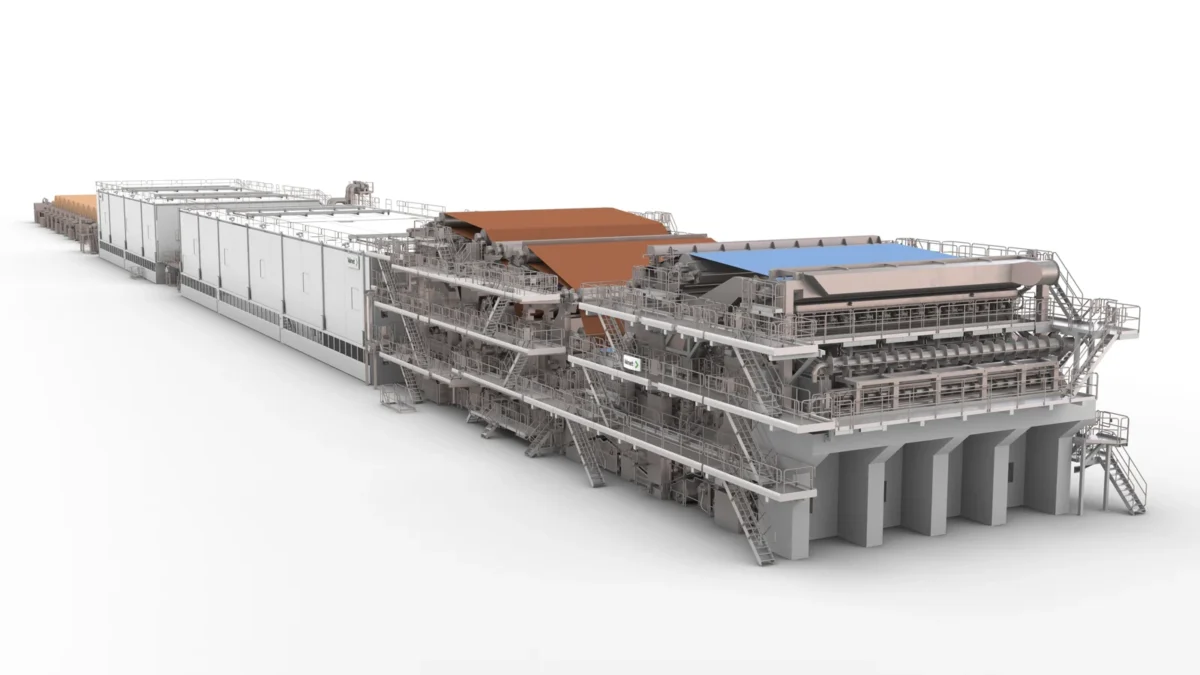
The main image is an official Valmet technology rendering used as credited editorial context, not a photograph or any tracked project site. The in-body figure is an original status synthesis.
Official sources and reference notes
- [S1] NatureWorks LLC. NatureWorks Announces Grand Opening of Fully Integrated Ingeo Biopolymer Manufacturing Facility in Thailand. 29 April 2026. 29 April opening; annual rated capacity and commercial-operation statement. Original public record; stated measure and scope only. Accessed 19 October 2026.
- [S2] Mondi. Mondi opens new paper bags plant in Pittsburgh, Pennsylvania, to support growing eCommerce and industrial customer demand. 22 April 2026. 22 April opening; Wellsburg/Oakdale consolidation and production scope. Original public record; stated measure and scope only. Accessed 19 October 2026.
- [S3] International Paper. International Paper Breaks Ground on New Sustainable Packaging Facility in Rankin County, Mississippi. 26 May 2026. 20 May event reported26 May; USD225m,468,000sqft, anticipated June build/Q4 2027 startup. Original public record; stated measure and scope only. Accessed 19 October 2026.
- [S4] International Paper. Form 10-Q for quarter ended 30 June 2026. Public reference checked 19 October 2026. MD&A, PS North America; Riverdale ramp expectation at Q2 filing. Relevant filing passages read through the public web reader; ordinary direct HTTP returned403. Company-reported, not independently audited. Accessed 19 October 2026.
- [S5] Valmet. Valmet delivers the first commercial-scale 3D Fiber line to Metsä Group, enabling high-quality molded fiber packaging production. 27 August 2026. 27 August order; more than 100m products/year nominal basis and 2028 startup target. Original public record; stated measure and scope only. Accessed 19 October 2026.
- [S6] PureCycle Technologies. PureCycle Q2 2026 commercialization. Public reference checked 19 October 2026. Q2 investor presentation, slides10–12; qualification versus shipments. Relevant filing passages read through the public web reader; ordinary direct HTTP returned403. Company-reported, not independently audited. Accessed 19 October 2026.
- [S7] International Paper. International Paper to Close Carrollton South, Texas Packaging Facility. 16 July 2026. 16 July announcement; closure targeted for end-Q3, not completion evidence. Original public record; stated measure and scope only. Accessed 19 October 2026.
- [S8] Sealed Air / transaction parties. Sealed Air acquisition by CD&R. Public reference checked 19 October 2026. 9 April completion exhibit; transaction enterprise value and ownership change. Relevant filing passages read through the public web reader; ordinary direct HTTP returned403. Company-reported, not independently audited. Accessed 19 October 2026.
- [S9] Graphic Packaging Holding Company. Form 10-Q for quarter ended 30 June 2026. Public reference checked 19 October 2026. MD&A, Financial Condition/Liquidity; capital spending223m, capitalized183m and capacity/process145m. Relevant filing passages read through the public web reader; ordinary direct HTTP returned403. Company-reported, not independently audited. Accessed 19 October 2026.
The public corrections channel is currently inactive. Read our corrections policy.