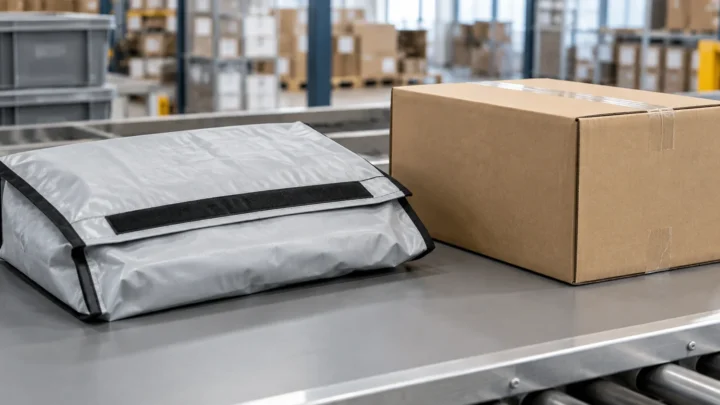
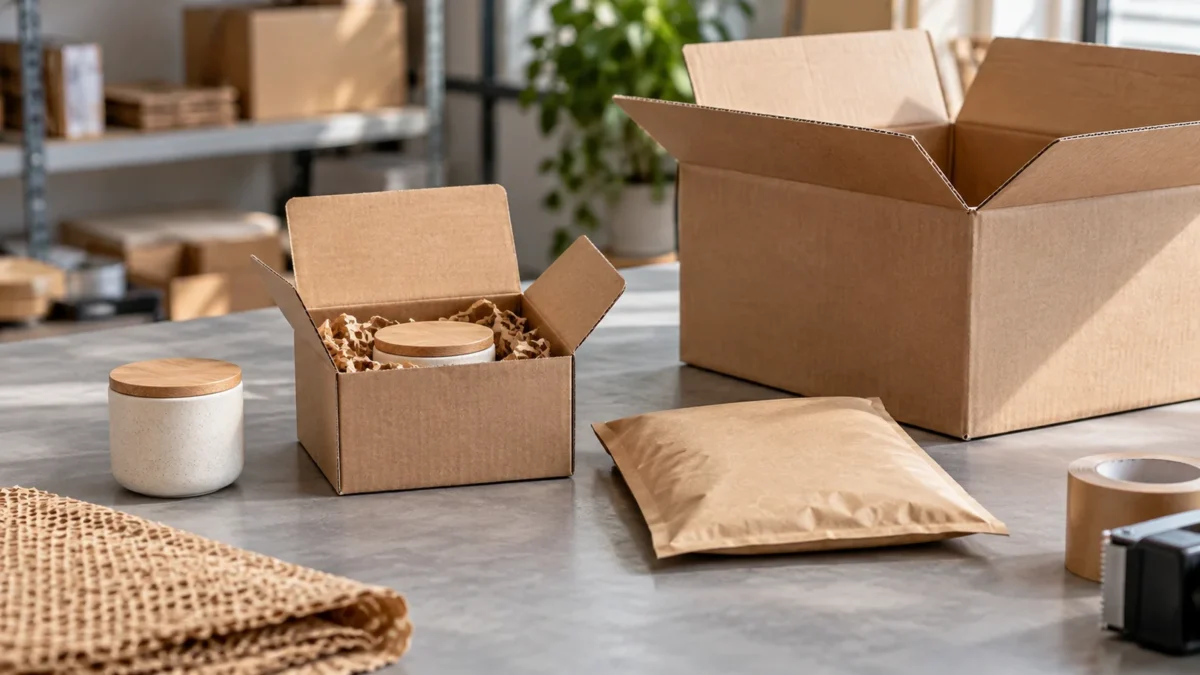
An e-commerce box can fail before anything inside it breaks.
If a small product is shipped in a large box, the package may use more corrugated board, more void fill, more warehouse space and more vehicle volume than the product actually requires. The shipper may also pay for dimensional weight rather than actual weight.
But shrinking every parcel to the exact outline of the product is not the answer either.
A fragile electronic device still needs clearance for cushioning. A bottle needs protection from side impact and leakage. Several products in one order may need separation. An irregular item may need a larger shape simply to survive automated handling.
Right-sizing is not the removal of empty space. It is the removal of unnecessary empty space while preserving the protection the distribution system actually requires.
Start with the air inside the parcel
Traditional fulfillment often begins with a fixed catalogue of box sizes. [S8]
The packer selects the closest suitable carton, places the order inside and fills the remaining volume with paper, air pillows or another cushioning material.
That system is operationally simple, but it can ship a large amount of unused cube.
The problem is not only visual.
| Excess-volume effect | Why it matters |
|---|---|
| More corrugated board | A larger box generally needs more sheet area. |
| More void fill | Unrestrained products may need dunnage to control movement. |
| Higher dimensional weight | Parcel carriers may price a low-density shipment by occupied volume rather than scale weight. |
| Lower vehicle cube efficiency | More parcel volume means fewer orders fit into a truck, van, cage or aircraft position. |
| More product movement | Extra clearance can increase internal movement if restraint is inadequate. |
| Larger storage footprint | Oversized cartons and dunnage also consume fulfillment-center space. |
This is why e-commerce packaging optimization increasingly starts with volume rather than material alone.
Dimensional weight turns empty space into a financial signal
Parcel pricing makes the cube visible. [S11]
FedEx defines dimensional weight as the amount of space a package occupies in relation to its actual weight and charges based on dimensional weight or actual weight, whichever is greater for the relevant shipment.
The exact divisor and rules vary by market and service, but the underlying mechanism is simple:
a large lightweight box can be billed as though it were heavier because it consumes scarce transport volume.
That gives right-sizing a direct commercial value.
Reducing package length, width or height can lower dimensional weight even if the product itself does not become lighter.
It can also reduce the amount of material needed to stabilize the order.
The best box size is not necessarily a box
One documented design change in e-commerce is to avoid defaulting every suitable order into rigid corrugated packaging. [S1] [S2]
Soft goods, books, clothing, accessories and many non-fragile products may not need a six-sided shipping box.
For suitable orders, paper bags and mailers can conform more closely to the product; whether they use less material or lower total impact depends on the compared designs and damage outcomes.
Amazon’s current packaging program illustrates the change at large scale.
The company says it has retrofitted automated packaging machines that formerly made plastic delivery bags so they can create made-to-fit paper bags. In North America, Amazon reports that this helped avoid 288 million plastic bags in 2025.
The company also reports that more than half of its 2025 shipments in North America and Europe used lightweight formats such as bags or envelopes.
The important shift is not “plastic bag to paper bag” by itself.
It is the combination of:
- choosing a flexible format only where the product can tolerate it;
- measuring the order;
- forming the package to suit that order;
- using less empty volume;
- keeping the package compatible with the target recycling route.

Made-to-fit paper bags remove one dimension of the box problem
A flexible paper bag does not need to preserve a rigid rectangular cavity around the product. [S2] [S6]
That makes it useful for products such as:
- apparel;
- textiles;
- books and media;
- some beauty products;
- small household items;
- sports accessories;
- other non-fragile consumer goods.
Amazon describes its automated paper-bag equipment as using product dimensions to create packaging closer to the item size. The company has also deployed paper-bag automation in Japan; its new Amagasaki fulfillment center, opened in August 2026, was announced with automated paper-bag packing equipment for products verified as suitable for that format.
That last condition matters.
Paper bags are not a universal substitute for boxes.
A sharp metal component can puncture a bag. A heavy item can stress the seal. A bottle may require more leak and impact protection. A fragile cosmetic jar may need cushioning and a rigid outer structure.
The format has to follow the damage mode.
Paper itself is being engineered for automated e-commerce duty
Standard kraft paper is not automatically suitable for high-speed delivery packaging. [S4]
In September 2026, Amazon described a stronger extensible paper developed for its packaging network. The company reported that the material was designed to stretch more than conventional kraft, resist puncture better and work in automated heat-sealed packaging.
That is a useful reminder about paperization.
A paper mailer is not simply a plastic mailer with a different material name.
Its puncture resistance, tear behavior, seal method, weather exposure and machine handling all need their own engineering.
When a bag is not enough, make the corrugated package fit the order
Products that need more protection can still benefit from right-sizing. [S2]
Automated fit-to-product systems measure the order and create a corrugated package around the required dimensions rather than selecting from a fixed box inventory.
Amazon describes one such system as producing on-demand, made-to-fit protective corrugated packages for items that need more protection than a non-padded bag.
The engineering opportunity is straightforward:
reduce unnecessary box length, width and height while keeping enough structural space for product protection.
That can reduce:
- corrugated area;
- void fill;
- shipment cube;
- dimensional weight exposure;
- warehouse storage of multiple box sizes.
But it also puts more responsibility on the measurement and packing system.
An incorrect product dimension, unexpected accessory, irregular geometry or unstable multi-item order can create a package that is too tight.
Multi-item orders are the hardest right-sizing problem
A single rectangular product is easy compared with five unrelated items. [S2] [S8]
An order containing a bottle, a book, a soft textile item and a small electronic accessory creates competing requirements.
The pack has to decide:
- which items can touch;
- which need separation;
- which orientation is stable;
- whether the bottle could leak;
- whether a heavy item can crush a light one;
- how much cushioning is needed;
- whether the order should be split.
This is why machine learning and packing algorithms are increasingly part of packaging design.
Amazon says its systems use machine learning to select efficient packaging and improve the fit of multi-item orders.
The algorithm is effectively making a packaging decision:
minimum practical package volume subject to a damage constraint.
The outer package can disappear completely
One right-sizing option is to avoid an additional fulfillment box altogether. [S1]
It is no additional delivery package.
Amazon’s Ships in Product Packaging program certifies products that can move through its fulfillment and parcel network in the manufacturer’s own package with only a shipping label or other minimal preparation.
In its 2025 sustainability reporting, Amazon said:
- 11% of global packages shipped without additional Amazon packaging;
- 28 million unique products were certified for the program globally;
- 7.9 billion packages had shipped in North America and Europe without additional Amazon packaging since 2020.
These are company-reported program metrics, not an industry-wide e-commerce adoption rate.
They demonstrate a large company-reported program for removing additional delivery packaging when the product package qualifies; they do not establish an industry-wide rate or an independent impact result.
“Ships in product packaging” changes the design brief upstream
A retail package designed only for shelf presentation may not be ready for parcel delivery. [S9]
If it is expected to ship without overboxing, it may need to survive:
- conveyors;
- manual handling;
- drops;
- random vibration;
- compression;
- label application;
- weather exposure;
- direct consumer delivery.
That can move packaging work upstream to the brand or product manufacturer.
The result can be a stronger primary or secondary product package that eliminates a second shipping box.
But there is a trade-off.
Strengthening the product package may add material to that package.
The correct comparison is therefore:
strengthened ship-ready product package versus product package plus fulfillment overbox plus void fill.
Product protection is the hard limit on right-sizing
Right-sizing becomes counterproductive if the damage rate rises. [S8] [S9]
A box can be made smaller until:
- cushioning clearance disappears;
- a product contacts the outer wall;
- a corner becomes vulnerable;
- several products strike each other;
- fragile surfaces lose isolation;
- liquids are no longer adequately contained.
That is why packaging optimization has to include distribution testing.
ISTA’s current e-commerce test portfolio distinguishes between products shipped in their own container and products placed in an overbox. Its 6-Amazon.com Over Boxing procedure was updated in 2026 to reflect current supply-chain practices, while SIOC testing evaluates packaged products intended to move without additional fulfillment packaging.
The two modes are different because the protective system is different.
A smaller package has less room to absorb a mistake
Oversized packaging is inefficient, but it can hide poor design by providing more space for cushioning. [S8]
Right-sized packaging removes that excess margin.
That makes engineering precision more important.
The package designer has to know:
- the product’s damage tolerance;
- the drop environment;
- the vibration environment;
- how much compression the parcel may see;
- whether humidity affects the cushioning;
- how the product is oriented;
- which faces are most vulnerable.
A right-sized package is therefore not necessarily a simpler package.
It can be a more precisely engineered one.
Void fill is sometimes necessary—but PPWR will treat it as empty space
Europe is turning this engineering discussion into a future legal measurement problem. [S13] [S14]
Article 24 of the Packaging and Packaging Waste Regulation requires that, by 1 January 2030 or three years after the relevant implementing acts enter into force, whichever is later, grouped, transport and e-commerce packaging meet a maximum empty-space ratio of 50%.
The Commission must establish the calculation methodology by 12 February 2028.
The Regulation also states that filling material such as paper cuttings, air cushions, bubble wrap, foam and similar materials is counted as empty space for this calculation.
That is significant.
Adding void fill does not legally convert an oversized e-commerce box into a “full” box for the future PPWR calculation.
At the same time, the law requires the methodology to consider cases where extra space is necessary for product protection, including irregular, fragile, liquid or multi-product shipments.
So the direction is clear:
reduce avoidable space, but keep justified protective space.
A 50% future ceiling is not a 2026 box-design formula
This boundary needs to remain explicit. [S13] [S14]
As of October 2026, the Commission has not yet adopted the final implementing methodology required for Article 24.
The future 50% rule should therefore not be translated into a current design instruction such as:
“all e-commerce boxes can be 50% empty.”
Nor does it mean 50% is the engineering target.
A good fit-to-product pack may operate far below that level.
The legal threshold is a future maximum under a methodology that still has to be finalized.
Right-sizing can move material from the box into the product package
There is another system boundary. [S9]
If an e-commerce program removes the outer shipping box, the manufacturer may redesign the retail pack to survive parcel distribution.
That could require:
- stronger corrugated board;
- better corner protection;
- more secure closure;
- stronger seals;
- internal fiber inserts;
- tamper evidence;
- weather resistance.
That may still reduce total packaging.
But the reduction should be measured across the entire delivered package system, not only by counting the fulfillment-center carton that disappeared.
The damage-return problem belongs in the calculation
Reducing packaging material while increasing damaged deliveries can create a false optimization. [S8]
A damaged item may trigger:
- replacement product;
- return transport;
- additional packaging;
- warehouse handling;
- write-off or refurbishment;
- customer dissatisfaction.
The appropriate metric is therefore not:
grams of corrugated per shipment.
It is closer to:
packaging required per successfully delivered, undamaged order.
That is why SIPP certification, distribution testing and damage data are more useful than a photo of a small box.
The empty-air audit
| Question | Design implication |
|---|---|
| Can the product ship in its own packaging? | If yes, test/certify the product package before adding another delivery pack. |
| Does the product need a rigid outer structure? | If no, evaluate paper bag or mailer formats. |
| What is the minimum protective clearance? | Keep only the space required for cushioning, separation and handling. |
| Can the pack be made to fit on demand? | Use automated fit-to-product bag or corrugated systems where volume supports them. |
| Is the parcel billed by dimensional weight? | Reducing cube can have direct freight-cost value. |
| Will a smaller pack increase damage? | Validate with a distribution test representative of the actual route. |
| Is void fill solving protection—or hiding oversizing? | Remove avoidable volume before adding dunnage. |
| What is the total delivered-package system? | Include strengthened retail packaging, inserts and secondary materials in the comparison. |
The right-sized rule
E-commerce packaging is moving away from the assumption that every order needs a standard corrugated box plus enough dunnage to fill the gap. [S8] [S11] [S13] [S8] [S13]
The emerging hierarchy is more disciplined:
ship in product packaging where the product package can survive → use a flexible paper bag or mailer where rigid protection is unnecessary → create a fit-to-product corrugated pack where additional protection is required → use void fill only for justified protective space.
That sequence reduces empty air without pretending that air is always waste.
Sometimes the empty space is a design failure.
Sometimes it is the crush zone keeping a glass jar, electronic device or liquid product intact.
The job of right-sizing is knowing the difference.
Methodology and editorial note
This is an engineering and regulatory synthesis, not a package test or environmental life-cycle comparison. Amazon program results are attributed company reports; carrier rates vary by service and geography. Article 24 sets a future maximum while the implementing calculation method remains pending. Sources checked 20 October 2026. The main image is an AI-generated generic editorial illustration, not a named company or real facility.
Sources and reference notes
- [S1] Amazon. 2025 Sustainability Report. 2025 packaging program metrics; company reported. Accessed 20 October 2026.
- [S2] Amazon Sustainability. Packaging innovation. current operator approach and packaging program. Accessed 20 October 2026.
- [S4] Amazon. Meet the new paper replacing Amazon’s plastic packaging. 9 September 2026 operator description and internal test. Accessed 20 October 2026.
- [S6] Amazon Japan. Amazon launches new Amagasaki fulfillment center. 5 August 2026 facility and paper-bag equipment announcement. Accessed 20 October 2026.
- [S8] ISTA. Project 6-Amazon.com Over Boxing Overview 2026. 2026 procedure overview; overboxed parcel simulation. Accessed 20 October 2026.
- [S9] ISTA. Test Procedures. SIOC and Over Boxing are distinct test configurations. Accessed 20 October 2026.
- [S11] FedEx. What is Dimensional Weight?. carrier-specific volume/weight billing principle. Accessed 20 October 2026.
- [S13] European Parliament and Council. Regulation (EU) 2025/40, Article 24. timing, 50% future maximum, filler rule and required methodology. Accessed 20 October 2026.
- [S14] European Commission. Guidance on Regulation (EU) 2025/40. 2026 Commission interpretation of Article 24. Accessed 20 October 2026.
The public corrections channel is currently inactive. Read our corrections policy.