A reusable e-commerce package does not become a reuse system when it leaves the warehouse. It becomes one only when the package comes back, is checked, prepared for another order and actually goes out again. That return trip is the design problem.
For a one-way box, the packaging engineer can largely stop at protection, packing speed, cube efficiency and end-of-life. A returnable mailer or box adds a second network on top of the outbound parcel network: collection, reverse transport, identification, inspection, cleaning or repair, storage and redistribution. If any of those steps fail often enough, a durable package can spend most of its life waiting in a cupboard, being lost from the pool or travelling farther than the products it was meant to protect.
The package is only half the system
The simplest reusable e-commerce loop has six stages: [S4] [S5]
- Outbound: the retailer packs and ships an order in a reusable mailer, box or protective container.
- Use: the customer opens the package without destroying its closure, label area or return feature.
- Return: the empty package goes back through a mailbox, store, drop-off point, courier hand-back or a product-return shipment.
- Recovery: the operator receives and identifies the asset.
- Reconditioning: the package is inspected and, where necessary, cleaned, repaired, relabelled or retired.
- Redistribution: it is positioned where the next order can use it without creating an excessive empty backhaul.
That loop explains why a returnable mailer is not simply a heavier poly mailer with a second adhesive strip. Its performance depends on the surrounding logistics system as much as on tear strength or nominal cycle life.
Four return paths—and four different friction points
| Return route | Where it can fit | Main advantage | Main system risk |
|---|---|---|---|
| Postal return | Foldable mailers, apparel, small consumer goods | Can use an existing postal network and familiar drop points | Long or centralised return distances can dominate the loop |
| Store or drop-off return | Omnichannel retail, cosmetics, apparel, urban networks | Can aggregate many empties at one node | Low convenience or a dedicated consumer trip can depress return performance |
| Courier hand-back or collection | Subscription, rental, scheduled delivery, dense local routes | Return can be paired with an existing delivery | A dedicated pickup for an empty package can add cost and transport |
| Merchandise-return integration | Fashion, rental, electronics accessories, repair and spare-parts flows | The same package can carry a returned product back | It only helps when a product return is already taking place |
The Singapore reusable e-commerce packaging pilot run by WWF-Singapore with logistics and retail partners is useful because it tested several of these frictions in practice. Across roughly 15,000 customer orders, one in three customers selected reusable packaging when offered the option, and the average package return rate across participating retailers was 56%. WWF-Singapore reported that reminders and consumer education shortened return time and improved return performance, while convenient drop-off routes mattered more to many participants than incentives alone. These are pilot results from one market, not a universal adoption rate. WWF-Singapore’s published pilot findings nevertheless show why the reverse channel has to be designed as carefully as the package. [S4] [S9]
Foldability is a logistics feature, not just a package feature
An empty returnable package should normally occupy much less space on the way back than it did on the way out. A mailer can fold flat. A rigid reusable box may collapse, nest or require a return flow that is dense enough to justify moving empty volume. That difference changes storage, parcel pricing, collection capacity and the number of empty units that can move together. [S8] [S9]
RePack is one long-running e-commerce example. European Commission CORDIS records describe its reusable-packaging-as-a-service project as combining reusable delivery packaging with a data and logistics platform for returning empty packaging. The project also reported trials and adoption by online retailers, while noting that large-scale adoption had not been reached during the funded project period. That distinction matters: a functioning pilot and a technically reusable package do not by themselves demonstrate a high-volume, high-return closed loop. The CORDIS project record is more useful here as evidence of the system design and commercialization effort than as proof of universal environmental superiority.
The physical design still has to survive repeated opening, closure, label removal or relabelling, abrasion, weather exposure and handling. A reusable mailer that is hard to fold, difficult to seal for the next trip or covered with old logistics labels will create labour or sorting problems even if the base textile or polymer could theoretically survive dozens of cycles.

Nominal durability is not achieved reuse
This is the most important accounting rule in reusable e-commerce packaging: [S4] [S5]
Do not count the number of trips a package could survive. Count the number of completed rotations the system actually achieves.
A supplier may design a package for 20, 40 or more trips. But a pool with high loss or low return rates may never approach that technical life. Packages can be kept by consumers, discarded, damaged, misrouted or stranded in the wrong warehouse.
The WWF-Singapore pilot’s feasibility model illustrates the gap. It estimated that a return rate in the range of roughly 75–83% would be needed to produce about four to six uses per package under its assumptions. The observed pilot average was lower, at 56%. The point is not that 75% is a universal threshold. It is that achieved return rate controls achieved rotations, and any environmental or economic model that substitutes design life for real rotations can make reuse look better than the operating system actually is.
Distance can reverse the result
Returnable packaging adds reverse transport. Whether that added movement is small or decisive depends on where the package has to go after the customer returns it. [S6] [S7]
A 2024 peer-reviewed life-cycle study in the Journal of Industrial Ecology compared two returnable-packaging systems in Canadian apparel e-commerce. In one case, a centrally managed returnable mailer had higher impacts than the expendable mailer in nine of ten assessed impact categories even when the reusable mailer was modelled at 40 cycles and the customer was in the same city as the brand owner; transportation distance was a major driver. In the second case, a returnable box used in a rental model and managed through a decentralised system performed better than the expendable corrugated box in six of ten categories under the study’s specific conditions. The authors concluded that total trip distance and number of reuses were primary drivers. Park, Waqar and Snyder’s open-access study is a strong warning against using cycle count alone.
A separate 2024 Journal of Cleaner Production study comparing eight European cases reached a related conclusion: material, return/reuse rate and supply-chain design—including centralised versus decentralised networks, travel distance and transport mode—were the main variables affecting the carbon footprint of the reusable systems studied. It also found that many of the analysed systems crossed the study’s carbon comparison point before reaching their maximum technical life, but the break-even point varied with the system. The study’s case-based carbon analysis therefore supports a conditional conclusion, not a blanket claim that reusable packaging always outperforms cardboard.
Route density is why subscription and rental can be different
Reuse becomes easier when the business already expects something to come back. [S7] [S10]
Rental apparel, equipment subscriptions, repair programs and some B2B spare-parts networks have a built-in reverse transaction. The consumer or business customer is already returning a garment, device, component or empty asset. The package can travel with that return instead of requiring a separate empty-package journey.
Subscription models can create another advantage: predictable addresses and recurring delivery intervals. If the next delivery can collect the previous empty package, the operator can reduce consumer effort and combine forward and reverse logistics. This is one reason reusable packaging is often easier to operate in dense, repeated loops than in one-off cross-border purchases.
That does not make subscription automatically better. A weak recovery rate, long depot distance or oversized durable container can still erase part of the benefit. The relevant question is whether the business model creates a return opportunity that already exists.
Tracking matters when packaging becomes an asset
A one-way corrugated box is normally an expense. A returnable shipper is closer to a circulating asset. Operators need to know how many units are in customers’ hands, in postal channels, at stores, at cleaning or inspection points, and ready for dispatch. [S8] [S9]
Tracking can be as simple as a scannable identifier tied to shipment records or as sophisticated as RFID or other connected hardware. The technology should match the value and operational risk of the pool. Low-cost mailers may not justify expensive electronics; higher-value reusable boxes used for electronics, medical devices or B2B parts may justify more active tracking.
The EU Packaging and Packaging Waste Regulation reinforces this distinction between an item that is merely durable and one operating inside a reuse system. Article 12 requires reusable packaging placed on the market from the applicable future date to carry a reusable-packaging label and, subject to the Regulation’s conditions and exceptions, a QR code or other standardised open digital data carrier providing reuse-system and collection-point information and facilitating tracking and calculation of trips and rotations. The start date is conditional: 12 February 2029 or 30 months after the relevant implementing act enters into force, whichever is later. Regulation (EU) 2025/40 should be checked again before publication or compliance decisions because implementing measures continue to develop.
The EU reuse target is not “40% of every e-commerce parcel”
Article 29 of the same Regulation is also relevant, but it is easy to overstate. From 1 January 2030, it sets a 40% reuse target for specified transport packaging and sales packaging used for transporting products within the Union, including products distributed via e-commerce. The listed scope includes boxes and flexible formats. [S2] [S3]
However, Article 29(4) contains exclusions, including packaging in the form of cardboard boxes. The Regulation also contains separate rules for particular intra-company and domestic business-to-business transport flows, plus other exemptions and implementing details. The correct editorial reading is therefore not “the EU requires 40% of all e-commerce packaging to be reusable by 2030.” The obligation depends on the packaging format, actor and transport context.
Where returnable e-commerce packaging is most plausible
| Application | Why reuse can fit | What can break the loop |
|---|---|---|
| Apparel | Soft goods tolerate foldable mailers; product returns are already common in many channels | One-off customers, long return distances, consumers keeping the mailer |
| Rental | The product must come back, giving the packaging a natural reverse trip | Damage, cleaning burden, poor packaging-to-product fit |
| Subscription products | Recurring delivery can enable hand-back on the next route | Low route density or irregular subscription behaviour |
| Cosmetics and personal care | Compact products and omnichannel store networks can support drop-off models | Leakage, contamination, premium presentation requirements, low return participation |
| Electronics accessories | Higher product value can justify durable protection and tracking | Need for cushioning, security, irregular consumer return |
| B2B spare parts | Known counterparties, repeat routes and existing return logistics can create a controlled loop | Asset imbalance between sites, long-distance repositioning, loss at customer locations |
Cleaning and inspection need a defined boundary
“Reusable” does not specify what happens between trips. For a dry apparel mailer, reconditioning may involve inspection, removal of labels and limited cleaning. A box carrying cosmetics may need a different protocol if leakage occurs. Electronics packaging may need inspection of cushioning, closures and tamper features. A returnable system should therefore define: [S4] [S6] [S7] [S6] [S7]
- what contamination is acceptable;
- when cleaning is required;
- what cleaning method is used;
- what damage can be repaired;
- when the package is retired;
- how retired units are managed at end of life.
These steps consume labour, transport, water, energy or replacement components to varying degrees. They should be inside the system boundary when a company compares reusable and one-way packaging. For non-food e-commerce, food-contact hygiene rules should not be imported into the analysis unless the actual application requires them.
The decision is operational before it is material
A returnable mailer can be made from a durable polymer, textile, board-based composite or another construction. That material choice matters, but the first decision should be operational: [S2] [S6] [S7]
- Who owns the package?
- How does the customer return it?
- Is the return free, prepaid, deposited or tied to the product return?
- How far does an empty unit travel?
- Can empties collapse or nest?
- Where are they inspected and reconditioned?
- How are lost units identified?
- What return rate is actually achieved?
- How many rotations occur before retirement?
- Does the network already have reverse logistics that the package can use?
If those questions do not have workable answers, switching from a one-way cardboard box to a durable mailer may simply replace a disposable package with an under-used asset. When the return route is convenient, dense and integrated with an existing customer or logistics loop, reuse becomes a system that can be measured rather than a durability claim printed on a bag.
Methodology and editorial note
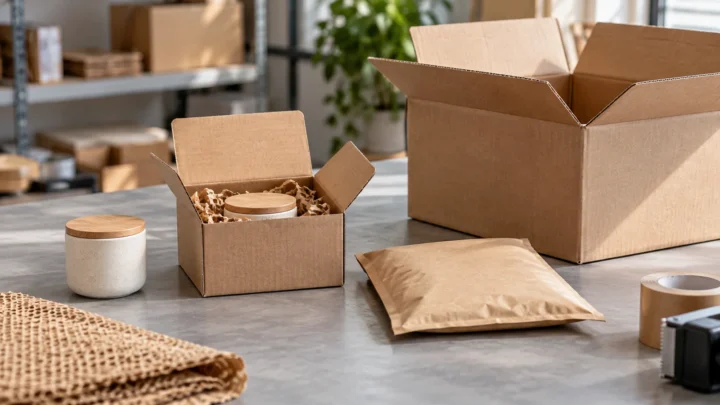
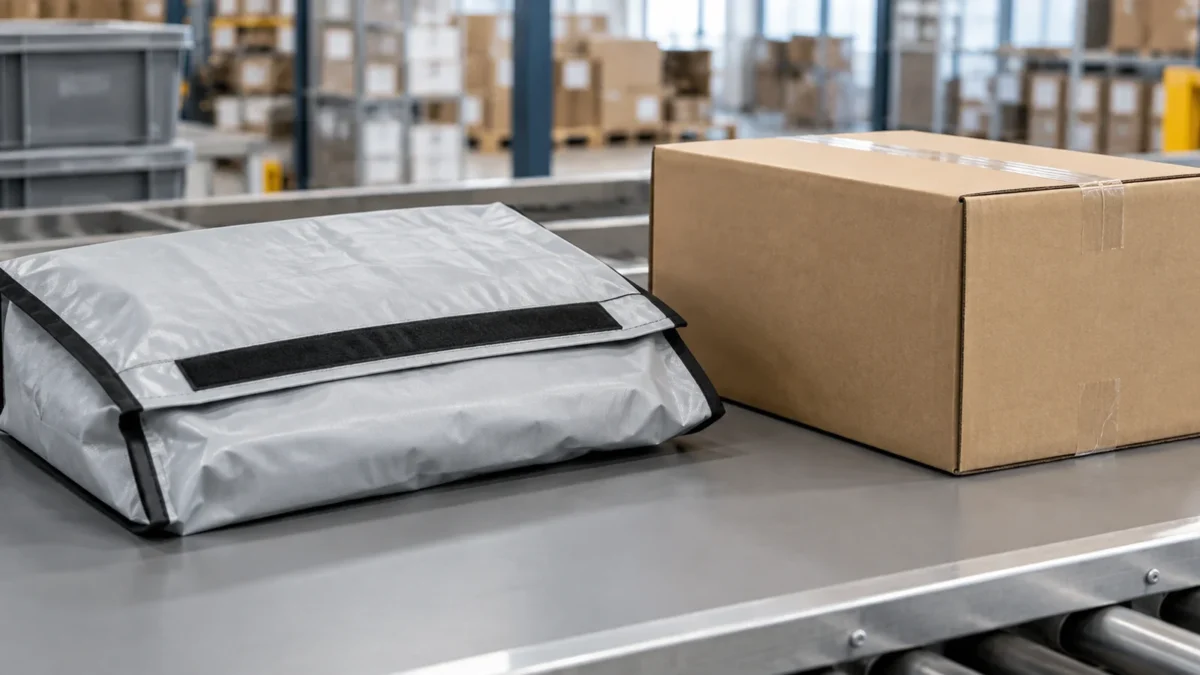
A comparison of documented e-commerce return pilots, two peer-reviewed life-cycle studies and the EU PPWR. Pilot return rates and modeled break-even points are specific to their populations and network designs; no package was tested for this article. Sources checked 21 October 2026. The main image is an AI-generated generic editorial illustration, not a named company, real facility or tested product. Editorial Team human review remains pending after publication.
Sources and reference notes
- [S2] European Parliament and Council. Regulation (EU) 2025/40 of 19 December 2024 on packaging and packaging waste. Article 12(2)–(3); Article 29(1)–(4); relevant definitions. Accessed 21 October 2026.
- [S3] European Commission. Commission Notice — Guidance document for Regulation (EU) 2025/40 on packaging and packaging waste. Section 14 labelling of existing reusable transport packaging; sections on Article 29 reuse targets. Accessed 21 October 2026.
- [S4] WWF-Singapore. WWF-Singapore’s pilot initiative shows consumers’ willingness to opt for reusable e-commerce packaging, with a return rate greater than 50 per cent. WWF-Singapore reusable e-commerce pilot. Accessed 21 October 2026.
- [S5] Pilot project consortium / WWF-Singapore program materials. Reusable E-commerce Packaging Pilot Report. WWF / reusable e-commerce pilot report. Accessed 21 October 2026.
- [S6] Park, Waqar & Snyder 2024. Environmental analysis of returnable packaging systems in different eCommerce business and packaging management models. Park, Waqar & Snyder 2024. Accessed 21 October 2026.
- [S7] González-Romero et al. 2024. Can reusable packaging revolutionise e-commerce? Unveiling the environmental impact through a comparative carbon footprint analysis. González-Romero et al. 2024. Accessed 21 October 2026.
- [S8] European Commission CORDIS. Reusable packaging as a service for e-commerce — project 881343 reporting. European Commission CORDIS / RePack project. Accessed 21 October 2026.
- [S9] RePack. Return / Returning. RePack return instructions. Accessed 21 October 2026.
- [S10] Ellen MacArthur Foundation. Reusable packaging business models. Ellen MacArthur Foundation reuse models. Accessed 21 October 2026.
The public corrections channel is currently inactive. Read our corrections policy.