A returnable pallet can survive dozens of trips and still be a bad reuse system if it spends half its life waiting behind a retailer, travels home empty over long distances, disappears from the pool, or arrives back faster than the inspection and repair operation can process it. The asset is only the visible part. The real product is the closed loop.
That is why returnable transport packaging should not be compared with one-way packaging using purchase price or theoretical durability alone. Totes, crates, pallets, sleeve packs, intermediate bulk containers and reusable dunnage have to move through a repeatable sequence: dispatch, use, empty accumulation, return, inspection, cleaning or repair, inventory and redeployment.
The system works when enough assets complete that loop, fast enough and in good enough condition, to avoid excessive replacement stock and empty repositioning.
Map the loop before buying the asset
| Stage | Operational question | Failure signal |
|---|---|---|
| 1. Deploy | Is the right tote, pallet, crate or dunnage available where the product is packed? | Emergency one-way packaging, production delay, excess safety stock |
| 2. Use | Does the asset protect the product and remain compatible with handling equipment? | Product damage, broken hinges, crushed feet, contamination |
| 3. Accumulate empties | Can empty assets be collapsed, nested or stacked efficiently? | Return vehicle fills with air; store/backroom congestion |
| 4. Return / backhaul | Is there a reliable vehicle, route and handoff for empties? | Long cycle time, stranded assets, one-way empty freight |
| 5. Inspect | Can damaged, contaminated or missing components be identified quickly? | Unserviceable assets re-enter the pool |
| 6. Wash / repair | What reconditioning is necessary before the next use? | Bottleneck, water/energy burden, repair backlog |
| 7. Reallocate | Can the pool balance supply against the next demand location? | Assets exist in the network but not where needed |
ISO 18603:2013 formalises the same systems perspective. The current edition—confirmed by ISO in 2024—sets requirements for classifying packaging as reusable and for assessing the associated reuse system. Reusability is therefore not established merely by making a container stronger. The packaging has to be designed for repeated use and exist within a system that enables those repeated uses. [S1] [S2]
See the current ISO 18603:2013 record.
Five metrics that should never be collapsed into “reuse rate”
Closed-loop packaging programmes often fail because different operating metrics are treated as synonyms. [S4] [S5]
- Return rate: the share of issued assets that come back.
- Cycle time: how long one outbound-use-return cycle takes.
- Turns per year: how many completed rotations an asset can achieve in a year.
- Lifetime rotations: how many successful trips the asset completes before retirement.
- Loss / damage rate: the share that disappears or becomes uneconomic to recover or repair.
A crate that completes 50 lifetime trips but takes 70 days to return may require a much larger pool than one with the same durability and a 14-day cycle. Likewise, a high return rate does not guarantee high utilisation if assets sit idle in the wrong location.
Research on returnable transport items has used RFID histories to estimate cycle-time and return-rate distributions precisely because the two variables drive different planning decisions. Inventory-control studies also show that uncertain returns and repairability create safety-stock requirements and determine when additional containers need to be purchased.
This turns asset visibility into a capacity issue, not merely an IT feature.
Tracking matters when the package has become an asset
GS1’s Global Returnable Asset Identifier (GRAI) is designed for reusable transport items such as pallets, crates and kegs. It can identify an asset by type and, where needed, individually. GS1 also describes GRAI-based systems that record asset ownership, location, movement and life-cycle history. [S2] [S3] [S6]
That does not mean every reusable crate needs an RFID tag. Barcode, QR, RFID or other identifiers can all be appropriate depending on scan frequency, automation and asset value. The key is to make the information useful to the loop:
- where was the asset last seen;
- how long has it been outside the pool;
- which customer or site has custody;
- how many rotations has it completed;
- is it due for inspection or repair;
- what fraction of a shipment failed to return?
GS1’s current GRAI guidance provides the identification layer. The operational value comes from linking that identifier to real custody and return events.

Pool ownership changes who solves the reverse-logistics problem
Returnable transport assets can be managed in several ways. A manufacturer may own a captive pool circulating between its own plants and suppliers. Trading partners may exchange standardised assets. A specialist pooler may retain ownership and rent or allocate crates or pallets across many users. [S8]
Those structures allocate risk differently. In a captive loop, the product manufacturer owns the assets and normally controls replenishment, repair and loss. In a pooling model, the provider may coordinate collection, inspection, cleaning, repair and redistribution across customers. A systematic review of pallet supply chains describes pooling as a closed-loop model in which the provider retains ownership and manages multiple life-cycle stages, while also noting the greater coordination complexity created by reverse logistics.
Pooling can improve network density and asset utilisation, but it does not eliminate the basic equations. Someone still has to recover the asset, move the empty, repair it and position it for the next demand point.
Foldability and nesting can be as important as durability
The return trip often carries little or no product. Empty logistics therefore matters disproportionately. [S4] [S5]
Reusable plastic crates used in fresh-produce systems are commonly designed to fold so that empty return volume is lower than the volume used during the loaded trip. Sleeve packs can collapse. Nestable totes can place multiple empty units in the space required by one or two deployed units. Pallets cannot collapse easily, so their pool depends more heavily on stacking efficiency and backhaul availability.
The design question is the empty-return cube:
How much transport and storage volume does one completed reuse cycle require when the asset is empty?
A durable package with poor empty-cube efficiency can generate additional reverse freight and warehouse congestion. Conversely, a collapsible design can reduce return transport but may add hinges, locking features and wear points that require inspection.
Washing is not automatically part of every transport-packaging loop
Food and other contamination-sensitive systems may require washing or sanitisation, while industrial dunnage, dry-part totes or pallets may need only inspection, debris removal or repair. The correct reconditioning step depends on what the asset carried and the next use. [S9]
A life-cycle study of reusable plastic crates used for fruit and vegetables modelled inspection, washing, sanitisation, breakage and final recycling using primary data from Italian pooling operations. Its scenarios showed that reconditioning can become a substantial share of life-cycle impacts as the number of uses rises. That does not argue against reuse; it shows why washing must be included rather than treated as an invisible service.
The same paper reported different operating scenarios in which either all crates or only part of the returning fleet were washed after inspection. Those are system-specific practices, not a universal hygiene rule for returnable transport packaging.
The study is available in Resources.
Repair can extend life—and also create a queue
Pallets, racks, totes and dunnage do not normally move directly from “usable” to “waste.” They often pass through a repairable state. A pallet may need a board or block replaced. A rack may need a bent component corrected. A tote can lose a hinge, latch or divider. Reusable dunnage may need foam, textile or molded components replaced before the carrier itself is retired. [S8]
This makes repair capacity part of pool size. If inspection identifies 1,000 damaged assets but the repair line clears only 200 before the next demand peak, the fleet effectively contains 800 unavailable assets. Closed-loop inventory models therefore treat inspection and repair timing together with uncertain return quantities.
The useful KPI is not simply “repairable.” It is repair turnaround time plus the percentage restored to service.
Loss is more damaging than wear because it removes the future rotations
An asset retired after many successful uses has delivered most of its intended service. An asset lost after its second trip has not. [S7]
Academic work on returnable transport items repeatedly identifies shrinkage or non-return as a central economic problem. Loss forces the operator to buy replacement assets while also reducing pool availability. Tracking systems can improve visibility and forecasting, but the root cause may also be contractual: unclear ownership, weak customer incentives, no deposit, informal exchange or assets leaving the intended network.
The correct planning metric is therefore not theoretical durability. It is achieved lifetime rotations after loss, damage and retirement are included.
Environmental break-even is a network result, not an asset property
Life-cycle studies of reusable crates reach different answers because their logistics assumptions differ. [S9] [S10] [S11]
A 2019 LCA of reusable plastic crates for fruit and vegetables found that the studied RPC system required only a small number of deliveries to outperform a lighter single-use alternative in that specific model, while manufacturing dominated at low use counts and washing/reconditioning became more important as rotations accumulated.
By contrast, a study comparing reusable HDPE crates with recyclable corrugated boxes for bread distribution found the corrugated system preferable across the impact categories it assessed under its defined routes and assumptions, with transport being a major driver.
More recent research continues to show the same boundary. A 2026 comparative LCA of reusable plastic-crate scenarios found that the result was strongly influenced by reverse-logistics distance and reuse frequency; its modeled reusable systems deteriorated when reuse cycles were too low or reverse transport too long.
These studies should not be averaged into one universal “break-even cycle.” They demonstrate why reuse performance belongs to the route, washing system, asset mass, return distance and achieved rotations of the actual network.
PPWR makes transport-packaging reuse a compliance question as well
The EU Packaging and Packaging Waste Regulation adds a legal driver to this engineering problem. From 1 January 2030, subject to the Regulation’s scope and implementation rules, Article 29(1) requires economic operators using specified transport packaging—or sales packaging used for transporting products within the Union—to ensure that at least 40% of those packaging uses in total are reusable packaging within a reuse system. The listed formats include pallets, foldable plastic boxes, boxes, trays, plastic crates, IBCs, pails, drums and canisters, as well as specified flexible transport formats. [S12] [S13] [S14]
However, the scope has important exceptions and stricter sub-rules. Article 29(2) requires reuse within a reuse system for listed packaging used between different sites of the same operator or between linked/partner enterprises. Article 29(3) applies a corresponding requirement to listed packaging used to deliver products to another economic operator within the same Member State.
Article 29(4) excludes several formats/uses from paragraphs 1–3, including dangerous-goods transport packaging, custom-designed packaging for specified large-scale machinery/equipment/commodities, certain direct-food/feed-contact flexible transport packaging, and cardboard boxes. Article 29(13) also creates a calendar-year exemption for economic operators that both meet the Regulation’s micro-enterprise definition and make no more than 1,000 kg of packaging available in the territory of a Member State during that year.
The Commission’s June 2026 guidance adds an important import boundary: for goods arriving from third countries, the transport-packaging reuse requirements apply after import/placing on the EU market, generally from the first EU warehouse onward where onward distribution occurs. Article 30 also requires a Commission implementing act on the calculation methodology by 30 June 2027, so operators should not invent their own compliance denominator before the final methodology is available.
There is also a 2026 update that should not be missed. Commission Delegated Decision (EU) 2026/429, which applies from 1 January 2030, exempts economic operators using pallet wrappings and straps from the 100% reuse requirements in Article 29(2) and (3). It does not create a blanket exemption from every reuse rule for every transport format.
See the current Commission PPWR Guidance and Delegated Decision (EU) 2026/429.
Closed loops are strongest where the return trip already exists
| Application | Why reuse can fit | Critical failure mode |
|---|---|---|
| Automotive parts | Repeat supplier–plant routes, high part value, engineered dunnage, frequent backhaul | Asset stranded at tier suppliers; model change makes dedicated dunnage obsolete |
| Grocery / fresh produce | High crate throughput, recurring retail/DC routes, foldable RPC pools | Washing bottleneck, store accumulation, uneven regional demand |
| Manufacturing components | Repeat lanes, defined part geometry, damage avoidance | Too many bespoke container types and poor empty consolidation |
| Pallet pooling | Standard footprint, broad network, repairable asset | Loss, quality variability, imbalance between demand locations |
| Bulk liquids / powders | Drums/IBCs can circulate where cleaning and product compatibility are controlled | Residual contamination, cleaning burden, hazardous-material restrictions |
| Low-frequency one-way export | Potential only if a pool or reverse lane exists at destination | Long empty return, customs/ownership complexity, low achieved rotations |
The cost equation starts after the purchase order
Comparing a €10 one-way pack with a €70 returnable tote tells almost nothing by itself. The returnable system should be evaluated on cost per successful service cycle, including: [S8] [S10] [S4] [S5] [S7]
- asset purchase or rental;
- pool size and safety stock;
- empty return freight;
- collection and handling;
- sorting / inspection;
- washing where required;
- repair and spare parts;
- tracking / software / scanning;
- loss and theft;
- retirement and end-of-life;
- avoided one-way packaging purchases and waste handling;
- product-damage differences where evidence exists.
The denominator must also be real: successful achieved cycles, not the design life printed in a specification.
A reusable package is a logistics system with a packaging asset inside it
The strongest returnable systems are not necessarily the ones with the toughest container. They are the ones where product flow and empty-asset flow reinforce one another: repeat lanes, high shipment frequency, short return distances, predictable custody, dense pickup networks and useful backhaul capacity. [S1] [S12]
That is why returnable transport packaging appears so often in automotive manufacturing, grocery distribution, industrial components and pallet/crate pools. These sectors can build a loop around an asset rather than simply hope the customer sends it back.
The design file should therefore end with four numbers: return rate, cycle time, achieved rotations and loss/damage rate. Add empty-return cube, reconditioning time and pool utilisation, and the operator can see whether the system is genuinely circular or merely owns a durable package.
Methodology and editorial note
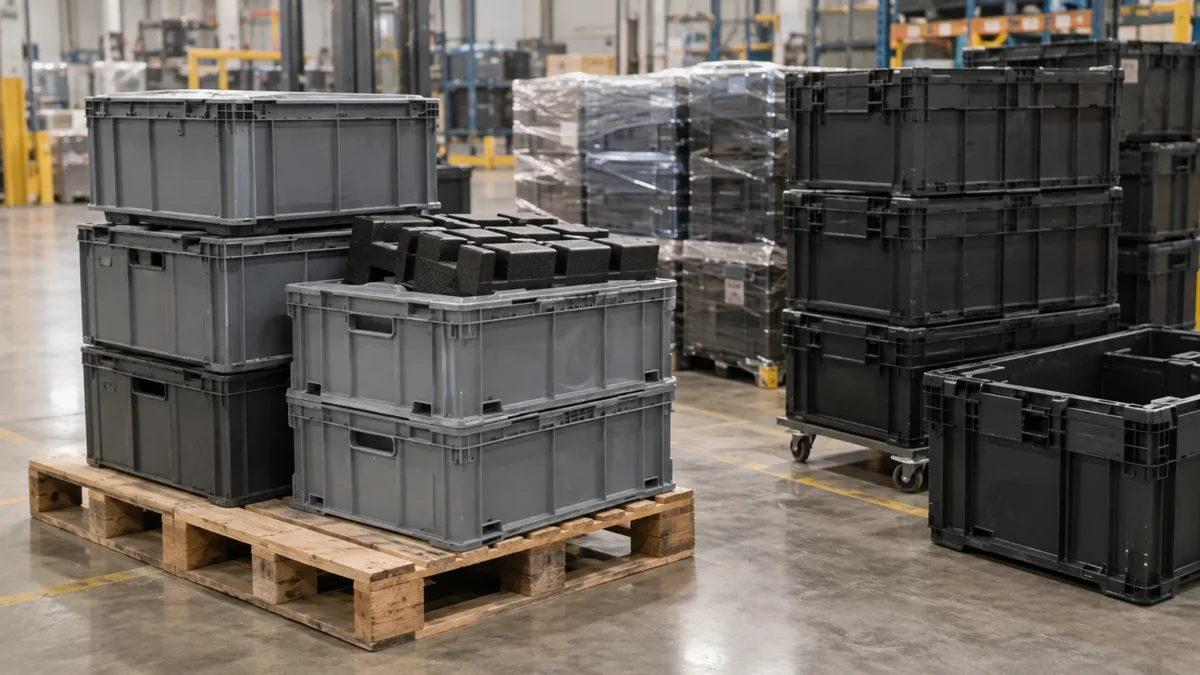
This compares published logistics and life-cycle studies with the EU PPWR. Legal obligations are scoped to the cited formats and exemptions; break-even results depend on the modelled routes, achieved rotations and reconditioning. Sources checked 21 October 2026. The main image is an AI-generated generic editorial illustration, not a named company, real facility or tested product. Editorial Team human review remains pending after publication.
Sources and reference notes
- [S1] International Organization for Standardization (ISO). ISO 18603:2013 — Packaging and the environment — Reuse. Official abstract / status record. Accessed 21 October 2026.
- [S2] GS1. Global Returnable Asset Identifier (GRAI). Application description. Accessed 21 October 2026.
- [S3] GS1. GS1 General Specifications / GS1 System Architecture Document. GRAI / RTI asset-management examples. Accessed 21 October 2026.
- [S4] Cycle time and return-rate estimation. Estimating cycle time and return rate distributions for returnable transport items. Abstract. Accessed 21 October 2026.
- [S5] RTI inventory control. Inventory control for returnable transport items in a closed-loop supply chain. Highlights; abstract. Accessed 21 October 2026.
- [S6] RFID in reusable-container closed loops. On the use of RFID in the management of reusable containers in closed-loop supply chains under stochastic container return quantities. Abstract / introduction. Accessed 21 October 2026.
- [S7] RTI loss-rate decision model. Optimal decisions in reducing loss rate of returnable transport items. Introduction / model scope. Accessed 21 October 2026.
- [S8] Pallet closed-loop review. Management and Logistics of Returnable Transport Items: A Review Analysis on the Pallet Supply Chain. Abstract; Sections 2 and 5–6. Accessed 21 October 2026.
- [S9] Reusable plastic crate LCA. Life Cycle Assessment of Reusable Plastic Crates (RPCs). Abstract; system description; reconditioning inventory. Accessed 21 October 2026.
- [S10] Reusable HDPE crate vs corrugated box LCA. Reusable plastic crate or recyclable cardboard box? A comparison of two delivery systems. Abstract. Accessed 21 October 2026.
- [S11] 2026 comparative LCA. A Comparative Life Cycle Assessment of Conventional and Reusable Packaging Systems Under Alternative Logistic Configurations. Abstract; sensitivity analysis; methods. Accessed 21 October 2026.
- [S12] European Union. Regulation (EU) 2025/40 on packaging and packaging waste. Article 29(1)–(4), (13); Article 30; Recitals 94–96. Accessed 21 October 2026.
- [S13] European Commission. Commission Notice — Guidance document for Regulation (EU) 2025/40 on packaging and packaging waste. Sections 18–21 on transport/sales packaging reuse targets and imports. Accessed 21 October 2026.
- [S14] European Commission / European Union. Commission Delegated Decision (EU) 2026/429 … exempting certain economic operators that use pallet wrappings and straps from the 100% reuse requirements. Recitals 1–5; Articles 1–2. Accessed 21 October 2026.
The public corrections channel is currently inactive. Read our corrections policy.