Reuse did expand in 2026.
But mostly in places where the return problem could be controlled.
Campuses added tracked containers. Two Danish cities launched a deposit-return network. Six competing Belgian supermarket chains agreed to use one standardized reusable tray. A California university reported a 95% return rate after adding financial incentives. Starbucks reported materially higher reusable-cup use in stores.
What is harder to find is evidence that open, everyday reuse has suddenly become the default across mainstream takeaway or grocery packaging.
That distinction matters.
In this selected set, reuse is advancing where operators can answer four questions. That is an editorial reading of documented cases, not a measured ranking of the fastest-growing systems.
Where does the package come back? Who tracks it? Who washes it? What happens if it never returns?
Copenhagen moved beyond a restaurant-by-restaurant pilot
In April, Copenhagen and Frederiksberg launched a city-wide reusable takeaway packaging return system with New Loop and Mastercard. [S1]
The operational detail is more important than the announcement.
Consumers can pay a deposit, return the reusable packaging through participating infrastructure and receive the deposit back through the payment system. The model is intended to make cups and takeaway containers interoperable across participating locations rather than locking the user into one café. [S1]
Our interpretation is that shared return points and deposit handling can reduce fragmentation. The launch itself does not establish that fragmentation caused a failure elsewhere or that this network has solved it.
The Danish project attempts to solve the network problem first.
It is still too early to treat the launch as proof of durable city-wide economics. The evidence available by the October cutoff establishes rollout, not long-run return rate, loss rate or profitability.
Belgium tested something even harder: competitors sharing the same tray
In Mechelen, six major supermarket chains—Albert Heijn, Aldi, Carrefour, Colruyt, Delhaize and Lidl—started a six-month reusable mushroom-tray pilot in April. [S3] [S3b]
The tray is standardized across participating retailers. Consumers pay a €0.30 deposit and can return the package to any participating chain. Each tray carries a unique QR code so the system can measure return behavior, circulation time and logistics performance. [S3]
The trial matters because reusable packaging in grocery retail has a coordination problem that a single-brand pilot does not.
Growers, packers, retailers, washing operations, logistics providers and consumers all have to accept the same package and the same circulation rules.
By coordinating six competitors into one shared system, the Belgian pilot is testing whether standardization can reduce that friction.
But it is still a pilot.
The system was designed to generate the return, logistics and economic data needed for a later scaling decision. It should not be reported as if reusable fresh-produce packaging had already become standard across Belgian retail.
Helsinki showed the other common 2026 pattern: test first, economics later
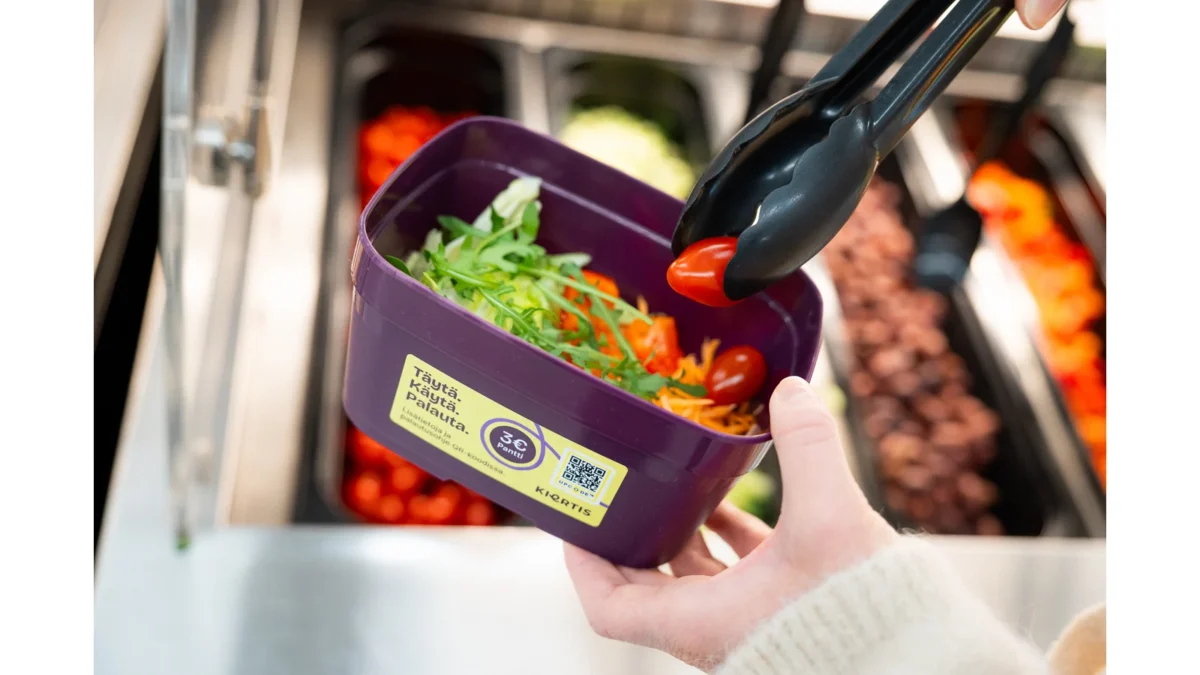
Kesko’s 7 April report describes a Kiertis pilot that had begun in early March at four stores in Espoo, in the Helsinki region. Containers were available until the end of May, with returns accepted until 28 June. This is an April disclosure about a spring trial, not a new April launch or evidence that the pilot was still running in October. [S2]
The project explicitly set out to evaluate three things: [S2]
- whether customers would choose the reusable container;
- whether the return system could work cost-efficiently;
- what environmental impacts the system would produce.
That language is useful because it does not assume the answer.
A pilot demonstrates trial use. It does not by itself establish recurring adoption at viable scale.
It becomes commercially interesting when the operator can show enough returns, enough cycles and enough volume to justify washing and reverse logistics.
Campuses provide a more controlled test bed
The U.S. cases reviewed here concentrate on university campuses, which place users, meals, return points and washing in a bounded geography. This sample does not establish that campuses accounted for the most U.S. reuse expansion.
That is not accidental.
Campuses concentrate meals, users, return stations and commercial dishwashing inside a relatively small geography.
CU Boulder launched reusable stainless-steel takeout containers in August at participating dining locations. Users scan the package, return it within three days and face late or replacement charges if it does not come back. [S4]
Lafayette College replaced its older carabiner exchange system with a digitally tracked ReusePass program in August. Containers are checked out against a student account and a USD 5 charge applies if the package is not returned within three days. [S5]
USC launched its Choose to Reuse program in fall 2026 and applied a USD 2.50 charge to disposable to-go containers for eligible residential dining users who did not choose the reusable option. [S6]
Different campuses used different mechanisms, but the commercial logic was similar:
make return convenient, identify the borrower and put a price on non-return or single-use behavior.
UC Riverside supplied the number most reuse pilots usually omit
UC Riverside expanded reusable meal containers to its HUB food court in September after earlier testing at other dining locations. [S7]
Its dining department disclosed two particularly useful operating results from testing:
about half of customers chose the reusable option, and approximately 95% of containers were returned when financial incentives were in place. [S7]
UCR reports a USD 1 disposable-container charge, five days to return a borrowed container before a USD 5 charge, and a refund if it is returned within 30 days. Its test account supplies no sample denominator or full observation period; the 95% figure is not an audited long-run rate after the September expansion. [S7]
This is stronger evidence than a launch announcement because it reports both participation and return.
It illustrates the distinction in our analysis of the economics of return, washing and loss rates: high returns help, but washing, loss, throughput and financing still determine the actual system balance.
The reusable container is only an asset if the system gets it back.
Pittsburgh shows that convenience can matter as much as deposits
The University of Pittsburgh expanded its USEFULL reusable-container program across additional campus retail locations in fall 2026. [S8]
The university reported that checkouts increased 227% between January 2025 and January 2026 and that the system had recorded more than 17,600 checkouts in total by September. [S8]
Pitt describes a fee-free borrowing model, not an assurance that late or lost containers can never incur a charge. Its 17,600-plus figure counts checkout transactions, not distinct people or a measured return rate. [S8] [S8b]
Pitt’s own history is informative. An earlier reusable-container program launched in 2016 initially charged users USD 5 to participate and struggled with adoption. The fee was later removed, and participation improved. [S8b]
That does not mean “fees are bad.”
UC Riverside uses charges to protect return rates. Pitt’s account suggests an upfront participation fee may have been a barrier; it does not isolate the fee’s causal effect from other program changes.
The difference is between charging for access and charging for failure to return.
Starbucks produced a large-scale usage signal—but it is not a six-month rollout metric
Starbucks’ July 2026 Impact Report said reusable cup use in coffeehouses increased 77% in fiscal 2025 when customers chose to sit and stay. [S9]
Its data tables reported 4.6% of beverages sold in reusable cups at global company-operated coffeehouses in FY 2025, compared with 2.6% in FY 2024. [S9b]
That is a meaningful scale signal from a large foodservice network.
But the observation period is fiscal 2025, not April–October 2026.
It belongs in this article as newly disclosed operating context, not as a physical 2026 rollout event.
The distinction matters because current publication date and observation date are not the same thing.
Which systems still lack scale evidence?
The six-month evidence is much stronger for launches and expansions than for documented shutdowns.
That does not mean every reuse system succeeded.
It means a responsible 2026 tracker should not manufacture a “retreat” category simply because the article title asks for one.
The evidence gap is visible in the project objectives, but missing results are not proof of stalling. The Belgian project is evaluating scale conditions; Helsinki’s published account describes a time-limited trial; Copenhagen’s launch release does not supply mature unit economics.
For these cases, the next useful evidence is the achieved number of uses, return timing, losses, washing and logistics cost. Controlled campus operation does not establish that an open merchant network will achieve the same results.
In other words:
many 2026 reuse systems advanced from concept to operation, but fewer advanced from operation to proven scalable economics.
There are retreat precedents—but they sit outside the six-month window
Two recent examples are useful context precisely because they are not counted as 2026 events.
Loop Japan ended its domestic reusable-packaging business in 2025. PepsiCo also sunset its former goal of delivering 20% of beverage servings through reusable models by 2030 in 2025, while continuing to track reuse inside a broader packaging strategy. [S12] [S13]
Neither belongs in the April–October 2026 event count.
A closed national business and a withdrawn corporate target are different forms of retreat. Neither source, by itself, establishes one common cause or proves that all reuse activity stopped.
The regulation signal strengthened even while business models remained unsettled
EU PPWR implementation added pressure in 2026.
The Commission’s August application announcement identifies reuse measures among the PPWR provisions scheduled from 2030. That gives operators a reason to prepare systems, while the covered formats, actor-specific duties and exceptions still require provision-level checks. [S10]
The Commission’s current implementation overview also identifies an exemption concerning pallet wrappings and straps from 100% transport-packaging reuse targets. Regulatory pressure is therefore not one universal reuse mandate. [S10b]
The important market implication is not that Europe suddenly has mature reuse infrastructure.
It is that operators now have a regulatory reason to build systems before 2030.
That is one plausible context for these pilots focused on deposits, shared packaging, tracking and reverse logistics rather than simply launching another “reusable” package.

What expanded, what remained unproven
| System | What changed | Operating model | Evidence at cutoff | What remains unknown |
|---|---|---|---|---|
| Copenhagen / Frederiksberg | City-wide return system launched | Deposit + interoperable return + digital refund | Operational launch | Mature return/loss economics [S1] |
| Mechelen, Belgium | Six retailers began shared reusable-tray pilot | €0.30 deposit + cross-retailer return + QR tracking | Large real-world pilot | Final return rate and scale economics [S3] |
| Helsinki region | Early-March trial described in April; store availability ended May | Deposit/return pilot | Time-limited spring pilot; later economics not established | Cost-efficient scaling [S2] |
| UC Riverside | Expanded to major campus food court | Tracked container + disposable fee + non-return charge | ~50% chose reuse; ~95% returned in incentive-backed testing; denominator not supplied | Long-run pool economics [S7] |
| University of Pittsburgh | Expanded to more locations | Fee-free tracked borrowing | 227% checkout growth Jan 2025–Jan 2026; 17,600+ total checkouts by Sep | Full cost per achieved use [S8] |
| Starbucks | 2026 disclosure showed higher prior-year reusable-cup use | Personal / in-store reusable cups | 4.6% of FY 2025 beverages at global company-operated coffeehouses; separate 77% sit-and-stay headline | Current-period FY 2026 share [S9b] |
Editorial synthesis. The metric, period, unit, evidence type and limitations accompany this asset.
The 2026 adoption pattern is becoming clearer
Reuse expanded where the operating environment reduced uncertainty.
Campuses know who borrowed the container. Deposit systems give users a financial reason to return it. Shared retailer systems standardize the package. City networks widen the number of places where a container can come back.
Those are not cosmetic features.
They are the infrastructure of reuse.
The systems that still look least proven are open-market models with fragmented merchants, low return density, long logistics loops and no shared standard.
That is why the most important 2026 reuse innovation may not be a new cup or tray.
It may be the operating rule around it.
The next phase will be decided by whether those systems can maintain high returns, low losses, efficient washing and enough throughput to justify reverse logistics.
In 2026, reuse moved from “is the package reusable?” toward the harder question: “can the return system keep it in circulation?”
Methodology and editorial note
Selected city, retailer and university accounts were checked against their actual event periods and stated operating metrics. This is not a national reuse census or an operator cost audit. The Helsinki trial began in March, before its April report; launches, test returns, checkout transactions, FY 2025 disclosure and 2025 withdrawals remain separate. Final scale economics were not established. The source window ends 19 October 2026, with source checks on 20 October. Sources checked 20 October 2026. No supplier audit, factory inspection or independent market census was performed for this article.
The main photograph is Kesko’s authentic Kiertis trial image, supplied in its media channel under the retained journalistic-use/source-credit terms. It is not a photograph of the other projects. The body visual is an original evidence map.
Official sources and reference notes
- [S1] Mastercard. New Loop partners with Mastercard to enable seamless payments for a reusable takeaway packaging return system. 9 April 2026. Opening and Mastercard Move deposit-refund explanation. Full relevant public text read; does not independently validate an operator or product. Accessed 20 October 2026.
- [S2] Kesko. Reusable containers for takeaway food – unique trial under way in the Helsinki region. 7 April 2026. Trial objectives; EUR 3 deposit; final paragraph: early-March start, end-May availability and 28 June return deadline. Full relevant news text read. Its broad PPWR paraphrase is not used as legal evidence. Accessed 20 October 2026.
- [S3] Fost Plus. Emballages réutilisables pour fruits et légumes : premier test à grande échelle à Malines. 2026; launch week of 20 April. Opening, six chains, EUR 0.30 deposit, GS1 tracking and industrial washing. French project-participant account read; not independent economic validation. Accessed 20 October 2026.
- [S3b] University of Antwerp Reuse Lab. Repasys. Live project page. Six-month Mechelen pilot; monitored purchase/return streams and scaling evaluation. Dutch project account read. No final return/economic results established. Accessed 20 October 2026.
- [S4] University of Colorado Boulder. Reusable takeout containers are coming to Campus Dining. 4 August 2026. 10/16 August launch dates; three-day return period; USD 1/day late charge. Full relevant public text read; does not independently validate an operator or product. Accessed 20 October 2026.
- [S5] Lafayette College. Dining to debut new reusable container program Aug.20. 6 August 2026. How it works: three days, USD 5 non-return charge; earlier carabiner system. Full relevant public text read; does not independently validate an operator or product. Accessed 20 October 2026.
- [S6] USC Hospitality. Sustainability — Choose to Reuse. Live page checked 20 October 2026. Fall 2026 program; named eligible plans; USD 2.50 disposable option. University operating description, not measured return-rate or cost data. Accessed 20 October 2026.
- [S7] UC Riverside. HUB food court now offers reusable containers. 29 September 2026. 21 September expansion; five-day return/30-day refund; reported test selection and return rates. University report quoting dining staff. No denominator, sample period or independent audit supplied. Accessed 20 October 2026.
- [S8] University of Pittsburgh Sustainability. USEFULL Expands to More Locations and Entire Pitt Community. 3 September 2026. January 2025–January 2026 checkout change, cumulative 17,600+,39% to over 50% of locations. University-reported figures; checkout transactions are not unique users or return rate. Accessed 20 October 2026.
- [S8b] University Times / Shannon O. Wells. Growing network of return locations boosts usage of Pitt Eats’ reusable containers. 11 September 2026. Opening 2016 fee history; comments on access and return convenience. Full relevant university journalism read via web reader; historical association, not a randomized fee experiment. Accessed 20 October 2026.
- [S9] Starbucks. 2025 Impact Report: progress, investments and results. 1 July 2026. Highlight 11: reusable-cup use rate and sit-and-stay qualification. Full relevant official web-reader text; FY 2025 self-reported outcome. Accessed 20 October 2026.
- [S9b] Starbucks. Fiscal 2025 Global Impact Report — Data Tables. Published 1 July 2026. Printed p 52 / PDF p 9, Sales in Reusable Cups: FY25 and FY24. Relevant original PDF table and adjacent scope read. Global company-operated coffeehouses; not all licensed stores. Accessed 20 October 2026.
- [S10] European Commission. New EU rules on packaging enter into application. 11 August 2026. Next steps: reuse measures from 2030. Official announcement read; no complete Article 29/product applicability opinion is offered. Accessed 20 October 2026.
- [S12] AEON Retail. Important notice for Loop members. Historical 2025 closure notice. Sales ended 24 May 2025; returns ended 30 June 2025. Japanese original read; out-of-window context, not a 2026 event. Accessed 20 October 2026.
- [S13] PepsiCo. PepsiCo refines sustainability goals to position business for the long-term. 22 May 2025. Goal comparison table, Reuse row. Full relevant issuer text read via web reader; target withdrawal is not proof all reuse activity ended. Accessed 20 October 2026.
- [S10b] European Commission. PPWR Implementation — Actions. Live overview. Pallet wrapping/strap exemption and secondary measures. Official overview read, not a package-specific applicability determination. Accessed 20 October 2026.
The public corrections channel is currently inactive. Read our corrections policy.