
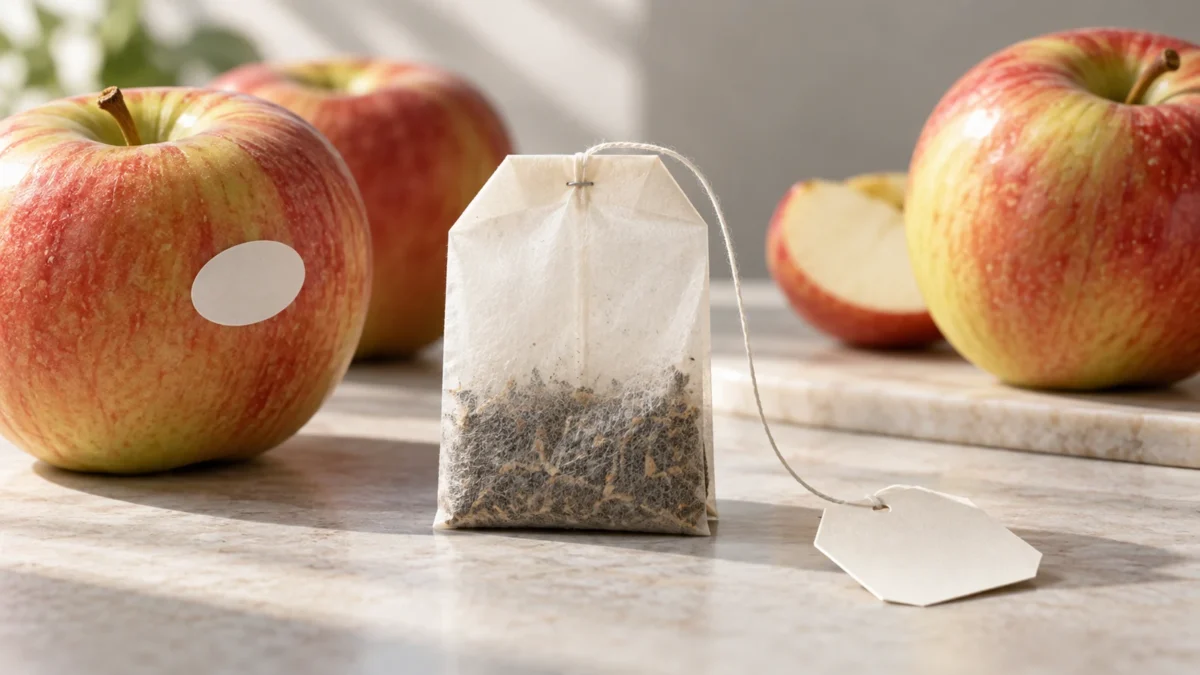
PPWR does not require all packaging to become compostable. Article 9 establishes a targeted route for specified formats, allows certain conditional Member State requirements, and directs other biodegradable packaging toward material recycling. The package’s legal category and waste-system context matter more than a broad “bioplastic” description. [1]
For designers, the useful question is whether the format falls within Article 9(1), a valid national route under paragraph 2, or the other-packaging rule in paragraph 3. These branches should be resolved before a compostability label is treated as the design answer.
Identify the specific format
Article 9(1) refers to the packaging category in Article 3(1)(1)(f) and to sticky labels affixed to fruit and vegetables. The cross-referenced category concerns permeable tea, coffee or other beverage bags and specified soft single-serve units intended to be used and disposed of with the product. It should not be paraphrased as “every coffee capsule”. [1]
For the covered formats, the provision specifies compatibility with the standard for composting in industrially controlled bio-waste treatment conditions by 12 February 2028, and with the referenced home-composting standards where Member States require that. Industrial and home composting are not interchangeable claims.
| Question | Rule or evidence | Important boundary |
|---|---|---|
| Permeable beverage bags and specified soft single-serve units | Article 3(1)(1)(f) category | Read the use-and-disposal definition rather than extending it to every capsule |
| Sticky labels on fruit and vegetables | Article 9(1) | Specified compostability requirement by 12 February 2028 |
| Additional national choices | Article 9(2) | Conditional on the provision’s waste-system and format conditions |
| Other biodegradable packaging | Article 9(3) | Design for material recycling by the stated date, without harming other streams |
National choices are conditional
Article 9(2) allows Member States to require specified additional formats to be compostable under stated conditions. The provision connects those choices to permitted co-collection with bio-waste and the availability of appropriate collection and treatment infrastructure. It identifies particular single-serve units and carrier bags, as well as certain packaging already subject to a national requirement before the regulation’s application. [1]
That is different from a manufacturer deciding that compostability is useful everywhere. Whether a particular national measure applies requires the actual country, format and current measure; the EU permission for such a measure is not proof that every Member State has adopted one.
Biodegradable does not automatically mean a bio-waste route
Article 9(3) provides that other packaging, including packaging made from biodegradable plastic polymers and other biodegradable materials, is to be designed for material recycling by 12 February 2028 in accordance with Article 6, without affecting the recyclability of other waste streams. [1]
This is the consequential boundary for material substitution. A biodegradation property is not a universal disposal instruction. Neither a bio-based feedstock nor a supplier’s compostability certificate establishes the local collection route for every finished pack.
Evidence belongs to the whole item and the relevant system
Article 9(4) connects conformity to technical documentation. Paragraph 6 addresses the development or updating of harmonised standards with treatment conditions in view. A standards-development deadline does not establish that a specific standard edition has been published or that a product has been certified to it. [1]
The resulting evidence question is specific: which complete construction, which applicable format and national rule, which standard or assessment, and which actual collection and treatment route? Those details determine what a label can communicate. They do not support littering, marine-degradation or landfill-disappearance claims.
The wider implementation context is covered in our PPWR overview; the present guide isolates the provision identified above.
Sources
Sources checked 21 October 2026. Legal text, official interpretation and editorial examples are distinguished above. No individual product or business conformity assessment was performed.
- European Parliament and Council / Official Journal via BOE. Regulation (EU) 2025/40 on packaging and packaging waste. 19 December 2024; OJ 22 January 2025. Locator: Articles 3(1)(1)(f)–(g), 9(1)–(6); Annex III. Relevant full original provisions read in the official Spanish rendition; English explanation is an editorial paraphrase, not an official translation.
The public corrections channel is currently inactive. Read our corrections policy.