Modified atmosphere packaging (MAP) changes the mixture of gases surrounding food inside a package. Instead of leaving ordinary air in the headspace, a packer may introduce a selected mixture of oxygen (O₂), carbon dioxide (CO₂) and nitrogen (N₂), or design a breathable film so the food itself gradually changes that atmosphere. The aim is to slow a particular route of quality loss—such as oxidation, aerobic spoilage or excessive respiration—without creating new unacceptable risks.
MAP is not one gas recipe, one machine or one type of film. A successful system must match the food, gas composition, finished package, sealing process, temperature history and validated shelf life. A film that works for a cooked ready meal may be a poor choice for living salad leaves. A low-oxygen package that looks fresh may still require stringent controls for pathogens that do not need oxygen.
How does modified atmosphere packaging work?
Air normally contains approximately 21% oxygen and 78% nitrogen, with smaller amounts of other gases. MAP deliberately changes the atmosphere in the product’s immediate surroundings. For some foods, oxygen is reduced to slow oxidation or the growth of aerobic spoilage organisms. In others, some oxygen remains necessary to support plant respiration or to preserve the visible colour of fresh red meat. Carbon dioxide can inhibit the growth of many spoilage microorganisms, while nitrogen is commonly used as a relatively inert balancing gas.
In an industrial tray-sealing application, a machine may remove or displace the air, add a food-grade gas mixture, then seal a lidding film to the tray. With fresh produce, the result may instead depend on a carefully selected permeable or microperforated film. The internal gas composition can subsequently change as the food respires, gases dissolve into the product, or gases pass through the package material. The Linde overview of modified atmospheres describes the roles of food characteristics, free gas volume, material permeability and processing conditions in selecting a system.
| Approach | How atmosphere changes | Important distinction |
|---|---|---|
| Gas-flushed MAP | Air is displaced, often with an intended gas blend, before sealing. | Residual air and the eventual gas composition must be measured in real packs. |
| Vacuum–gas MAP | Some air is withdrawn and a selected gas mixture is introduced before sealing. | It is not the same as leaving a vacuum in the finished pack. |
| Passive MAP for fresh produce | Produce respiration and the film’s gas exchange gradually establish an atmosphere. | Temperature and product respiration can change the equilibrium. |
| Vacuum packaging | Air is withdrawn and the pack is sealed, usually without a replacement gas mixture. | Package shape and gas volume differ from a gas-filled MAP tray. |
| Controlled-atmosphere storage | A storage environment is monitored and adjusted to maintain a chosen atmosphere. | Continuous control in a storage room is not a single sealed MAP pack. |
MAP can preserve the quality that was present at packing; it does not reverse inadequate hygiene, repair damaged food or sterilise the contents. The claimed shelf life must come from product-specific validation rather than the presence of a MAP label.
What do oxygen, carbon dioxide and nitrogen do in MAP?
The three principal gases have different functions. Calling any one of them “the preservation gas” overlooks the compromises that determine whether the food remains safe, appealing and commercially viable.
| Gas | Why it may be used | What can go wrong |
|---|---|---|
| Oxygen (O₂) | Often reduced to limit oxidation and aerobic spoilage; intentionally retained for some fresh produce and meat-colour applications. | Too much may accelerate oxidation; too little may cause anaerobic deterioration in living produce and create different microbiological hazards. |
| Carbon dioxide (CO₂) | Can suppress the growth of many bacteria and moulds associated with spoilage. | Its dissolution into moist food can reduce headspace volume; excessive levels can impair flavour, texture or produce physiology. |
| Nitrogen (N₂) | Displaces oxygen and helps maintain pack volume where a balancing gas is needed. | It has no universal antimicrobial effect and cannot compensate for inadequate temperature or hygiene controls. |
The mixture selected for a dry snack is not a useful starting formula for a raw seafood pack. Gases interact with water, fat, pigments and microorganisms, and those interactions change with storage conditions. Supplier descriptions of possible gas blends are useful for shortlisting, but an appropriate specification requires the food producer’s own risk assessment and trials.
Where is MAP used in food packaging?
MAP is used across fresh and processed foods, but the target mechanism varies. The following matrix helps identify what the package is being asked to control before anyone chooses a gas ratio or orders a new tray.
| Food category | Primary preservation question | Critical packaging variable | Separate safety or quality check |
|---|---|---|---|
| Fresh-cut vegetables and salad leaves | Can respiration and moisture loss be controlled without anaerobic stress? | Film oxygen and carbon-dioxide exchange, possible microperforations, product mass. | Produce-specific gas limits, condensation and temperature excursions. |
| Raw red meat | How should colour, oxidation and spoilage control be balanced? | Headspace gas design, film barrier, tray and seal integrity. | Colour stability is not a food-safety determination. |
| Chilled cooked meals | Can an appropriate atmosphere and barrier support a validated refrigerated shelf life? | Complete tray–lidding construction, filling hygiene and gas retention. | Hazards from reduced oxygen, time–temperature history and product formulation. |
| Bread and other bakery items | Is mould growth, oxidation or moisture change the key quality limit? | Gas retention and moisture behaviour of the wrapper or tray. | Product water activity, recipe and actual spoilage testing. |
| Dry snacks and nuts | Does replacing oxygen reduce oxidation while protecting texture? | Oxygen ingress, pack volume and moisture barrier. | Rancidity, humidity ingress and seal failures. |
| Fish and seafood | Can any preservation benefit be achieved with a defensible hazard-control plan? | Finished-package gas behaviour and reliable refrigerated distribution. | Product-specific pathogen and toxin hazards; additional specialist evaluation is essential. |
For living produce, the distinction between a low-permeability barrier and a breathable package is especially important. The UC Davis postharvest training material explains that produce continues to respire after harvest and that a workable package must balance respiration against gas exchange through the film.
Active and passive MAP: why fresh produce behaves differently
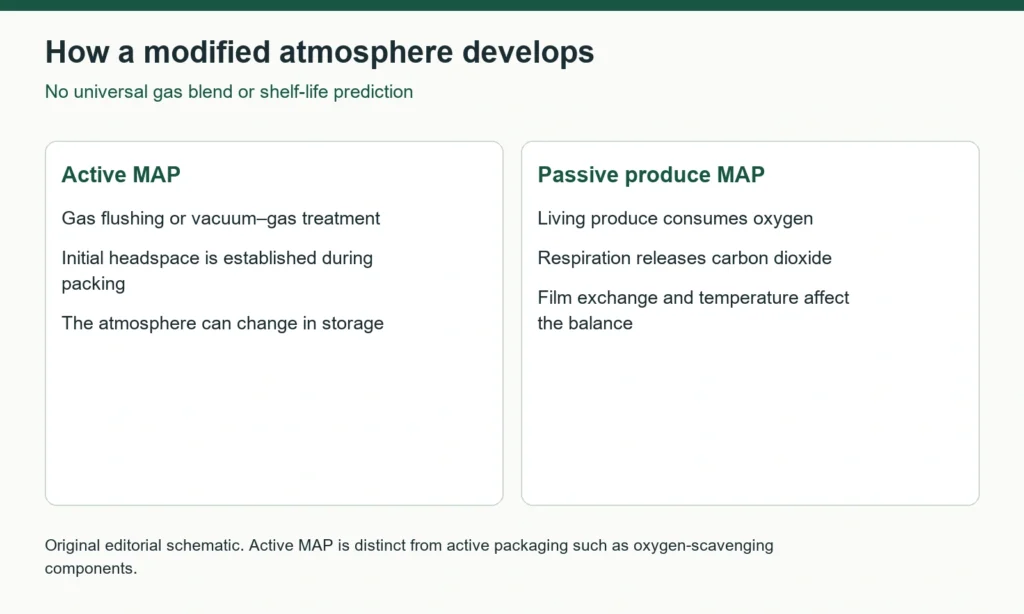
Active MAP normally begins by deliberately changing the package atmosphere, for example by flushing in a gas mixture before sealing. Passive MAP depends substantially on the product’s own respiration and the film’s permeability. These terms describe how the atmosphere is established, not whether the food is safe or whether the finished package is recyclable.
For the separate technology category, see active packaging that controls oxygen, moisture or ethylene.
In fresh produce, oxygen is consumed and carbon dioxide is produced as cells continue to respire. Oxygen also enters from outside and carbon dioxide leaves through the film or perforations. The resulting atmosphere depends on respiration rate, product mass, available headspace, gas-transfer properties and temperature. A change in storage temperature may simultaneously change the plant’s respiration and the package’s gas transfer; the balance achieved during one cold-chain trial may not persist during warmer distribution.
Consider the difference between intact broccoli and a sealed pack of cut florets. These are not physiologically identical products. In its broccoli postharvest fact sheet, UC Davis reports that fresh-cut pieces have higher respiration rates than intact heads and warns that insufficient oxygen can cause undesirable odours when temperatures fluctuate. This is a documented product-specific example, not permission to transfer a broccoli gas recipe to salad mixes, mushrooms or another crop.
A practical produce trial should therefore measure more than gas composition on sealing day. It should track headspace oxygen and carbon dioxide at planned intervals, product temperature, sensory quality, water loss or condensation and, where required, microbiological safety through the intended distribution period. Test mixed-product packs as mixed products: a high-respiring ingredient can upset the assumptions used for a single-component film design.
Which packaging films and trays work with MAP?
For many non-respiring chilled foods, the package needs to retain the selected atmosphere and avoid uncontrolled oxygen entry. For actively respiring produce, it may need a calibrated route for oxygen ingress and carbon-dioxide escape. The correct engineering question is not “Which material has the lowest OTR?” but “What gas transfer must the entire package permit under the relevant storage conditions?”
OTR is important, but it is not the whole specification
Oxygen transmission rate (OTR) describes oxygen passing through a specified material under stated test conditions. It differs from a permeability coefficient, which involves material thickness and the pressure-driving force under the relevant definition. An OTR number is not comparable without its units, test method, temperature, humidity and specimen construction. ASTM D3985-24 identifies an oxygen-transmission test for films and related materials; ISO 15105-2:2025 identifies an equal-pressure gas-transmission method. Their public listings establish the scope and editions, not unexamined technical clauses.
Our guide to grease, water, OTR and WVTR barriers explains why these properties are different.
A low film OTR also does not establish the gas performance of the finished tray. Seals, corners, lidding interfaces, microperforations, closures and handling damage can become the dominant leakage route. A buyer should ask for data on the tested construction and actual pack geometry—not substitute a flat film report for shelf-life evidence from a filled, sealed container.
Water-vapour transfer, fogging and sealing
Water-vapour transmission rate (WVTR) addresses a different transport process from oxygen transfer. It matters to crisp dry products, moist foods, condensation control and the changing mechanical performance of some paper-based systems. ASTM’s F1249 listing covers a water-vapour transmission test for flexible barrier materials. An excellent oxygen barrier is not automatically an adequate moisture barrier.
Other essential properties include seal-initiation conditions, hot-tack or seal strength where appropriate, puncture resistance, film clarity, anti-fog behaviour, lidding peelability, food-contact suitability and compatibility with transport, chilled storage or intended reheating. If a tray will be heated, the heating claim must be validated separately from the MAP storage claim.
How is MAP produced on a packaging line?
Packaging equipment can use continuous gas flushing on form–fill–seal lines, vacuum-and-gas cycles in chamber or tray-sealing machines, or other engineered arrangements. Gas delivery, fill level and seal performance need to work together. A mixer setting is not proof of the atmosphere actually present in each closed pack.
Gas-flush efficiency is affected by pack geometry, product loading, machine speed, gas flow, sealing conditions and any air trapped within the food. A nominal gas mixture at the supply line can differ from the initial sealed headspace. For this reason, production qualification should check residual oxygen and other relevant gases on sealed samples, not merely confirm the gas-cylinder label.
Common production controls include incoming gas identity and grade, gas-mixing verification, headspace analysis, seal inspection or leak testing, package appearance, traceability, and documented response when results fall outside validated limits. Sampling plans and acceptance thresholds must come from a qualified product- and line-specific validation. MAP equipment designed for unusually oxygen-rich gases may also need additional compatibility and safety assessment by the equipment and gas suppliers.
Why do MAP packages fail during storage?
The causes of MAP failure are often more informative than a brochure showing the intended gas blend. The same symptom may have several causes; it should trigger investigation rather than an automatic change to the gas recipe.
| Observation | Possible contributors | Evidence to examine |
|---|---|---|
| Headspace oxygen rises faster than expected | Incomplete flush, seal leak, material transmission, puncture or air released from food. | Gas readings immediately after sealing and during storage; leak tests; construction-level OTR. |
| Tray or pouch contracts | Carbon dioxide dissolving into food; unsuitable initial headspace or gas balance. | Gas composition over time, pack volume, food moisture and integrity. |
| Salad develops off-odours | Insufficient oxygen, excess carbon dioxide, warm storage or unsuitable film. | Produce-specific respiration, perforation design, time–temperature log and headspace history. |
| Condensation or fogging increases | Moisture behaviour, temperature gradients or inadequate film/pack design. | Humidity and temperature records, anti-fog performance and WVTR context. |
| Product fails before proposed use-by period | Raw-material variation, processing hygiene, temperature, formulation, leakage or an invalid shelf-life model. | Batch records, microbiology, quality endpoints and the original validation protocol. |
For example, carbon dioxide can dissolve in a high-moisture food and cause a pack to shrink even when its seals are intact. Conversely, a tidy-looking pack can still contain an unsuitable atmosphere or unsafe food. The troubleshooting process must combine measured gases, pack integrity and the product’s actual safety and quality results.
Does MAP keep food safe without refrigeration?
No. MAP is not a replacement for chilling, sanitation, hazard analysis, validated processing or an appropriate use-by determination. Lower oxygen can slow some aerobic spoilage organisms while changing the conditions for other microorganisms. A sealed pack does not become sterile merely because a gas mixture has been introduced.
The UK Food Standards Agency’s vacuum and modified-atmosphere packaging guidance specifically highlights the risk from non-proteolytic Clostridium botulinum in relevant chilled foods and the need for appropriate controls. The guidance also stresses that hazards such as Listeria monocytogenes must be considered separately. Its scope and exceptions matter: rules or guidance for one jurisdiction and food class must not be applied automatically to every MAP product worldwide. The cited guidance applies to England, Northern Ireland and Wales and excludes chilled fresh beef, lamb and pork from its scope; those exclusions are not a general safety exemption.
There is no safe universal statement such as “MAP extends shelf life by three times” or “a low-oxygen tray stays safe for 14 days.” A responsible claim requires a defined recipe, finished package, gas specification, processing hygiene, temperature profile, relevant microbiological assessment, shelf-life study and documented acceptance criteria. Where a national guidance document mentions a decision threshold, it must be interpreted within that guidance’s product and jurisdictional scope, not converted into a global allowance.
Can MAP be used with recyclable, paper-based or compostable packaging?
MAP can be considered alongside paperboard trays, recyclable polymer structures or emerging compostable films, but an environmental attribute does not demonstrate gas retention or food safety. A fibre tray may need a functional barrier or lidding layer; the material seen by the consumer is not necessarily the material that controls gas movement. Buyers must assess the complete product-contact construction, including coatings, seals and closures.
A current format example is paperboard ready-meal trays and their line-qualification questions.
Biodegradable and bio-based film research has explored approaches to oxygen and moisture barriers, but the relevant properties depend on polymer choice, film formulation, thickness, manufacturing method and exposure conditions. A 2025 open-access review of biodegradable packaging films describes both materials-development opportunities and functional limitations. It does not establish that a generic PLA, starch-based or fibre structure is suitable for MAP.
End-of-life claims require their own evidence. “Designed for recycling,” “repulpable in a test,” “industrial compostable” and “accepted by a local processor” are different questions. Where an alternative package changes barrier properties, shelf life, food losses or disposal routes, any environmental comparison should use an equivalent food-protection function and an appropriate life-cycle scope. A lower visible plastic weight is not enough to establish lower overall impact.
What should a buyer validate before specifying MAP?
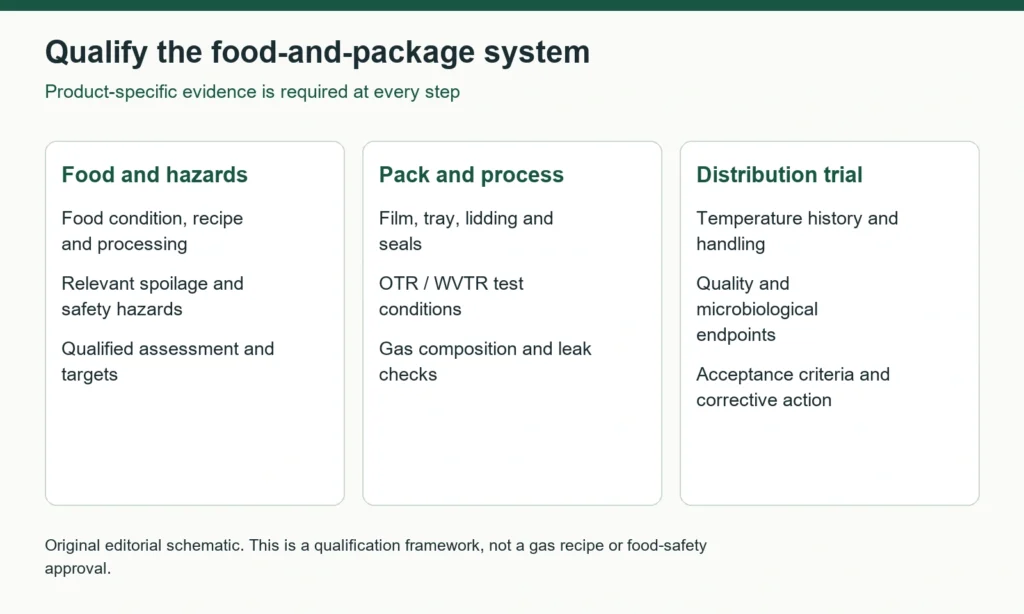
A useful technical inquiry starts with the food and the required distribution performance—not with a generic request for a “MAP tray.” The following framework can be used for a supplier discussion and a trial plan. It is not a substitute for a qualified food-safety study.
| Question | Evidence or input to request | Why it matters |
|---|---|---|
| What food is being packed? | Recipe, pH, water activity, product size, cut state, initial condition and processing route. | Determines spoilage mechanisms and food-safety hazards. |
| What shelf life is proposed? | Target period, storage temperature limits, intended market and validation protocol. | Separates an aspiration from demonstrated performance. |
| How will the atmosphere be established? | Gas grade, gas mixture proposal, machine configuration, sealing process and residual-gas checks. | Supply-gas composition is not the same as sealed-package composition. |
| What exactly is the package construction? | Tray, coating, lidding, seals, thickness, area, OTR, WVTR and relevant test conditions. | A single material name cannot predict finished-pack performance. |
| How will failures be detected? | Seal integrity, leak testing, gas analysis, sampling plan and corrective actions. | Gas drift and mechanical damage can invalidate the design. |
| Can the claim survive distribution? | Temperature-logging trials, quality endpoints and microbiological assessment where needed. | A bench result may not match transport, retail or consumer handling. |
| What happens after use? | Finished-pack component weights, separation instructions and market-specific recovery evidence. | Food preservation and end-of-life performance must both be evaluated. |
The decision is to approve—or reject—a validated food-and-package system. Two suppliers may both quote a “modified atmosphere tray,” yet propose very different barriers, gas-retention behaviour, line compatibility and disposal outcomes. Specify and test the complete construction before treating the packs as interchangeable.
Sources / References
Found an error? Read our corrections policy and contact the editors.