

Editorial company profile
PulPac
PulPac develops and licenses Dry Molded Fiber technology through machinery, tooling and production partners. Its packaging role is a process platform rather than a conventional molded-pulp factory. Licensee production milestones, barrier requirements and application testing determine whether the technology can deliver a particular lid, tray or container at a useful commercial scale.
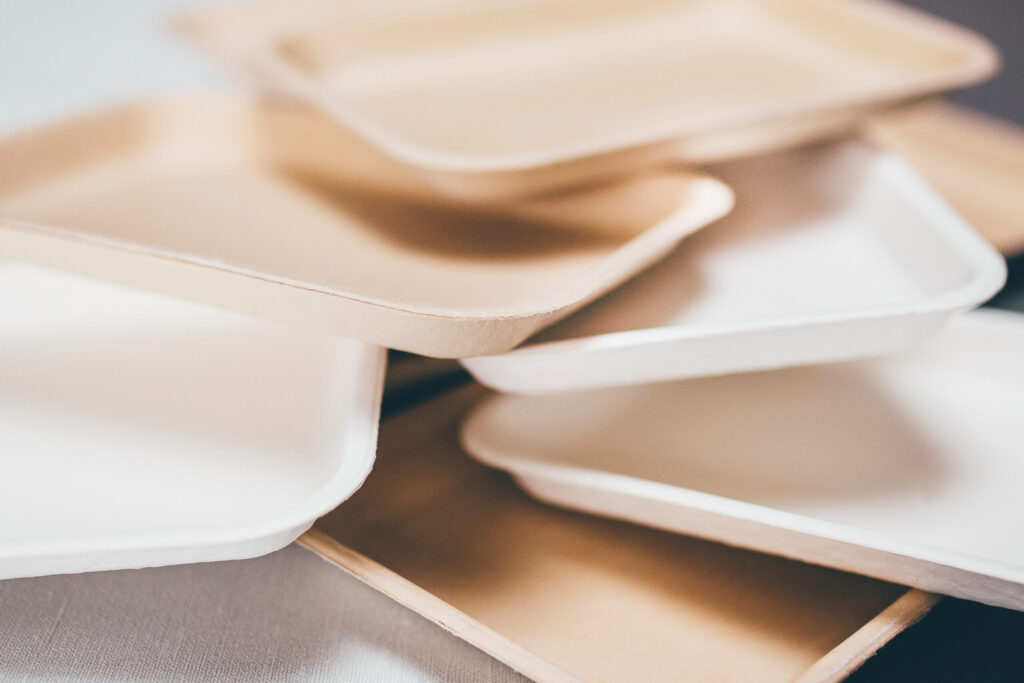
Official websiteImage: PulPac. Dry Molded Fiber tray samples.
Packaging-use example
PulPac — Dry Molded Fiber trays
Dry Molded Fiber packaging technology
Related Degradable Packaging analysis: Packaging Technologies Moving Toward Commercial Scale in 2026: A Six-Month Readiness Tracker. Licensee supply and application-specific barriers must be established separately.
Explore product and packaging detailsCompany overview
PulPac is a Swedish technology business that develops and licenses Dry Molded Fiber. Its role is centred on a manufacturing process and the surrounding machinery, tooling and partner network, rather than operating as a generic supplier of every molded-fibre product. Licensees and other industrial partners provide an important part of the route from the technology to saleable packaging. A buyer therefore needs to identify both the technology owner and the actual producer.
The process forms cellulose fibres into rigid articles using a dry-forming route. PulPac describes a sequence involving fibre preparation, an airlaid web and forming with heat and pressure. Application-specific barriers may be added where protection against water, oil or grease is required. A dry-forming process does not automatically remove the need for a coating, nor does it determine the recovery properties of the finished article.
The company's packaging relevance is clearest when a licensee moves from machinery installation into qualified commercial supply. Recent examples concern coffee lids in Malaysia and investment in production for snus cans in Sweden. These are different applications and different stages, so neither should be used as proof that every proposed Dry Molded Fiber format is already in volume production.
Packaging portfolio
| Area | Packaging role | Qualification boundary |
|---|---|---|
| Process and intellectual property | Dry Molded Fiber licensing | Confirm the licensed producer and production route. |
| Industrial ecosystem | Machinery, tooling and material partners | Installation, acceptance testing and qualified output are separate. |
| Packaging applications | Lids, trays and other formed containers | Barrier and food-contact requirements depend on the article. |
Materials and technologies
Dry-forming changes how the fibre web is prepared and pressed compared with a conventional wet-moulding route. The finished article still needs dimensional consistency and application-specific performance. PulPac's published process information discusses several barrier-application options. A customer should establish where the barrier is applied and how it affects food contact, sealing and recovery. [1], [2], [3]
Sustainability and circularity position
PulPac promotes reduced resource use for its process. This profile does not generalise a water, energy or carbon percentage across all licensees and products. A meaningful comparison needs the same article function, material mass, production boundary and location. Fibre origin alone also does not establish that a coated lid is accepted by a particular paper-recycling system. [1], [2], [3]
Why this company matters
PulPac's industrial significance is whether an alternative fibre-forming route can be replicated through a licensing network. Repeatable output at qualified licensees is stronger evidence than a machine order or a prototype. Packaging teams should track tooling economics, supply responsibility, barrier integration and sustained production, because those determine whether a promising process becomes a practical source of packaging.
Recent developments
- 28 October 2025 — PulPac reported full-scale commercial coffee-lid production by licensee HZ Green Pulp in Malaysia. This is an attributed licensee milestone for a named application.
- 28 April 2026 — Future Materials Sweden ordered two Scala machines for a new site focused initially on snus cans. The announcement concerns investment and planned installation, not proof of completed production.
What packaging teams should verify
- Name the licensee, machine route, tooling owner and party responsible for supply and quality.
- Request sustained production and acceptance-test evidence for the actual article rather than another licensee's example.
- Establish barrier chemistry, food-contact scope, dimensional performance and the finished product's recovery route.
Sources / References
Sources checked on 27 October 2026 with AI assistance. Company statements are attributed; no independent product testing is claimed. Post-publication human review by the Degradable Packaging Editorial Team is pending.
- [1] PulPac, Dry Molded Fiber process and Q&A, accessed 27 October 2026; process sequence, licensing and barrier options. https://www.pulpac.com/d
ry-molded-fiber/ - [2] PulPac release via Cision, 28 October 2025; HZ Green Pulp commercial coffee lids. https://news.cision.com/
pulpac-ab/r/pulpac-licen see-hz-green-pulp-enters -full-scale-production-a nd-launches-dry-molded-f iber-coffee-lids,c425769 9 - [3] PulPac release via Cision, 28 April 2026; Future Materials Sweden machine order and intended snus-can production. https://news.cision.com/
pulpac-ab/r/future-mater ials-sweden-moves-into-i ndustrialization-with-dr y-molded-fiber-investmen t,c4341100
Disclosure
Editorial company profile. Inclusion does not constitute a product endorsement, membership statement or commercial partnership.