Pharmaceutical packaging’s recyclability challenge is producing several redesign routes at once. Recent announcements cover predominantly polypropylene blisters, a pharmaceutical company’s planned mono-PP packs, paper for selected dry applications and polyethylene outer bags for sensitive bioprocessing. The variety is the story: different protection duties are generating different material and process decisions.
These examples do not establish that one sustainable pharmaceutical material has won. They show developers trying to simplify a packaging system without losing the function that made its existing construction useful. For buyers, the important comparison is therefore between equivalent applications and qualification stages, not between photographs of packs bearing different material labels.
Protection remains the entry condition
A medicine pack is part of a delivery system whose contents must remain usable through their intended life. Moisture and oxygen exposure, contamination control, seal integrity, identification and manufacturing consistency cannot be treated as optional features in a material substitution. The balance is product-specific: a dry tablet’s blister, a paper sachet and a protective bag around a bioprocess container are not interchangeable units.
This changes the meaning of a recyclability redesign. A developer has to identify which existing functions reside in which layers or components and decide how the replacement will provide them. Reducing the number of incompatible materials may make a recovery pathway easier to design, while increasing the importance of another formulation or processing decision.
Qualification also extends beyond the material supplier. The medicine manufacturer needs a pack that works with its product, equipment, information requirements and validation process. A supplier’s launch can establish availability of a proposed platform; it cannot establish that every medicine manufacturer has qualified it or that a healthcare waste stream accepts it.
Predominantly PP does not mean one pure resin
ACG’s 7 October 2026 announcement describes RecycloPod PP Ultra as a PP/EVOH/PP forming structure used with PP lidding. The company reports water-vapour transmission below 0.60 g/m² per day and oxygen transmission below 0.20 cm³/m² per day. These are ACG’s product statements, not measurements reproduced by Degradable Packaging. The release does not provide the complete conditioning and specimen information needed here for a comparative barrier ranking. [1]
The structure is a useful reminder that predominantly one polymer family and chemically identical throughout are different descriptions. EVOH serves a barrier role inside a PP-dominant design. Whether a finished blister qualifies for a particular recycling assessment depends on the complete construction and the applicable assessment, rather than on the absence of a second polymer name in its headline.
The engineering implication is not that an additional functional layer makes simplification meaningless. It is that simplification has to be evaluated at the level where it is intended to help. A forming web, lid, printing system and opened-pack geometry together create the recovery article. A material-level test does not resolve all those variables, and an oxygen result cannot substitute for a moisture result.
For a packaging team considering the route, the next useful evidence would connect the selected gauge and structure to the relevant forming, sealing and product-stability conditions. That would permit an application comparison without turning supplier catalogue numbers into a universal purchasing threshold.
Medicine launches follow a different clock
AstraZeneca’s 18 September 2026 account describes mono-PP material and packaging-line development, with product launches planned from 2027. It links the change to protection, manufacturing performance and usability, rather than presenting a material switch as a completed recycling outcome. The launch timing remains a plan. [2]
That distinction places the supplier and medicine-company examples on different clocks. The packaging platform can be announced before a medicine using it reaches patients. Filling-line tooling, pack configuration and product-specific qualification sit between those milestones. A trend analysis should preserve that interval instead of counting every development announcement as an additional commercial medicine launch.
The information carried by a blister is another practical part of the redesign brief. Changing a material does not remove the need to identify the medicine and batch or support the intended opening and handling experience. A comparison focused only on barrier film can miss the components through which the patient encounters the pack.
From a commercial perspective, staged introduction may be more informative than an immediate portfolio-wide promise. A named launch with a clear construction and validation boundary could establish a repeatable route. Extending that route to another product would still require evidence that the relevant conditions are sufficiently comparable.
Fibre enters a bounded dry-application space
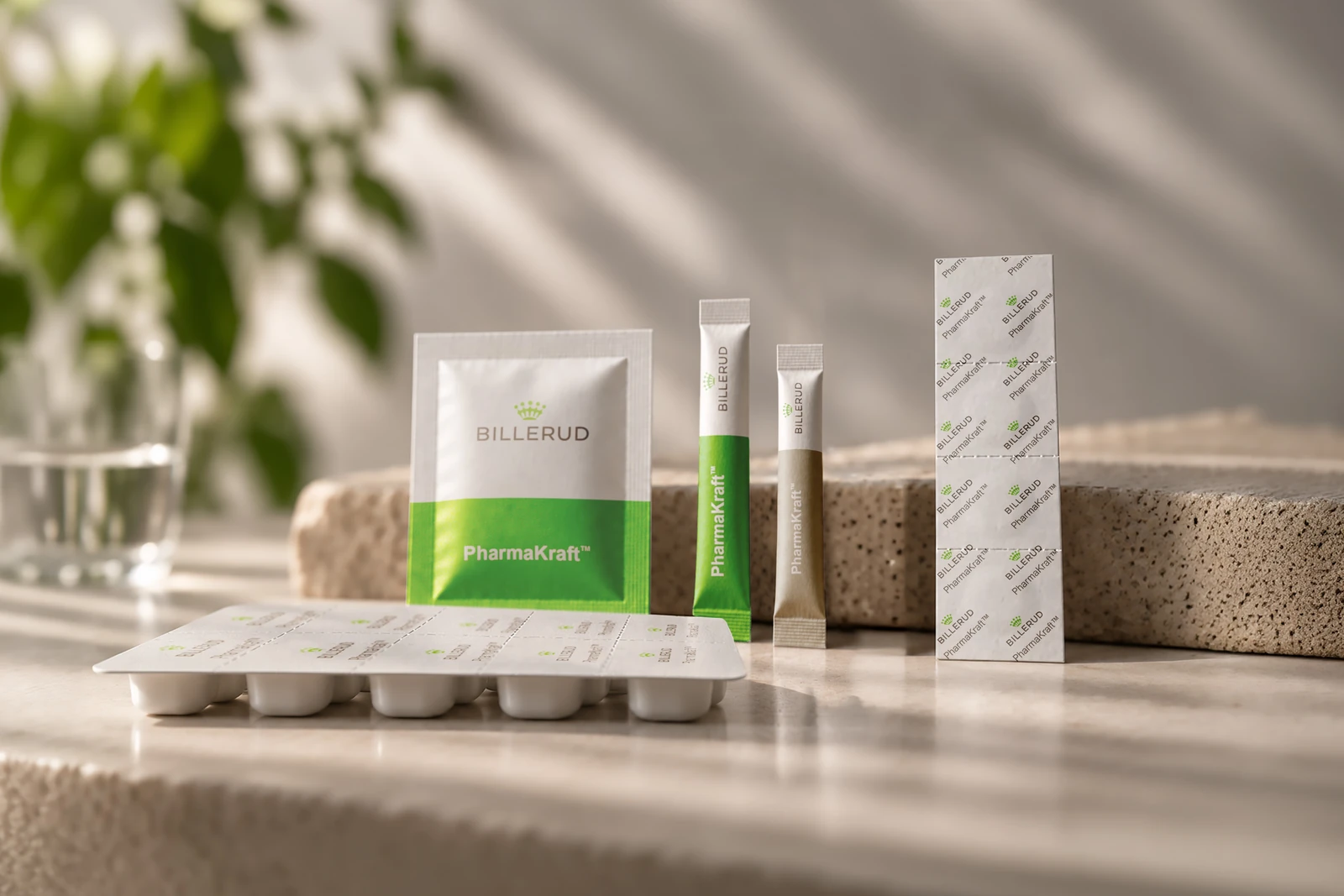
Billerud’s 15 October PharmaKraft announcement identifies non-sterile dry pharmaceutical applications, including sachets, stick packs, strip packs and blister lidding. The company describes a fresh-fibre paper intended to support purity, converting and qualification requirements. This is a proposed material platform within a defined application range, not evidence that paper can replace all pharmaceutical plastics. [3]
The opportunity is to select the applications whose required service can be delivered by the completed paper-based construction. A dry-use description does not mean that moisture exposure is irrelevant. Nor does a paper base disclose all the functional layers that a particular finished sachet or lid may require.
For converters, the commercially useful question is what qualification work changes. A paper route may require a different specification for forming, printing, sealing or handling. Material traceability can support that process without completing it. The medicine manufacturer’s package decision remains tied to the actual use, rather than to an assumption that a renewable feedstock settles protection or recovery.
A bioprocess outer bag is a separate function
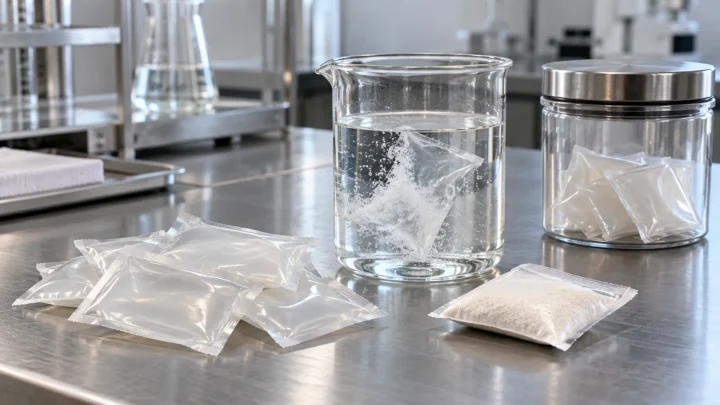
SÜDPACK Medica’s 22 October release concerns tubular mono-PE outer packaging for process bags in cell culture and bioprocessing. It describes an alternative to PE/PA/PE structures and attributes mechanical and processing performance to internal development and testing. This example belongs in the wider life-science packaging discussion, but it is not an oral-dose blister or a claim about direct contact with a medicine. [4]
Its inclusion broadens the argument only if that difference remains visible. An outer protective bag performs a different job from a cavity holding a tablet. A structure suitable for one cannot be ranked against the other as though both delivered the same service. The more defensible common pattern is the effort to retain a specific function with a less complex material architecture.
The company’s internal recyclability calculation and screening carbon comparison also answer narrower questions than an observed waste outcome. This article does not reproduce their headline percentages as independent environmental findings. A common-basis comparison would require the underlying construction, assessment assumptions and recovery conditions; an actual recycling claim would additionally need an operational pathway.
Four routes, four qualification questions

| Route | Potential design opportunity | Question that remains |
|---|---|---|
| PP-dominant blister | Bring forming and lidding toward one polymer family | Does the complete construction protect the specific medicine and fit a recovery pathway? |
| Mono-PP medicine-pack development | Coordinate material, pack and line changes | Which qualified products and markets actually launch? |
| Fibre-based dry application | Use paper within a bounded protection brief | What additional barriers and qualification does the finished format need? |
| Mono-PE bioprocess outer bag | Simplify a protective outer construction | Does the specific process-bag system meet its mechanical and contamination-control requirements? |
The matrix deliberately avoids a winner column. The reported development stages and protection duties differ. A comparative environmental conclusion would need equivalent service, consistent assessment boundaries and credible end-of-life assumptions. None of the announcements supplies that common experiment across all four routes.
Recyclability needs a destination
Bioleader’s food-packaging explanation of technically recyclable versus recycled in practice separates material compatibility from collection, sorting, reprocessing acceptance and an end market. That manufacturer-side distinction is useful here as a systems question, not evidence that a pharmaceutical blister passes a recycling test. [5]
Related-party disclosure: Bioleader is a disclosed industry/commercial related party of Degradable Packaging. Its reference concerns food-packaging recovery principles; pharmaceutical performance requires pharmaceutical-specific evidence.
For the pharmaceutical routes, the follow-through is to identify where used packs arise and which organisation can accept them. Household packs, hospital materials and industrial process packaging should not be assigned the same collection assumption. Instructions must reflect the actual local route, including relevant contamination or handling constraints, rather than the polymer name alone.
Regulatory applicability is a separate exercise again. A company release’s reference to the EU Packaging and Packaging Waste Regulation does not settle which provisions, exceptions or transition dates govern a specific medicinal or life-science pack. No pharmaceutical exemption or compliance verdict is inferred here from a supplier statement.
Watch the qualified transition
The next evidence to watch is concrete: a medicine launched in the specified pack, a documented qualification boundary, sustained production and an identified collection or recycling destination. Where the example is an industrial outer bag, the relevant proof is operation in that process and its waste route, not a consumer blister collection rate.
These distinctions make recyclability a more demanding engineering requirement, not a replacement for medicine protection. A redesign becomes commercially meaningful when protection, usability, qualified manufacture and a credible recovery pathway coexist. The 2026 announcements show several routes being worked on; the qualified transitions will determine which of them become repeatable packaging systems.
Sources
- ACG. ACG launches RecycloPod PP Ultra, 7 October 2026. Construction and reported transmission values; full comparative test conditions not supplied.
- AstraZeneca. Developing sustainable blister packaging, 18 September 2026. Development programme and planned launches from 2027.
- Billerud. PharmaKraft pharmaceutical-packaging announcement, 15 October 2026. Non-sterile dry application scope.
- SÜDPACK Medica. Tubular mono-PE sterile barrier development, 22 October 2026. Bioprocess outer-bag scope and internal testing account.
- Bioleader. Why “Technically Recyclable” Is Not the Same as “Recycled in Practice”. Five-stage systems distinction only; related-party manufacturer source. Sources checked 26 October 2026.
Found an error? Read our corrections policy and contact the editors.