A 2026 study of polycaprolactone/chitosan coatings offers a useful warning about selecting a paper barrier from its strongest result. The authors report large oxygen-barrier gains on dark paper, but much smaller reductions in water-vapour transmission. The engineering question is which function limits the intended pack—not whether the coating improves at least one laboratory measure. [1]
A waterborne coating with a solvent-based preparation step
Obando-Garzón and colleagues prepared dispersions combining synthetic polycaprolactone (PCL) and chitosan. Their method dissolves PCL in ethyl acetate, emulsifies it into an acidified aqueous chitosan phase with surfactant, then stirs for 24 hours under a laboratory hood to promote solvent evaporation. Coatings were applied to paper and, separately, to commercial PLA film. [1]
“Waterborne” describes the intended application dispersion; it should not be converted into a claim that no organic solvent was used to make it. The authors explicitly state that residual solvent was not quantitatively measured, so complete removal was not unequivocally confirmed. A production assessment needs its own drying, residual and process-control evidence rather than relying on the formulation label. [1]
Keep the oxygen result beside the moisture result
For the tested dark-paper systems, the authors report approximately 25-fold and 50-fold oxygen-barrier improvements with PCLCS4 and PCLCS3 coatings, respectively. Their paper oxygen-permeance method uses a nitrogen-purged sensor cell at 50% relative humidity. In contrast, reported water-vapour transmission reductions for PCLCS2 and PCLCS3 paper were only 8% and 5%. [1]
The paper water-vapour test used liquid water inside permeation cells and a 50% RH external environment, with measurements at 23°C. Those conditions matter when interpreting the modest moisture improvement. A percentage measured across that gradient is not interchangeable with one obtained using dry desiccant inside the cell, another humidity or a different substrate. [1]
For a developer screening a moisture-sensitive product, the decision is to set the acceptable water-vapour transfer first, then ask whether this exact coated construction reaches it. A large oxygen improvement cannot compensate for missing the moisture requirement unless the complete package design supplies that missing function elsewhere. That is a design decision to test, not a shelf-life benefit demonstrated here.
Do not transfer the PLA-film result to paper
The study also examines coated PLA at several humidities. Those film results cannot be copied into a paper specification: the substrate, measurement arrangement and moisture pathway differ. When requesting a coating trial, identify the paper grade, coating formulation and coat weight, application sequence and conditioning environment. Compare controls made from that same substrate before ranking candidate formulations.
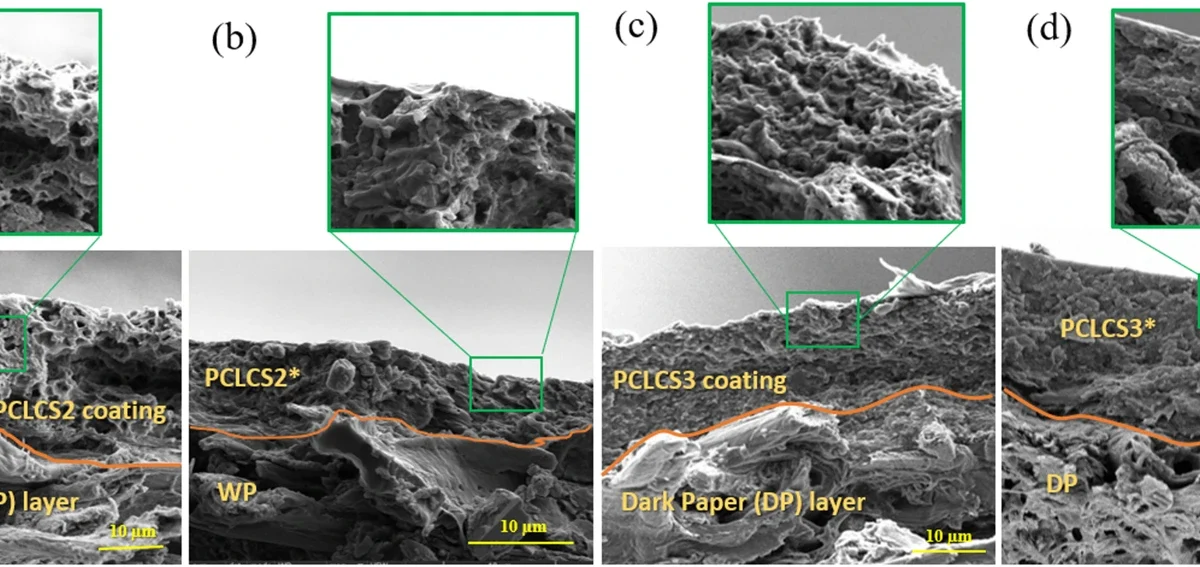
The actual electron micrographs above show how the coating and paper remain a layered physical construction. A locally smoother cross-section after hot pressing is evidence about morphology; it is not, on its own, evidence of the best moisture performance, seal integrity or a successful finished package. Retain the image’s specimen and processing labels when connecting it to a test result.
The next trial needs a package and a recovery route
The authors identify migration studies, real food-packaging validation, and recyclability and compostability testing as future work. The title’s potential end-of-life routes are therefore research directions, not certifications earned by this coated paper. Neither the chitosan name nor a laboratory barrier result establishes food-contact suitability or acceptance by a recycling or composting system. [1]
A useful development handoff would carry the exact construction and test conditions into a converted-pack trial, with separate evidence for product protection, production residues and the intended recovery route. Advance the application only when its limiting function passes. This study gives a concrete candidate and a set of unresolved checks; it does not yet supply a commercial replacement specification.
Sources and image credit
- Obando-Garzón et al. — Sustainable Waterborne Polycaprolactone/Chitosan Coatings for Potentially Recyclable and Compostable Paper-Based Packaging. 20 August 2026; Methods: preparation, oxygen and water-vapour tests; Results: paper systems and Fig. 9; Conclusions; Fig. 7 and rights notice. Accessed 24 October 2026.
Actual coated-paper cross-sections from Obando-Garzón et al., Journal of Polymers and the Environment (2026), Fig. 7: white paper/PCLCS2 before (a) and after hot pressing (b); dark paper/PCLCS3 before (c) and after hot pressing (d), reported at 5000×. Original specimen annotations and 10 µm scale bars retained. © The authors, CC BY 4.0 (licence). Resized and converted to WebP; these are electron micrographs of laboratory specimens, not a schematic or a commercial pack. Image source.
Found an error? Read our corrections policy and contact the editors.