Citral–chitosan coated paper is an active material whose performance depends on its surroundings. In a 2026 Cellulose study, Lungu and colleagues found that citral release differed among water, ethanol-containing and acidic media. That finding makes the intended food exposure part of the development specification, alongside the paper and coating—not a detail to add after selecting a promising laboratory result. [1]
Define the coating and its preparation first
The researchers used 72 g/m² bleached kraft paper and prepared chitosan derivatives with two different glucosamine-to-citral molar ratios, coded C1 and C2. They applied a single coating layer of up to 3 g/m² using a Meyer rod, then dried the paper in ambient conditions for two days. These are laboratory preparation conditions, not a demonstrated industrial drying cycle. [1]
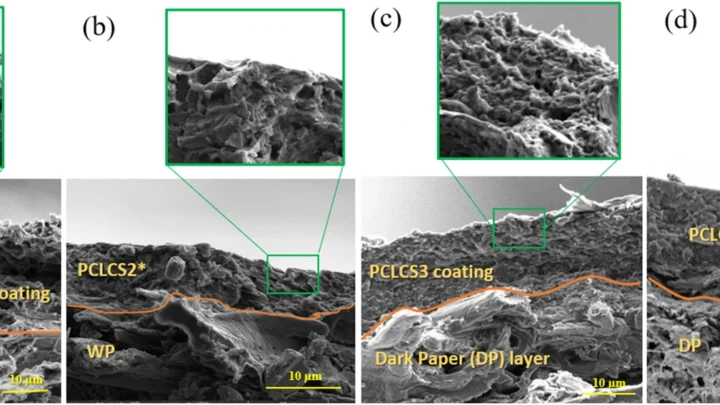
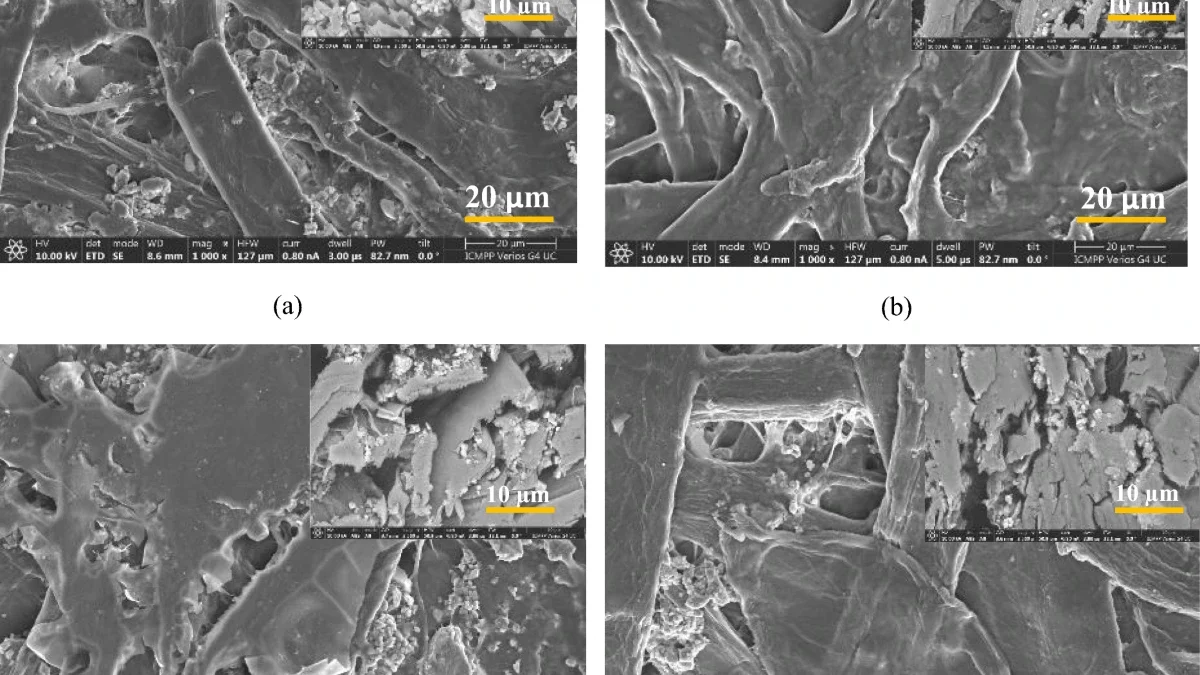
The physical micrographs above identify the reference, unmodified chitosan coating and two derivative coatings. The authors also discuss variation in coating uniformity and the difficulty of distinguishing coating penetration from cellulose in the SEM image without a marker. A photograph of a more covered surface should therefore not substitute for a measured coating distribution or release specification. [1]
The same coating meets different chemical environments
Release was examined in Milli-Q water, 50% ethanol and an aqueous acetic-acid medium at pH 3.84. The researchers used timed sampling with replacement of the withdrawn liquid, and a separate single-sampling experiment after 24 hours. Their results associate release with both the reversible imination process and citral’s solubility in the medium; acidic conditions produced greater release. [1]
For an active-packaging developer, this creates two separate questions. Does the coating deliver the intended function under the actual food’s exposure conditions, and what substances move into that food or its surroundings? A useful next trial preserves the food, contact geometry, temperature and exposure period. Calling citral a natural ingredient does not answer either question or establish food-contact suitability.
Seven days in a Petri dish is a defined model
The food experiment used 42 raspberries divided into seven groups of six, stored in Petri dishes under different covers. Conditions were 25 ± 3°C and 70–80% relative humidity. Eleven institute researchers assessed appearance and smell over seven days, while microbiological analyses examined the stored fruit. The authors report better preservation with the citral-containing papers within that experiment. [1]
That observation is useful for choosing the next experiment, but it is not a seven-day commercial shelf-life promise for every raspberry pack. The small groups, ambient environment, cover arrangement and researcher panel differ from a sealed retail pack travelling through a specified cold chain. A commercial claim needs endpoints and validation for that actual food-and-package system.
Carry the release question into the converted pack
The paper’s barrier tests also have defined conditions: the reported water-vapour method places 0% RH on one side and 50% RH on the other at 23°C. Surface wetting, vapour transfer and the active food experiment answer different questions. An engineer should keep each result attached to its test instead of treating one water-resistance figure as proof of the active package’s overall suitability. [1]
A practical handoff should specify the paper, coating ratio and coat weight, then request release and exposure evidence under intended use. Validate the converted pack’s product protection and relevant microbiological endpoints under its distribution conditions. Add production drying and coating-uniformity controls before scale-up. The study identifies an active-material candidate; those further records determine whether a particular packaging application is ready.
Sources and image credit
- Lungu et al. — Chitosan-citral coated paper: A simple and sustainable approach to eco-friendly food packaging. 13 May 2026; Materials and methods: synthesis, specimen preparation, release and raspberry model; Results: citral release and food preservation; Fig. 2; rights. Accessed 24 October 2026.
Actual paper specimens in Lungu et al., Cellulose (2026), Fig. 2: (a) uncoated reference, (b) chitosan C, (c) citryl-imine chitosan C2 and (d) C1. Surface micrographs with cross-section insets; original 20 µm and 10 µm scale annotations retained. © The authors, CC BY 4.0 (licence). Converted to WebP. These physical specimen micrographs show morphology, not a commercial package or a food-contact clearance. Image source.
Found an error? Read our corrections policy and contact the editors.