Expanded polystyrene has lasted so long in protective packaging for a simple reason: it solves a difficult mechanical problem at low mass. A television corner block, appliance end-cap or electronics cushion has to absorb shock, limit acceleration reaching the product, resist compression in a stack and keep the product located inside the outer box. Replacing the foam therefore requires more than replacing its chemistry.
The real question is not “What material can replace EPS?” It is: what protective structure can keep this specific product below its damage threshold through the actual distribution route?
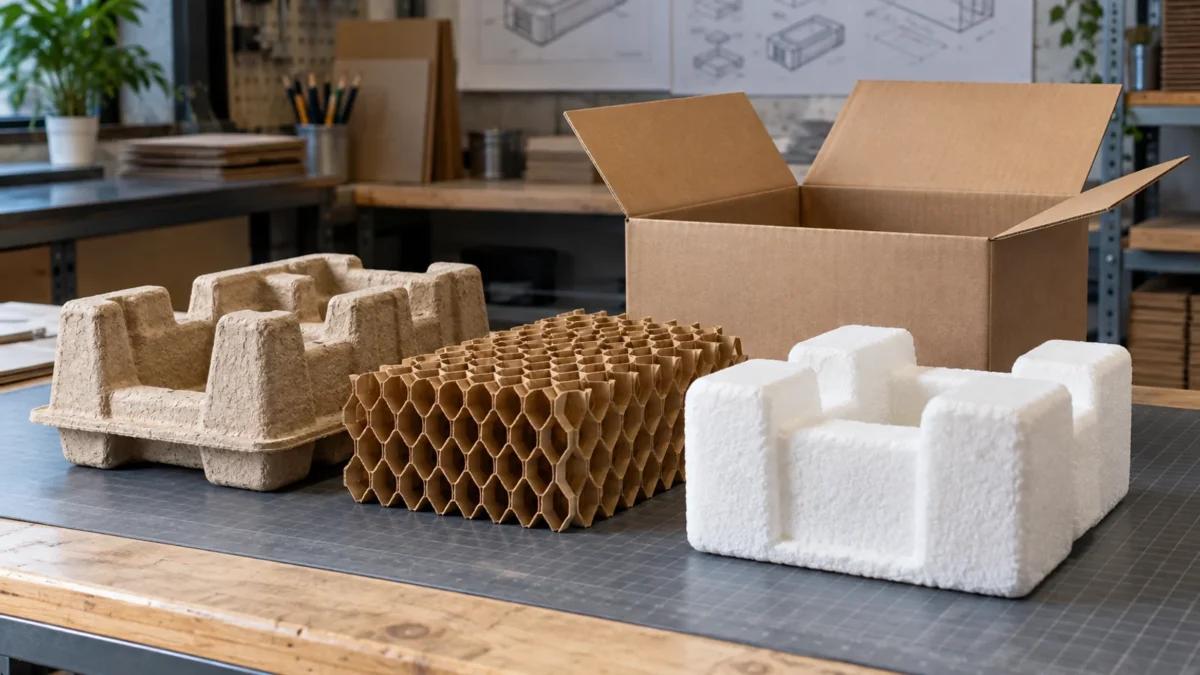
That answer increasingly includes molded fiber, paper honeycomb, engineered corrugated inserts, starch-based loose fill and foams, emerging cellulose foams and reusable protective systems. But they are not interchangeable. Each uses a different mechanism to absorb energy, manage load and occupy space.
Open a protective-packaging decision file before choosing the material
A useful EPS-replacement project starts with the product and route, not a catalogue of “eco” cushions. At minimum, the engineering file should record: [S1] [S2]
- Product mass and geometry: overall weight, centre of gravity, fragile protrusions and supported surfaces.
- Fragility: the acceleration, displacement or local-load condition the product cannot exceed, where known.
- Distribution route: parcel, LTL, palletised freight, export container, internal plant movement or a controlled closed loop.
- Likely hazards: drops, repeated vibration, compression, impacts, humidity, temperature and stacking duration.
- Package geometry: cushion thickness, bearing area, clearances, outer-box strength and whether parts can move inside the pack.
- Operational constraints: nesting, warehouse volume, line speed, assembly labour, tooling and return logistics.
- End-of-life route: the actual collection, sorting, recycling, composting or reuse system expected in the destination market.
ISTA’s 3-Series procedures are built around this same principle: a packaged product is exposed to a sequence of distribution hazards such as vibration, drops and atmospheric conditioning rather than one isolated material test. ASTM D4169 likewise describes a sequence of anticipated hazard elements for evaluating shipping units. Neither method says which cushioning material is “best”; they provide a framework for testing whether the complete package survives its route.
For parcel shipments, ISTA 3A applies to individual packaged-products up to 150 lb (70 kg), while LTL routes have different procedures such as ISTA 3B. Test selection must follow the actual shipment configuration rather than the material being evaluated. See the current ISTA procedure overview and ASTM D4169.
EPS sets the incumbent performance problem
EPS is a rigid cellular plastic that can be moulded around a product and tuned by density and geometry. Industry technical sources emphasise shock absorption, compressive strength, low mass and custom mouldability as reasons it remains common around appliances, electronics, furniture and other fragile goods. [S3]
Those strengths matter when assessing alternatives. A replacement that uses more volume, collapses after one severe impact, loses strength at high humidity or requires a much larger outer carton may still be useful—but it is not an equivalent replacement until the total packaged-product performance is demonstrated.
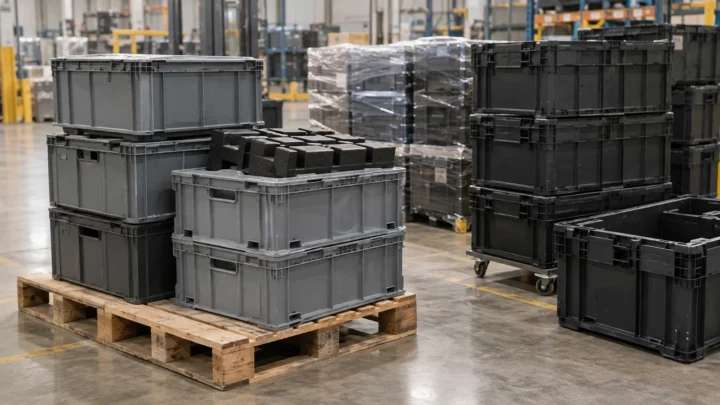
EPP provides useful incumbent context at the other end of the foam spectrum. Expanded polypropylene is often used where repeated impacts, resilience and reusable dunnage matter. BASF, for example, describes its EPP transport-packaging grades as retaining energy absorption after repeated impact loading. That is a manufacturer statement about defined products, but it illustrates why a reusable industrial loop may need a different cushion architecture from a one-way consumer shipment.
Molded fiber: geometry does much of the cushioning work
Molded fiber is attractive because one formed part can locate the product, create ribs and crush zones, separate accessories and sometimes replace several EPS blocks or corrugated pieces. The material name, however, does not predict cushion performance. [S4] [S5]
Peer-reviewed work on molded-pulp cushioning shows strong strain-rate effects. A 2014 study tested molded pulp used around mobile phones under static compression and dynamic impact. Yield stress and energy absorption changed as impact velocity increased. The samples had been conditioned before testing, and the authors treated the molded structure as a geometry-dependent shell rather than a homogeneous foam.
That is important for design review: a static compression curve from a flat material coupon is not automatically a drop-test result for a formed insert. Wall thickness, draft angle, ribs, local buckling zones, contact area and how the product loads the insert all matter.
The same literature also shows why moisture belongs in the test plan. Recent research on molded fiber reports that ambient humidity changes moisture content, which in turn changes modulus, yield and failure behavior. A molded insert qualified in a dry laboratory may therefore need conditioning representative of a humid warehouse, ocean route or tropical distribution environment before equivalent protection is claimed.
The original strain-rate study is available through Materials & Design.

Paper honeycomb: a crushable structure, not simply “thick cardboard”
Paper honeycomb protects by progressive cell-wall deformation. Under compression, the structure moves through an initial elastic response, a crush or plateau region where substantial energy can be absorbed, and eventually densification. Once densified, the structure has much less remaining crush distance and can transmit higher loads to the product. [S6] [S7]
Research on paper-honeycomb sandwich panels shows that cell geometry, relative density, core thickness and liner construction influence dynamic cushioning. Free-drop experiments have found that increasing relative density can increase energy absorption, while changing cell-wall dimensions and core thickness changes the impact response. More recent dynamic-compression work continues to treat paper honeycomb as an engineered cellular structure rather than a generic paper grade.
Humidity is again material. A dedicated study modelled paper-honeycomb energy absorption across different ambient relative humidities and structural ratios. The engineering consequence is simple: a honeycomb block designed from dry-condition compression data should not be assumed to deliver the same plateau stress after prolonged exposure to high humidity.
See the published work on paper-honeycomb impact and energy absorption and humidity-dependent energy absorption.
Engineered corrugated inserts: protection through folds, columns and controlled collapse
Corrugated fiberboard can become a cushion when it is folded, laminated or arranged into load-bearing cells. It is particularly useful when the same blank can provide both structural location and energy absorption without a dedicated moulded part. [S8]
Its performance is highly directional. Flute orientation, number of layers, bearing area, fold geometry and static stress can change the transmitted acceleration during a drop. Published drop-testing work on laminated corrugated cushioning demonstrates that package designers can use static-stress and shock-response relationships to tune a corrugated structure rather than treat the board simply as void fill.
This makes engineered corrugated attractive for flat-pack logistics and shorter development cycles, but “corrugated” is too broad to be a performance specification. A die-cut insert that works around a light cosmetic bottle may not be suitable around a dense motor or appliance compressor.
One open-access example of this approach is the drop-test study of corrugated fiberboard cushioning.
Starch-based foams: closest in appearance, most sensitive to formulation and moisture
Starch foams can resemble expanded plastic foams and are already established in loose-fill applications. Their cushioning behaviour depends on formulation, moisture content, expansion, cell structure and additives. [S9] [S10]
That dependence is the main design boundary. Research on starch-based cushioning materials repeatedly identifies water sensitivity as a limitation. Relative humidity can change mechanical behaviour because water plasticises or weakens the starch network. Recent work continues to modify starch foams with PVA, fibres, chitosan derivatives or other components to improve water resistance, recovery and compression properties.
A 2025 study of extruded starch-based foam, for example, found that foam expansion, water absorption and mechanical recovery varied with feed moisture, PVA polymerisation degree and added carboxymethyl chitosan. Those results describe a specific formulation—not “starch foam” as a universal material.
That distinction also matters at end of life. A foam containing starch, PVA, fibres, coatings or other additives should not be labelled compostable or biodegradable as a finished package merely because starch is the major feedstock. Certification, environmental conditions and local facility acceptance must be checked on the finished construction.
The 2025 formulation study is available in Carbohydrate Polymers.
Cellulose foam: promising cushioning data, but not yet one standard commercial material
Foam-formed cellulose is developing as a lower-density fibre cushion between conventional molded pulp and synthetic foams. A 2022 review identified low density, cushioning potential and renewable fibre feedstocks as attractive features, while also highlighting reduced mechanical strength at low density and water sensitivity as technical challenges. [S11] [S12]
Research has progressed. A 2024 open-access study examined 129 foam-formed cellulose trial points across densities, fibre types, refining levels, additives and forming conditions to understand energy absorption and resilience under quasi-static compression. Newer work continues to improve recovery, compressive strength and even sensing functions.
The important editorial boundary is commercial maturity. “Cellulose foam” covers several structures and formulations—foam-formed fibre networks, aerogels, capillary foams and composite systems. Laboratory performance from one formulation should not be transferred to another, and none should be declared an EPS-equivalent protective insert without packaged-product testing.
For technical background, see the 2022 cellulose cushioning review and the 2024 energy-absorption study.
The drop-test matrix changes with the product
| Application | Primary protection risk | Formats worth evaluating | Evidence that matters most |
|---|---|---|---|
| Small electronics | Corner shock, connector damage, cosmetic scuffing, parcel drops | Molded fiber, engineered corrugated, cellulose foam, EPS | Packaged-product drop sequence, vibration, product acceleration, retention after first impact |
| Large appliance | High product mass, edge/corner load, compression, repeated handling | EPS, EPP, honeycomb, heavy engineered corrugated, hybrid fiber/foam systems | Compression, impact under realistic mass, pallet/LTL route, humidity conditioning |
| Glass bottle / cosmetics | Local contact stress, bottle-to-bottle collision, appearance damage | Molded fiber, corrugated cells, honeycomb, cellulose cushion | Drop orientation, divider movement, abrasion, pack fit and moisture exposure |
| Automotive / industrial part | High mass, sharp edges, repeat handling, oil/chemical exposure | EPP/reusable dunnage, honeycomb, heavy corrugated, molded fiber where suitable | Repeated impacts, compression set, contamination resistance, return-loop durability |
| Furniture component | Large surface area, edge damage, abrasion, warehouse stacking | Honeycomb, corrugated edge protectors, molded fiber corner forms, selected foams | Edge compression, long-duration stacking, vibration, abrasion and carton interaction |
Warehouse cube can reverse the material decision
Protective performance is only part of the system. EPS end-caps can be extremely light but occupy a large volume before use. Some molded-fiber parts can nest deeply; die-cut corrugated arrives flat; honeycomb may ship compressed or in panels; loose fill consumes storage volume unless generated or expanded close to packing; reusable EPP occupies space but may circulate many times. [S1] [S2] [S4] [S6]
Those differences affect warehouse cube, inbound freight, line-side inventory and packing labour. They also affect the outer box. If an alternative cushion needs more thickness to deliver equivalent shock attenuation, the finished shipper may become larger even when the cushion itself appears preferable on a material basis.
This is why a credible comparison uses the finished shipping unit: product + cushion + box + void space + palletisation, not kilograms of cushioning material alone.
Tooling is a commercial boundary, not proof of performance
Molded EPS, molded fiber and moulded EPP generally require geometry-specific tooling. Corrugated inserts and honeycomb structures may be developed with cutting dies, scoring and assemblies rather than deep moulds. Starch loose fill can avoid product-specific tooling but sacrifices precise product location. Reusable dunnage can justify more durable tooling where the same geometry circulates repeatedly. [S4] [S8]
Those are real procurement differences, but they are not universal cost rankings. Tool cost, cavity count, annual volume, automation, labour and freight vary too much between projects to support a generic statement that one format is “cheaper than EPS.” Article 73 therefore treats tooling as a decision boundary rather than publishing unsupported unit-cost comparisons.
Recovery claims have to follow the finished construction
Fiber-rich protective packaging can be designed toward paper recovery, but liners, adhesives, coatings, contamination and local mill acceptance still matter. Molded fiber made from recycled pulp is not automatically accepted in every paper stream. Paper honeycomb may contain face papers and adhesives that change repulpability. [S1] [S11]
Starch-based foam may be bio-based, biodegradable or certified compostable in some formulations, but that status cannot be inferred from the word “starch.” Cellulose foams can include crosslinkers, strength additives or coatings. EPS and EPP can be mechanically recycled where appropriate collection and reprocessing exist, but technical recyclability does not prove convenient local access or actual recycling.
The end-of-life question should therefore be asked after the protective design has been frozen, with the exact construction, destination market and collection/reprocessing route known.
The replacement decision is made after the test, not before it
A useful EPS-replacement programme can be reduced to one sequence: [S1] [S2]
- Define the product fragility and route.
- Shortlist structures that can physically fit the required crush distance and support area.
- Condition them for the relevant temperature/humidity where fiber or starch systems are sensitive.
- Run the complete shipping unit through the appropriate drop, vibration and compression sequence.
- Inspect both the package and the product. Cosmetic survival is not enough if connectors, calibration, glass seals or internal assemblies are damaged.
- Repeat where multiple impacts or reuse are part of the real route.
- Only then compare warehouse volume, assembly, tooling, recovery and total system cost.
That process explains why there is no single material replacing EPS. Molded fiber is strong where geometry can be engineered into formed ribs and crush zones. Honeycomb works as a high-energy-absorbing paper structure for larger loads. Corrugated inserts can combine location and cushioning with flat logistics. Starch foam is credible in selected loose-fill and cushioning formats but remains moisture- and formulation-sensitive. Cellulose foam is technically promising but still varies widely by process and formulation. EPP and reusable dunnage remain relevant when repeated impacts and closed-loop logistics dominate.
The right replacement is the one that passes the required distribution test with the actual product, at the required environmental condition, inside the final shipping pack. Without that evidence, “EPS alternative” is a material description—not a protection claim.
Methodology and editorial note
This is a sourced qualification framework, not an independent impact or protective-performance test. Material studies address their tested compositions; an insert must be qualified with the actual product and distribution route. Sources checked 21 October 2026. The main image is an AI-generated generic editorial illustration, not a named company, real facility or tested product. Editorial Team human review remains pending after publication.
Sources and reference notes
- [S1] International Safe Transit Association (ISTA). Test Procedures — International Safe Transit Association. General Simulation Tests; Procedure 3A; Procedure 3B. Accessed 21 October 2026.
- [S2] ASTM International. ASTM D4169-23e1 — Standard Practice for Performance Testing of Shipping Containers and Systems. Scope; Significance and Use. Accessed 21 October 2026.
- [S3] EPS Industry Alliance. EPS Packaging / Cushion Curve resource. Protective packaging / custom moulding overview. Accessed 21 October 2026.
- [S4] Molded pulp strain-rate study. Effect of strain rate on cushioning properties of molded pulp products. Abstract; physical performance; static compression/dynamic impact; energy absorption sections. Accessed 21 October 2026.
- [S5] Molded fiber humidity/moisture study. Study on the mechanism and law of temperature, humidity and moisture content on the mechanical properties of molded fiber products. Abstract. Accessed 21 October 2026.
- [S6] Paper honeycomb impact study. Impact behavior and energy absorption of paper honeycomb sandwich panels. Abstract; introduction. Accessed 21 October 2026.
- [S7] Paper honeycomb humidity model. Mathematical modelling of energy absorption property for paper honeycomb in various ambient humidities. Abstract. Accessed 21 October 2026.
- [S8] Corrugated cushioning drop-test study. Shock Absorption Characteristics and Optimal Design of Corrugated Fiberboard Using Drop Testing. Methods; in-package experiment; results. Accessed 21 October 2026.
- [S9] Starch foam 2025 study. Optimization of starch foam extrusion through PVA polymerization, moisture content control, and CMCS incorporation for enhanced antibacterial cushioning packaging. Abstract; highlights. Accessed 21 October 2026.
- [S10] Starch cushion process/formulation study. Effect of formulation and process on the extrudability of starch-based foam cushions. Abstract; introduction; conclusion. Accessed 21 October 2026.
- [S11] Cellulose cushioning review. Overview on Foam Forming Cellulose Materials for Cushioning Packaging Applications. Abstract; introduction; strength/water-resistance discussion; conclusions. Accessed 21 October 2026.
- [S12] Cellulose energy-absorption study. Energy absorption and resilience in quasi-static loading of foam-formed cellulose fibre materials. Abstract; material/trial description. Accessed 21 October 2026.
- [S13] BASF. As blue as the sky: new Neopolen color grade for transport boxes, toys and leisure products. Neopolen/EPP properties and applications. Accessed 21 October 2026.
The public corrections channel is currently inactive. Read our corrections policy.