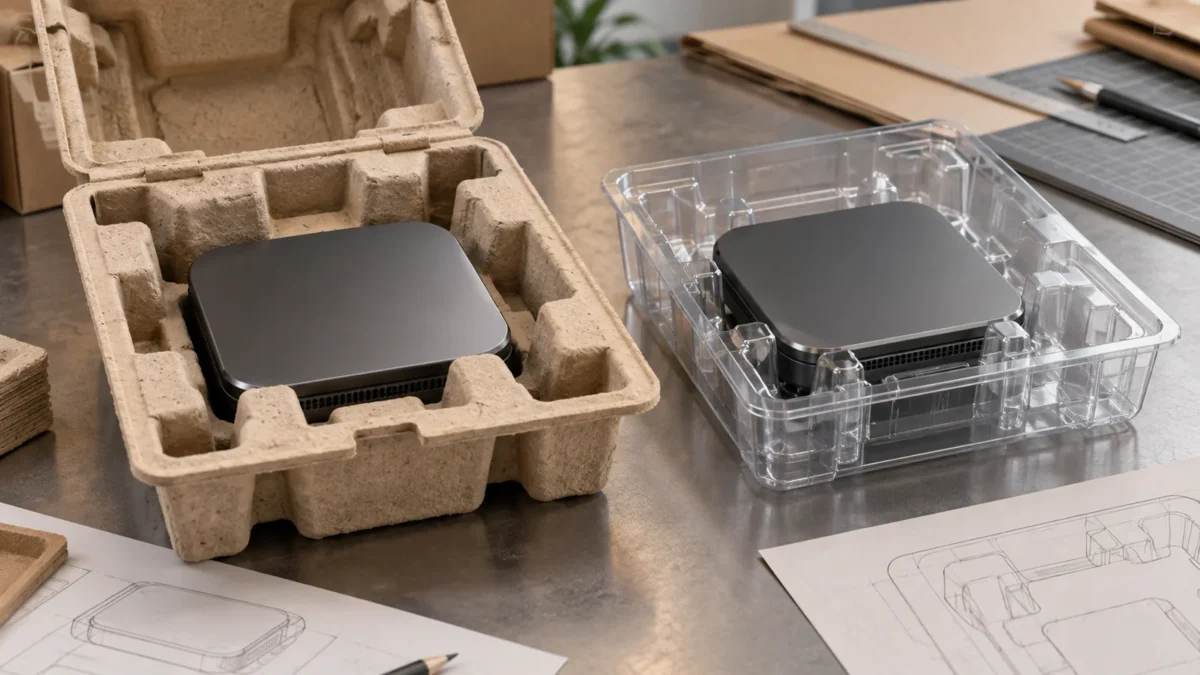
Open a modern electronics box and the first material change is often not the product shell, the cable or the charger.
It is the insert.
The thermoformed plastic tray that once held a phone, mouse, headset, cosmetic jar or accessory in position is increasingly being replaced by molded fiber, folded paperboard or other fiber-based structures.
That switch can look simple from the outside.
It is not.
The insert has to do more than fill space. It has to locate the product, absorb shock, resist vibration, protect fragile surfaces, hold accessories, survive humidity, run through packing operations and still present the product cleanly when the box is opened.
A molded-fiber insert only replaces a plastic tray when it replaces the tray’s mechanical job—not merely its material.
Why electronics became an early proving ground
Electronics provide unusually demanding evidence because products can be high-value, fragile and dimensionally precise. [S1] [S2]
Apple’s packaging history makes the progression visible.
The company says it replaced two HIPS plastic trays with one molded-fiber tray for iPhone 7 in 2016, moved the first iPad away from a plastic tray in 2017, used molded fiber for MacBook in 2018, and later replaced foam cushioning in larger products with molded fiber and corrugated spring structures.
By 2026, Apple reported that all new Apple products shipped in 100% fiber-based packaging within its stated packaging-goal boundary, which excludes inks, coatings and adhesives and retains limited vintage/refurbished exceptions.
The important part is not the headline percentage.
It is the engineering sequence behind it:
- replace a rigid plastic locating tray;
- replace foam cushioning;
- replace cable wraps and accessory holders;
- remove plastic films and labels;
- validate fiber-based structures for multiple product families.
That progression shows why inserts matter.
They are one of the first places a package can remove rigid plastic without changing the product itself.
The insert has three jobs: locate, cushion and present
| Function | What it means in practice | Failure mode |
|---|---|---|
| Locate | Keep product and accessories in the intended position | Movement, abrasion, collisions, poor unboxing |
| Cushion | Absorb shock, vibration and compression during distribution | Cracked product, broken screen, damaged bottle or component |
| Present | Maintain dimensional appearance, cleanliness and fit | Dust, rough edges, loose fit, visible deformation |
Thermoformed plastic performs these jobs efficiently because it can be thin, dimensionally consistent, smooth and deeply formed. [S8]
EPS and other foams are strong at energy absorption and can be designed around fragile products.
Molded fiber has to reproduce enough of those functions with a different material system and a different failure behavior.
Molded fiber protects by controlled deformation
Fiber cushioning works partly because ribs, cones, walls and crush zones deform under load. [S8]
Research on molded-pulp packaging used for mobile phones has shown that its load-carrying and energy-absorption behavior changes under dynamic impact compared with static compression. The same work identified buckling as part of the energy-absorption process.
That matters because protective packaging should not simply be “strong.”
If it is too rigid, impact energy can transfer directly into the product.
If it is too weak, the insert collapses before it absorbs enough energy.
The useful design is a structure that deforms predictably within the required distribution environment.
Cushioning is a geometry problem as much as a fiber problem.
Ribs and crush zones replace some of what foam used to do
A molded-fiber tray can be engineered with: [S8] [S9]
- vertical support ribs;
- angled walls;
- cones;
- bridges;
- corner cushions;
- localized crush zones;
- product-contact pads;
- accessory pockets.
The shape controls where the package bends and collapses.
This is why a tray molded to the outline of a device is not automatically a protective package.
The engineer still needs to understand where the product is vulnerable, how much clearance exists, where the center of gravity sits and which surfaces must never contact the outer carton during a drop.
Apple’s molded fiber shift is more than cosmetic substitution
Apple’s 2026 Environmental Progress Report says its engineers replaced foam cushioning with molded-fiber structures and corrugated spring cushions across product packaging. [S1] [S2]
The company also states that its packaging design guidelines require fiber-based materials to break down into pulp in mixed-paper recycling systems, and that it tests packaging against methods from organizations including Western Michigan University and Cepi.
That is a useful boundary.
Fiber-based packaging is not automatically accepted simply because it is made from paper pulp.
The company’s approach treats recyclability and mechanical performance as separate qualification questions.
The product still has to survive distribution.
The fiber structure still has to enter the intended paper-recycling route.
HP shows the same trend from another electronics system
HP says it uses molded-fiber cushions in packaging for selected PCs, printers and toner-related products and has developed its own molded-fiber tooling technology. [S4] [S6]
HP says its June 2025 interim milestone reached a reported 75% reduction in average single-use plastic packaging per shipped unit against 2018, citing rounded figures of 221 grams and 61 grams. HP separately reports a 72% full-year 2025 reduction after its product mix changed later in the year. The rounded 221-to-61-gram comparison yields about 72.4% by arithmetic and should not be presented as the basis for the company’s 75% interim figure.
HP’s packaging specifications also require major dissimilar packaging components to be separable under stated conditions and generally restrict multilayer plastic packaging unless needed for function.
The example is useful because it shows that fiber inserts are part of a broader packaging-system redesign rather than an isolated material substitution.
Not all molded fiber is the same product class
This is where the phrase “molded pulp tray” becomes too broad. [S8]
Industrial protective inserts can differ significantly in:
- fiber source;
- pulp refining;
- forming process;
- pressing pressure;
- drying method;
- density;
- wall thickness;
- surface finish;
- tooling precision;
- trim quality.
A rough dry-formed protective end cap for an appliance does not have the same appearance or dimensional tolerance as a smooth wet-pressed insert for a perfume bottle or electronics accessory.
This distinction is commercially important.
Protection, automation and shelf presentation demand different process windows.
Electronics care about tolerance as much as cushioning
A smartphone or earbud case can require a tight fit. [S8]
If the cavity is too loose, the product moves. If it is too tight, packing becomes slow or the surface can be marked. Cable channels, accessory wells and charging components may need their own tolerances.
Fiber also behaves differently from thermoformed plastic because it is hygroscopic.
Moisture uptake can change stiffness, dimensions and cushioning behavior.
Research on molded pulp cushioning has shown that increasing relative humidity can reduce elastic modulus and buckling stress under the tested conditions.
That makes humidity conditioning important when the package may move between dry factories, humid warehouses and long international distribution routes.
A tray that fits perfectly at one laboratory condition may not behave identically after moisture exposure.
Beauty changes the priority from shock protection to finish quality
Cosmetics and personal care use molded-fiber inserts for a different reason. [S8]
A glass serum bottle or fragrance can still need protection, but the consumer also sees the tray as part of the presentation.
The insert may need:
- a smooth surface;
- precise cavities;
- clean edges;
- consistent color;
- embossed or debossed branding;
- low visible dust;
- controlled fiber texture.
That creates a different trade-off from electronics.
A rough molded-pulp cushion can be mechanically adequate and still fail the brand requirement.
Conversely, a beautifully pressed tray can fail distribution if its ribs, bottle restraint or drop-clearance geometry is insufficient.
Premium appearance and protection have to be qualified separately.
Glass bottles make the beauty insert mechanically serious
Luxury skincare and fragrance often use glass primary packages. [S8]
That means the insert may have to protect a brittle, heavy object with concentrated contact points.
A fiber cavity that is too hard at the wrong location can transmit impact into the glass. Too much clearance can allow the bottle to accelerate before striking the insert. Too little clearance can make packing difficult or create pressure on decorated surfaces.
For multi-product gift sets, another risk appears:
the products can damage each other.
So the insert must control spacing as well as cushion the outer-package impact.
Consumer electronics prove fiber inserts can reach high volume
Apple is not the only electronics company shifting packaging this way. [S1] [S4] [S7]
Logitech announced in 2025 that it was moving tens of millions of products away from plastic clamshell packaging and toward paper-based systems. It has also described molded-pulp hang tabs and other fiber components as part of its packaging program.
HP’s current strategy likewise prioritizes molded fiber where practical.
These examples do not prove that molded fiber should replace every thermoformed tray.
They prove something narrower and more useful:
fiber-based protective structures can operate at mass-market electronics scale when geometry, tooling, packing and distribution testing are solved.
The distribution test has to use the complete packaged product
A compression test on an empty tray is not enough. [S11] [S12] [S13]
ISTA guidance emphasizes that packaged-product testing should reflect the actual distribution environment, including shock, drop, vibration, compression and atmospheric conditions.
For parcel systems, test protocols can include random vibration and repeated drop sequences. Atmospheric conditioning is relevant when temperature or humidity may affect package performance.
ISTA also states that package testing should be repeated when changes to the product, package, materials, components, manufacturing process or distribution system could affect performance.
That rule is particularly important when replacing a thermoformed plastic insert with molded fiber.
The material change alters several variables at once:
- cushion stiffness;
- humidity response;
- part retention;
- friction;
- clearance;
- wall geometry;
- outer-box interaction.
The redesign therefore needs packaged-product testing—not a paper specification alone.
Fiber can reduce part count—but only if the geometry is integrated
One of molded fiber’s strongest design opportunities is combining several packaging functions into one formed part. [S2]
A single tray can sometimes replace:
- a plastic locating tray;
- a separate accessory pocket;
- foam pads;
- paperboard dividers;
- small plastic clips.
Apple’s early iPhone redesign is a clear example: the company says one molded-fiber tray replaced two HIPS trays.
That is more significant than simply swapping one tray material for another.
It is functional integration.
But integration also concentrates risk. If one fiber component performs several jobs, a dimensional or strength failure can affect several parts of the pack simultaneously.
Nesting and cube efficiency matter before the insert reaches the product
Thermoformed plastic trays can nest tightly. [S9]
Molded-fiber inserts can also be designed to nest, but wall angles, ribs and depth affect how efficiently they stack for shipment to the packing line.
A deep protective structure that uses little material may still consume significant transport or warehouse volume if it cannot nest well.
This is another reason why “grams per tray” is not enough to compare the two systems.
The relevant manufacturing system includes:
- tool count;
- forming cycle;
- drying energy;
- trim operations;
- nested shipment density;
- packing-line feeding;
- reject rate;
- outer-box dimensions.
Tooling is where design intent becomes production reality
Molded fiber is shape-specific. [S6]
That means tooling quality directly affects:
- cavity dimensions;
- wall distribution;
- surface marks;
- drainage;
- drying;
- part release;
- repeatability.
For a low-volume protective end cap, looser tolerances may be acceptable.
For a premium beauty tray or automated electronics pack-out, the tooling requirement can be much tighter.
This is where sampling matters.
A CAD model can show geometry.
It cannot prove that the molded part will shrink, dry, trim and feed through production exactly as expected.
Fiber source should not be used as a shortcut for performance
Molded fiber can be made from recycled paper, virgin wood fiber, bagasse, bamboo and other plant fibers. [S8]
Those feedstocks can differ in fiber length, cleanliness, color and forming behavior.
But a product should not be selected simply because one feedstock sounds more sustainable.
The relevant question is what the finished insert actually needs to do.
A recycled-fiber end cap for a printer and a smooth bleached bagasse insert for a cosmetic jar may serve different markets even if both are “molded fiber.”
As the Materials cluster established earlier, molded fiber is not one material and its performance depends on fiber system, process and geometry.
Paper recyclability still belongs to the finished insert
A plain molded-fiber insert may have a relatively straightforward paper-recycling route. [S9]
But premium packaging can add:
- coatings;
- dyes;
- laminations;
- foil effects;
- adhesive labels;
- soft-touch finishes;
- magnetic components.
Those additions can change sorting and mill behavior.
This is especially relevant in cosmetics, where the insert is part of the brand presentation.
A designer can unintentionally recreate the same multi-material complexity that the fiber tray was intended to remove.
The correct claim is therefore not:
“molded fiber is recyclable.”
It is:
“the finished insert must remain compatible with the intended paper-recycling route.”
Where molded fiber is a strong replacement candidate
The format is especially promising when the product needs location, moderate cushioning and a custom cavity without extreme barrier or static-control requirements. [S1] [S4]
Typical strong candidates include:
- phones and small electronics;
- earbuds and accessories;
- computer peripherals;
- cosmetic jars and bottles;
- fragrance gift sets;
- small appliances;
- consumer accessories;
- premium home goods.
The common feature is not the industry.
It is that a formed insert can replace a rigid locating or protective component while the outer carton carries the package.
Where plastic or foam can still be difficult to replace
Molded fiber becomes more difficult when the application requires: [S9] [S12]
- very high energy absorption in limited space;
- extremely low dust;
- electrostatic discharge control;
- water resistance over long exposure;
- very tight dimensional tolerance;
- sterile or controlled-cleanliness conditions;
- transparent product display;
- extreme drop performance for heavy products.
In those applications, plastic, foam or hybrid systems may still provide useful functions that the fiber design has to reproduce before substitution is credible.
The right conclusion is not that fiber “cannot” do these jobs.
It is that the burden of evidence becomes higher.

The insert decision file
| Decision factor | Plastic tray / foam baseline | Molded-fiber question |
|---|---|---|
| Product retention | Precise formed cavity | Can molded tolerance hold the product without excessive force or movement? |
| Shock / drop | Known tray or foam response | Do ribs and crush zones absorb the required event? |
| Vibration | Stable geometry / friction behavior | Will movement, abrasion or fiber wear appear over time? |
| Humidity | Usually limited mechanical change | How does moisture affect stiffness, dimensions and cushioning? |
| Surface quality | Smooth and repeatable | Is finish adequate for electronics or premium beauty? |
| Automation | Consistent nesting / feeding | Can parts denest and place reliably at commercial speed? |
| Tooling | Thermoforming / foam tooling | Can molded-fiber tools hold required geometry and output? |
| Recycling | Depends on resin and local system | Does finished fiber insert remain compatible with target paper stream? |
| Cube efficiency | Often highly nestable | Do wall angles and ribs allow dense inbound shipment? |
Inside-the-box rule
The shift from plastic trays to molded fiber is real, and electronics show that it can scale far beyond niche packaging. [S11] [S13] [S11]
But the successful switch is not driven by the word “fiber.”
It happens when the insert is redesigned around the product and the distribution system.
For electronics, that means controlled shock, vibration, humidity, tolerance and automation.
For cosmetics, it adds surface quality, color, dust control and glass protection.
For consumer goods, it can mean integrating several locating and cushioning components into one molded part.
The strongest replacement case is therefore:
plastic tray or foam function identified → fiber geometry engineered → real molded samples produced → complete packaged product conditioned and distribution-tested → recovery route verified.
If the project stops at “the CAD tray fits,” the package is not finished.
Methodology and editorial note
Company-reported Apple and HP transitions are kept within their disclosed packaging-goal scopes. Mechanical studies and ISTA procedures establish questions for qualification; no complete packaged product was tested for this article. Sources checked 20 October 2026. The main image is an AI-generated editorial illustration of a generic packaging scene; it does not depict a named product, facility, company or test.
Sources and reference notes
- [S1] Apple. Environmental Progress Report 2026. Apple 2026 Environmental Progress Report. Company statements are attributed; scientific/technical claims are limited to the stated test or review scope. Accessed 20 October 2026.
- [S2] Apple. Environmental Progress Report 2025. Apple 2025 report / recyclability testing boundary. Company statements are attributed; scientific/technical claims are limited to the stated test or review scope. Accessed 20 October 2026.
- [S4] HP. Has HP established environmental guidelines for product packaging?. HP packaging environmental guidelines 2026. Company statements are attributed; scientific/technical claims are limited to the stated test or review scope. Accessed 20 October 2026.
- [S6] HP. HP Molded Fiber Advanced Tooling Solution. HP molded fiber tooling/application. Company statements are attributed; scientific/technical claims are limited to the stated test or review scope. Accessed 20 October 2026.
- [S7] Logitech. Smarter Design, Less Waste: Logitech Fully Transitions to Paper Packaging. Logitech paper transition. Company statements are attributed; scientific/technical claims are limited to the stated test or review scope. Accessed 20 October 2026.
- [S8] Molded pulp cushioning. Effect of strain rate on cushioning properties of molded pulp products. Molded pulp cushioning / strain-rate study. Abstract/indexed record only unless retained source capture proves full text; no precise result inferred from an inaccessible paper. Accessed 20 October 2026.
- [S9] Relative humidity and molded pulp cushioning. Influence of relative humidity on energy absorption properties of molded pulp cushioning packaging for mobile phone. Relative humidity and molded pulp cushioning. Company statements are attributed; scientific/technical claims are limited to the stated test or review scope. Accessed 20 October 2026.
- [S11] International Safe Transit Association. Getting Started with Design & Testing. ISTA design/testing guidance. Company statements are attributed; scientific/technical claims are limited to the stated test or review scope. Accessed 20 October 2026.
- [S12] ISTA. Test Procedures. ISTA test procedures. Company statements are attributed; scientific/technical claims are limited to the stated test or review scope. Accessed 20 October 2026.
- [S13] ISTA. When should a packaged-product be retested?. ISTA retest rule. Company statements are attributed; scientific/technical claims are limited to the stated test or review scope. Accessed 20 October 2026.
The public corrections channel is currently inactive. Read our corrections policy.