
In a 15 September 2026 company report, Sidel said Arpanon commercialised a 600 ml PET water bottle in Thailand at a stated weight of nine grams on its 36,000-bottle-per-hour line.
The supplier behind the redesign said the bottle was about 30% lighter than the previous specification while still exceeding 30 kilograms of top-load performance and running on a 36,000-bottle-per-hour line.
The important number is not nine grams.
It is what had to remain true after those grams were removed.
The bottle still had to survive blowing, filling, capping, conveyors, packing, stacking, transport and consumer handling. The same engineering problem appears in shampoo bottles, detergent containers, cosmetic jars and thin-wall polypropylene tubs.
Lightweighting is not the act of making every wall thinner. It is the act of putting less material only where the package can afford to lose it.
Every gram has a structural job
A rigid package carries loads through its geometry. [S2] [S3]
Material near the neck may resist closure torque and capping loads. The shoulder helps transfer vertical force. Sidewalls resist squeeze, vacuum, handling and label-panel deformation. The base keeps the container standing and may carry internal pressure. A jar rim or tub flange has to remain stiff enough for lidding, snap-fit closure or denesting.
This is why the first lightweighting question should not be:
How much resin can we remove?
It should be:
Where does the package actually carry load?
| Package zone or function | Typical duty | Failure if pushed too far |
|---|---|---|
| Neck / finish | Closure engagement, torque, capping load, seal geometry | Distortion, leakage, cap-fit problems |
| Shoulder | Transfers vertical load into the body | Buckling or shoulder collapse |
| Sidewall | Squeeze resistance, handling, label stability, stacking support | Paneling, denting, ovalisation, poor consumer feel |
| Base | Standing stability, top-load path, pressure or hot-fill response | Rocking, base roll-out, stress concentration |
| Tub wall | Stacking, squeeze, cold/heat handling | Cracking, deformation, poor rigidity |
| Rim / flange | Lidding, snap-fit closure, denesting, robotic handling | Warping, closure failure, line jams |
The bottle is not a uniform tube
PET bottles are a useful example because stretch blow molding intentionally redistributes material. [S2]
The preform is reheated, stretched axially and expanded radially inside a mold. Heating profile, preform design, stretch-rod movement and pre-blow conditions all influence where the final wall becomes thick or thin.
Published simulation and experimental work has shown that changes in stretch rate and pre-blow pressure can move material toward or away from different bottle regions. Structural analysis then uses the resulting thickness distribution to evaluate loads such as top compression and internal pressure.
That means two bottles with the same total weight can behave differently.
One may have too much PET trapped in a low-stress region and too little in the shoulder or base. The second may distribute the same mass more efficiently and carry a higher load.
Weight is an input. Thickness distribution is the design.
Geometry can replace some of the stiffness removed with resin
Once walls become thinner, shape matters more. [S1]
Designers can use:
- vertical ribs;
- circumferential beads;
- panel geometry;
- controlled curvature;
- base features;
- shoulder transitions;
- smaller or redesigned neck finishes;
- strategic local stiffness.
A rib does not create material. It changes how a thin wall resists deformation.
The principle is similar to corrugation in paperboard or formed ribs in sheet metal: geometry can increase structural stiffness without simply making the entire wall thicker.
Commercial PET lightweighting concepts use this deliberately. The 2026 nine-gram bottle, for example, was not described as a uniformly thinner version of the old bottle. Its developer said the project combined preform design, bottle development and line optimisation to retain the required vertical-load performance.
That is the correct way to read a lightweighting claim.
Ask what changed in the structure and process—not only how many grams disappeared.
Top load is important, but it is not the whole package
Top load is one of the most quoted rigid-container measurements because bottles and containers experience vertical forces during capping, packing and stacking. [S4] [S5]
ASTM D2659 provides a standard method for measuring the column-crush properties of blown thermoplastic containers. It can report crushing yield load, deflection and apparent crushing stiffness.
The same standard also contains an important warning: a column-crush test represents the conditions of that test. Applications with different load-time behavior may need additional impact, creep or fatigue testing.
This matters for lightweighting.
A bottle that survives a short compression test may still deform slowly under a long warehouse stack. A detergent bottle may pass top-load testing but fail a drop. A cosmetic jar may be stiff when empty but distort after hot filling or prolonged product contact.
So “top load maintained” is useful evidence.
It is not a complete package qualification.
Creep becomes more visible as safety margins shrink
Rigid polymers are viscoelastic. [S3]
Under sustained load, they can continue to deform over time even when the initial force does not cause immediate failure.
For heavier rigid packs, excess wall thickness can hide this behavior.
As the package is lightweighted, the margin between normal deformation and unacceptable paneling or buckling can become smaller.
This is why warehouse dwell time, pallet pattern, temperature and secondary packaging can matter as much as a short laboratory compression value.
A lightweight design should therefore distinguish:
instantaneous strength from long-duration load resistance.
Thin-wall tubs have a different manufacturing problem
A polypropylene tub is not usually made like a PET bottle. [S6]
Thin-wall tubs, yogurt cups, deli containers and some cosmetic jars are commonly injection molded. As the wall becomes thinner, molten polymer has less time to reach the end of the mold cavity before it freezes.
That changes the process window.
Research on thin-wall polypropylene molding shows that injection speed, melt temperature and holding pressure affect both physical quality and compressive performance. Other work has shown that injection conditions alter the skin-core morphology and fracture behavior of thin PP sections.
In practice, thin-wall molding therefore depends on a combination of:
- high enough melt flow for the geometry;
- fast and repeatable cavity filling;
- mold temperature control;
- gate location;
- packing and holding pressure;
- cooling;
- resin stiffness and toughness;
- part ejection without buckling.
A tub can be lighter and still fail economically if it short-shots at the rim, warps after ejection or jams a high-speed filling line.
The rim may matter more than the wall average
For jars and tubs, the flange, rim and closure interface often become the non-negotiable zones. [S7]
A heat-sealed yogurt tub needs a stable flange. A snap-lid deli container needs consistent geometry. A cosmetic jar needs threads or a closure interface that maintains fit after molding, filling and storage.
This is why lightweighting rarely proceeds by reducing every dimension by the same percentage.
Designers may keep more material at:
- threads;
- snap beads;
- seal lands;
- flanges;
- hinges;
- handling features;
while removing more material from broad wall sections where geometry can recover the needed stiffness.
Hot fill changes the structural equation
Temperature reduces stiffness and changes internal stresses. [S2]
A rigid pack that performs well at room temperature may behave very differently when filled hot, pasteurised, microwaved, frozen or moved repeatedly between temperature conditions.
Hot-fill PET bottles are a classic example. The container must resist thermal shrinkage, vacuum formation during cooling and vertical loads in the supply chain.
Thin-wall PP tubs face their own thermal conditions: hot filling, reheating or low-temperature handling can change stiffness, impact resistance and dimensional stability.
For this reason, the useful lightweighting question is never simply:
Does the empty package pass?
It is:
Does the filled package pass under the complete temperature and distribution cycle?
Carbonated products add internal pressure
Still-water bottles and carbonated-beverage bottles do not carry the same structural loads. [S2]
Internal pressure changes how the sidewall and base work. Material distribution, orientation and base geometry become more critical, while barrier and carbonation-loss requirements can also place limits on wall reduction.
That is why a very light still-water bottle cannot be used as a universal benchmark for beverage packaging.
Likewise, a thin shampoo bottle cannot automatically become a household-chemical bottle simply because the polymer is the same. Product chemistry, permeation, stress cracking, squeeze behavior and closure system can change the required design margin.
Recycled content changes the process window, not just the sustainability claim
Lightweighting increasingly happens at the same time as recycled-content adoption. [S9] [S10]
Those two changes interact.
Studies of rPET bottles have shown that recycled PET quality and recycled-content level can change optical, thermal and mechanical behavior. More recent work on PET stretchability found that mechanical recycling can alter drawability in the rubbery state relevant to stretch blow molding, increasing the need to adapt process conditions.
Research on virgin/recycled PET blends similarly shows that preform heating conditions, crystallinity, viscosity and material microstructure affect the properties of the blown bottle.
This does not mean rPET cannot be lightweighted.
It means the lightweight specification cannot assume that a 12-gram virgin-PET bottle and a 12-gram high-rPET bottle have identical forming windows or failure behavior.
The resin source, contaminant history, intrinsic viscosity, color and process settings all matter.
The same warning applies to recycled polypropylene
Recycled PP is not one uniform material either. [S12] [S13]
Research on recycled PP shows that repeated processing and contamination can change strength, stiffness, ductility and flow behavior. Other studies show that processing adjustments or formulation changes can partly recover selected properties.
For thin-wall tubs and jars, that variability matters because the package already operates with a narrow structural margin.
A change in recycled-content specification may therefore require revalidation of:
- flow;
- fill balance;
- warpage;
- impact;
- compression;
- closure fit;
- cold or hot performance.
Recycled content and lightweighting are compatible design goals.
They are not independent design variables.
Removing grams can increase failure somewhere else
Source reduction is attractive because it is measurable. [S4] [S5]
If a package drops from 20 grams to 17 grams, resin use per unit falls by 15%.
But the packaging system can still use more material overall if the lighter primary package forces changes elsewhere.
Examples include:
- more corrugated board to stabilise the load;
- additional shrink film;
- more dividers;
- nitrogen dosing;
- higher product-damage rates;
- higher reject rates on the filling line;
- more scrap during molding;
- shorter shelf life or increased leakage.
The right functional unit is therefore not “grams in the empty container.”
It is the material and system required to deliver an acceptable filled product through its intended life.
The EU is making minimisation a design requirement—but functionality remains the boundary
The Packaging and Packaging Waste Regulation adds a regulatory reason to take lightweighting seriously. [S16] [S17]
Article 10 requires that, by 1 January 2030, packaging placed on the EU market be designed so that weight and volume are reduced to the minimum necessary to ensure functionality, subject to the Regulation’s performance criteria and specified exceptions.
The Commission’s 2026 guidance reinforces the same principle: packaging minimisation is not a command to remove material until the pack fails.
Functionality remains part of the legal boundary.
The Regulation also anticipates harmonised standards for measuring compliance and, where appropriate, limits such as adequate weight, volume, wall thickness and empty space for common packaging types.
As of October 2026, those future minimisation standards are not yet a universal thin-wall specification.
No responsible designer should turn Article 10 into a generic “make every bottle X% lighter” rule.
Lightweighting still has to coexist with recyclability
A lightweight package can use less polymer and still be poorly designed for recycling. [S14] [S15]
Colour, multilayer barriers, labels, closures, adhesives and attached components can affect the recycling stream independently of the package weight.
Europe’s newly published EN 18120:2026 family reflects this separation. It provides design-for-recycling guidance for PET bottles, other PET rigid packaging, PE/PP rigid formats and other plastic-packaging streams.
The European PET Bottle Platform makes the same point operationally: PET bottle design should reduce problematic non-PET components and preserve the quality of the recycled PET stream without compromising product safety.
So a lighter bottle is not automatically a more circular bottle.
Source reduction and design for recycling have to be checked separately.

The gram-by-gram qualification sheet
| Check | Why it matters | Typical evidence |
|---|---|---|
| Wall distribution | Material may move away from critical stress zones | Thickness mapping, process simulation, section measurements |
| Top load / compression | Stacking and capping margins can shrink | Container compression testing |
| Impact / drop | Thinner walls may dent, crack or buckle differently | Filled and empty drop tests under defined conditions |
| Creep | Long-duration stack loads differ from short crush tests | Time-dependent storage / compression tests |
| Closure fit | Neck, rim and flange geometry may distort | Torque, seal, leak and dimensional testing |
| Thermal performance | Hot fill, reheating or freezing changes stiffness | Application-temperature testing |
| Internal pressure / barrier | Relevant to carbonation and selected chemical products | Burst / pressure / shelf-life testing |
| Line performance | Light packages can jam, deform or reject at speed | Commercial-rate production trial |
| Secondary packaging | Primary lightweighting can shift material elsewhere | Full pallet / distribution-system review |
| Recyclability | Less weight does not correct incompatible components | Relevant design-for-recycling assessment |
The stopping point is a performance margin, not a target weight
The best lightweight package is not the lightest package engineers can manufacture once. [S4] [S5] [S16]
It is the lightest package that can be manufactured repeatedly, filled at commercial speed, closed reliably, distributed without unacceptable damage and handled by the consumer while maintaining the required safety and product-protection margin.
For a still-water bottle, that may mean highly optimized wall distribution and a structurally efficient base.
For a shampoo bottle, squeeze feel, stress cracking and closure fit may control the design.
For a detergent bottle, chemical resistance and drop performance may become decisive.
For a cosmetic jar, dimensional quality and closure geometry may preserve more material at the rim even while the body becomes lighter.
For a thin-wall PP tub, resin flow, rim stiffness, ejection and cold/heat behavior may set the lower limit.
The pattern is the same across all of them:
remove grams from low-value material, not from high-value function.
Methodology and editorial note
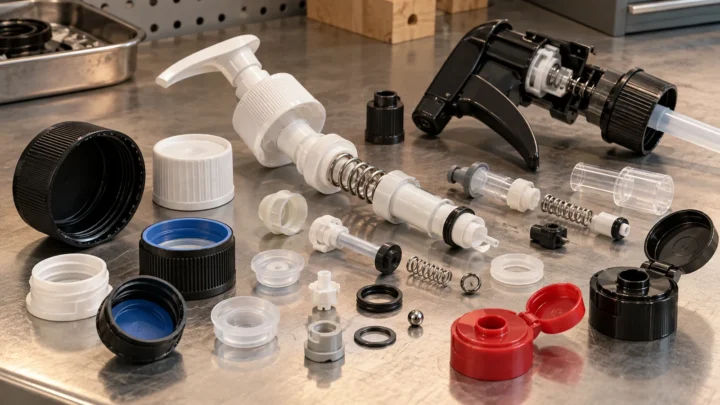
The nine-gram Arpanon/Sidel bottle is a company-reported commercial example, not an independently tested benchmark. The design questions combine published methods and European regulatory text; no container was independently tested for this article. Sources checked 20 October 2026. The main image is an AI-generated editorial illustration of a generic packaging scene; it does not depict a named product, facility, company or test.
Sources and reference notes
- [S1] Sidel. Arpanon advances its SENDAI brand with a Sidel developed ultra-lightweight 600 ml bottle. 2026 Arpanon / Sidel commercial example. Company statements are attributed; scientific/technical claims are limited to the stated test or review scope. Accessed 20 October 2026.
- [S2] PET ISBM simulation. A study of blow moulding simulation and structural analysis for PET bottles. PET ISBM simulation / structural analysis. Company statements are attributed; scientific/technical claims are limited to the stated test or review scope. Accessed 20 October 2026.
- [S3] PET deformation rate. The effect of the deformation rate on the wall thickness of 1.5LT PET bottle during ISBM process. PET deformation rate / wall-thickness distribution. Abstract/indexed record only unless retained source capture proves full text; no precise result inferred from an inaccessible paper. Accessed 20 October 2026.
- [S4] ASTM International. Standard Test Method for Column Crush Properties of Blown Thermoplastic Containers. ASTM D2659-16(2023). Company statements are attributed; scientific/technical claims are limited to the stated test or review scope. Accessed 20 October 2026.
- [S5] ASTM International. Standard Test Method for Drop Impact Resistance of Blow-Molded Thermoplastic Containers. ASTM D2463-23 drop-impact test. Company statements are attributed; scientific/technical claims are limited to the stated test or review scope. Accessed 20 October 2026.
- [S6] Thin-wall polypropylene packaging process study. Effect of injection parameters on mechanical and physical properties of super ultra-thin wall propylene packaging by Taguchi method. Thin-wall polypropylene packaging process study. Abstract/indexed record only unless retained source capture proves full text; no precise result inferred from an inaccessible paper. Accessed 20 October 2026.
- [S7] Thin-wall PP morphology. Structure and fracture toughness of thin-wall polypropylene moulded at different injection speeds. Thin-wall PP morphology / fracture toughness. Abstract/indexed record only unless retained source capture proves full text; no precise result inferred from an inaccessible paper. Accessed 20 October 2026.
- [S9] rPET bottle properties. Effect of recycled content and rPET quality on the properties of PET bottles, Part I: Optical and mechanical properties. rPET bottle properties. Abstract/indexed record only unless retained source capture proves full text; no precise result inferred from an inaccessible paper. Accessed 20 October 2026.
- [S10] PET stretchability after mechanical recycling. Effects of mechanical recycling on PET stretchability. PET stretchability after mechanical recycling. Abstract/indexed record only unless retained source capture proves full text; no precise result inferred from an inaccessible paper. Accessed 20 October 2026.
- [S12] rPP structure/property variability. Structure–Property Relationship in Injection-Molded Recycled Polypropylene: Mechanical, Thermal, and Spectroscopic Evaluation. rPP structure/property variability. Abstract/indexed record only unless retained source capture proves full text; no precise result inferred from an inaccessible paper. Accessed 20 October 2026.
- [S13] Recycled PP. Impact of reprocessing cycles and chain extender on recycled polypropylene properties. Recycled PP / processing-cycle study. Abstract/indexed record only unless retained source capture proves full text; no precise result inferred from an inaccessible paper. Accessed 20 October 2026.
- [S14] European PET Bottle Platform. Design Guidelines for PET bottles in contact with food and non-food products. EPBP PET bottle design-for-recycling. Company statements are attributed; scientific/technical claims are limited to the stated test or review scope. Accessed 20 October 2026.
- [S15] CEN-CENELEC. EN 18120: Europe sets a new benchmark for recyclable plastic packaging. EN 18120:2026 current European DfR series. Company statements are attributed; scientific/technical claims are limited to the stated test or review scope. Accessed 20 October 2026.
- [S16] European Parliament & Council / EUR-Lex. PPWR Article 10 packaging minimisation. PPWR Article 10 packaging minimisation. Company statements are attributed; scientific/technical claims are limited to the stated test or review scope. Accessed 20 October 2026.
- [S17] European Commission / EUR-Lex. Commission 2026 PPWR guidance on minimisation. Commission 2026 PPWR guidance on minimisation. Company statements are attributed; scientific/technical claims are limited to the stated test or review scope. Accessed 20 October 2026.
The public corrections channel is currently inactive. Read our corrections policy.