Short answer: California SB 54 is no longer just a future packaging target. Permanent regulations took effect on 1 May 2026, producer registration and participation obligations are already active, and Circular Action Alliance (CAA) submitted California’s first producer responsibility plan on 13 October 2026. CalRecycle now has 75 days to review that plan. The law’s major outcome targets still build toward 2032: 25% source reduction of plastic covered material, a 65% recycling rate for plastic covered material, and 100% of covered material meeting California’s recyclable-or-compostable requirement. [R1] [R2]
The most important distinction is that those targets do not all apply to the same thing. SB 54 covers single-use packaging across material classes and single-use plastic food service ware, but the source-reduction and recycling-rate targets are specifically directed at plastic covered material. The 100% recyclable-or-compostable requirement applies across covered material. [R1] [R3]
For a producer, the immediate task is therefore not to ask whether a package is “sustainable enough.” It is to determine who the producer is under California’s hierarchy, identify each covered material category, choose the correct compliance pathway, preserve the data needed for reporting and source reduction, and follow the approved producer responsibility plan once CalRecycle completes its review.
What changed in 2026?
SB 54 was signed in 2022, but 2026 is the year the implementation framework became materially more concrete.
On 1 May 2026, the Office of Administrative Law approved the permanent SB 54 regulations and filed them with the Secretary of State. The regulations became effective the same day. Those rules created detailed requirements for producer registration, independent-producer applications, exemptions, producer responsibility plans, reporting, source reduction, covered-material classifications, responsible end markets and other implementation mechanics. [R2] [R10]
The next major step occurred on 13 October 2026, when CalRecycle received CAA’s producer responsibility plan. CAA is already the approved producer responsibility organization (PRO), but approval of the organization is not the same as approval of its plan. At the 18 October 2026 source cutoff, the plan was under CalRecycle review. [R1]
This distinction matters because many operational details — including program budgets, implementation procedures and producer obligations under the plan — depend on the plan that CalRecycle ultimately approves.
See the packaging EPR introduction for the difference between a scheme, a PRO and producer responsibility.
What packaging does SB 54 cover?
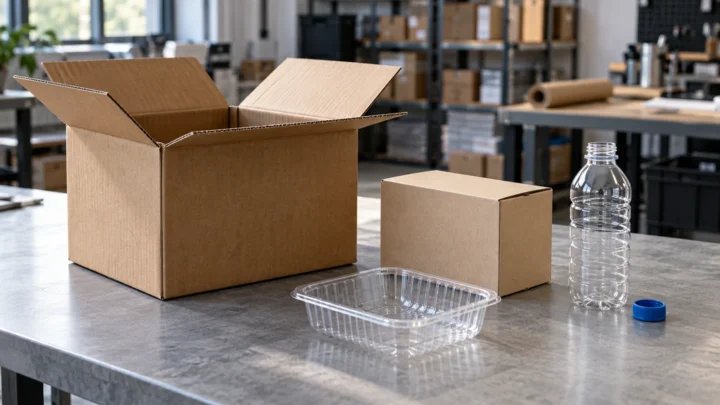
CalRecycle describes “covered material” as single-use packaging and single-use plastic food service ware. Packaging is not limited to plastic. California’s Covered Material Categories (CMC) system groups covered material into six broad classes:
- glass;
- ceramic;
- metal;
- paper and fiber;
- plastic; and
- wood and other organics. [R6]
Each CMC combines a material type with a package form. The CMC list is operationally important because CalRecycle uses these categories for recyclability or compostability determinations, recycling-rate calculations and producer reporting. The January 2026 update included updated recyclability/compostability determinations and the first recycling-rate determination for each category. [R1] [R6]
Classify the finished packaging form against the current CMC list rather than stopping at a broad label such as “paper” or “plastic.” Category-level information is not a substitute for checking the actual item and its components. [R6]
Who is the “producer” under SB 54?
SB 54 does not make every material supplier or packaging factory the regulated producer. California uses a tiered producer hierarchy tied to the party and transaction that place the packaged good or food service ware into the California market.
CalRecycle’s May 2026 screening tool asks, among other things, whether an entity is in California, whether it manufactured the good, whether it owns or licenses the trademark, whether it holds qualifying selling or distribution rights, and — if no higher-tier producer exists — who first sold, offered for sale or distributed the good in or into the state. [R4]
| Question | Why it matters |
|---|---|
| Is there a qualifying in-state manufacturer connected to the relevant brand or trademark? | The first producer tier can attach responsibility to an in-state party that manufactures the good and meets the brand/trademark conditions. |
| If not, is there another qualifying in-state brand, license or distribution party? | Responsibility can move through the statutory hierarchy when the first tier does not apply. |
| If no higher tier applies, who first sells, offers for sale, distributes or imports the product in or into California? | The regulated producer can be the party that introduces the product into the California market. |
| Is the company merely manufacturing or selling empty packaging? | The final regulations state that empty packaging not yet used by a good is not itself covered material, so a person is not a producer merely because it manufactures, sells or distributes that empty packaging. [R2] |
Editorial synthesis of the identified source provisions and evidence boundaries; illustrative examples are not product test results or compliance determinations.
This is particularly important for international supply chains. An overseas packaging manufacturer should not assume that it is the SB 54 producer merely because it made the container, and a California importer should not assume the opposite. Producer status depends on the statutory and regulatory hierarchy and the actual brand, licensing, manufacturing and distribution facts. CalRecycle expressly describes its producer tool as informational rather than a substitute for the statute or regulations. [R4]
What must producers do now?
CalRecycle’s current producer guidance gives three principal pathways:
- apply to participate in the CAA PRO plan;
- apply to comply as an independent producer; or
- if eligible, obtain a small-producer exemption. [R3]
The permanent regulations made the initial application obligation immediate in 2026. Section 18980.5 required existing producers to register with CalRecycle and, within 30 days of 1 May 2026, apply to become a participant of an approved PRO or apply to be an independent producer. Entities that became producers later in 2026 generally had 30 days after becoming a producer. Entities becoming producers on or after 1 January 2027 generally have six months to register and select a compliance route. [R2]
This corrects older summaries that describe 1 January 2027 as if it were the first date a producer needs to act. For many existing producers, registration, application and data preparation already began in 2026.
PRO participation
CAA is California’s first approved PRO. CalRecycle’s current guidance says CAA can manage registration, reporting and certain exemption or exclusion submissions on behalf of participating producers. Producers may also choose to self-report certain information through the Packaging Extended Producer Responsibility System (PEPRS). [R3]
At the source cutoff, CAA’s plan had been submitted but not yet approved. Producers therefore need to distinguish between joining the approved organization and operating under a CalRecycle-approved producer responsibility plan. The second step was still pending.
Independent compliance
Independent compliance is not simply an opt-out from the PRO. CalRecycle says an independent producer must qualify for the pathway and have a CalRecycle-approved plan detailing how it will meet the applicable requirements. [R3]
That makes independent compliance a defined legal pathway, not the default alternative for a producer that simply prefers not to participate in CAA.

The target timeline: source reduction, recycling and design are separate requirements
CalRecycle’s current producer guidance presents the major implementation milestones as follows:
| Date | Plastic source reduction | Plastic recycling rate | Covered material recyclable / compostable requirement |
|---|---|---|---|
| 1 January 2027 | 10% | — | — |
| 1 January 2028 | — | 30% | — |
| 1 January 2030 | 20% | 40% | — |
| 1 January 2032 | 25% | 65% | 100% |
Editorial synthesis of the identified source provisions and evidence boundaries; illustrative examples are not product test results or compliance determinations.
The three columns should not be read as versions of the same metric. Source reduction measures how much plastic is prevented or eliminated relative to the baseline. The recycling rate measures what share of plastic covered material is actually recycled under the program’s definitions. The recyclable-or-compostable requirement addresses whether covered material meets California’s applicable recyclability or compostability criteria. [R3]
The 25% source-reduction target is more specific than “use 25% less plastic”
California’s source-reduction system uses calendar year 2023 as its baseline. The final regulations required reporting entities to submit, by 1 July 2026, the total plastic covered material for which they were the producer in 2023, measured both by weight and by number of plastic components. CalRecycle must use that information to update the source-reduction baseline by 1 November 2026. [R8]
CalRecycle’s target summary distinguishes plastic source reduction from actual recycling and the recyclable-or-compostable requirement. Detailed credit allocation and reuse/refill sub-targets require the controlling statutory provisions; this explainer does not prescribe those calculations from the draft regulatory impact assessment. [R3]
This is why a producer should preserve both mass data and component-count data. A redesign can reduce grams of plastic without reducing the number of plastic components, or eliminate a component without producing the same percentage change in total weight.
“100% recyclable or compostable” is not the same as “100% recycled”
This is one of the most important SB 54 distinctions.
By 2032, the program target is that all covered material be recyclable or compostable under California’s framework. Separately, plastic covered material must reach a 65% recycling rate. [R1] [R3]
Those requirements should not be collapsed into one claim. A package can be designed or classified as recyclable without every unit being collected and recycled. Conversely, the statewide recycling-rate requirement depends on actual material flow and responsible end markets, not only package design.
See the design-versus-actual-recycling distinction.
The CMC list is the practical bridge between those concepts. CalRecycle publishes the categories and category-level recyclability, compostability and recycling-rate determinations. The list is updated at least annually, and the current list warns that category-level inclusion does not constitute a product-specific determination. [R6]
Reporting is becoming as important as material design
PEPRS is CalRecycle’s online system for producer registration, data submission and compliance tracking. Current guidance says it can receive application submissions, baseline and annual source-reduction data, aggregated reporting, PRO plan elements and other compliance documentation. [R3]
For packaging teams, that means the evidence file needs to extend beyond a resin name or supplier declaration. Depending on the item and reporting route, useful records can include:
- producer identity and California market role;
- covered material category;
- material and component construction;
- weight of plastic covered material;
- number of plastic components;
- quantities supplied into California;
- recyclability or compostability classification basis;
- source-reduction changes against the 2023 baseline; and
- PRO or independent-plan reporting records.
This data is not only administrative. California’s source-reduction baseline, recycling-rate calculations and producer responsibility plan all depend on material and market data.
What fees does SB 54 create?
SB 54 shifts substantial program costs to producers, but it is misleading to describe the law as one simple flat packaging tax.
CalRecycle’s official rulemaking summary states that producers must provide $500 million annually for ten years beginning in 2027—$5 billion in total—to address plastic-pollution impacts and affected communities. This is a program-level funding requirement, not a uniform per-package invoice. [R10]
Producer-specific costs will depend on the approved plan, budgets, fee schedules, covered material and other program factors. At the 18 October 2026 cutoff, CAA’s initial producer responsibility plan had only just entered CalRecycle review, so a universal “SB 54 fee per package” would be premature.
Exemptions and exclusions are real, but they are not one blanket escape clause
California has several different exemption and exclusion mechanisms. They operate at different levels: some apply to a producer, some to a material or component, and some remove an item from “covered material” only when specific criteria are met.
| Pathway | Current CalRecycle summary | Key boundary |
|---|---|---|
| Small producer exemption | Producers with gross annual sales below $1 million may apply to be exempt from most reporting and fee requirements. | Registration/application is required; CalRecycle says small producers still need to plan for the 2032 recyclable-or-compostable requirement. |
| Agricultural commodity on-site exclusion | A person who produces, harvests and packages an agricultural commodity on the same site may be excluded from being a producer. | The factual production, harvest and packaging conditions must match the statutory exclusion. |
| De minimis packaging components | Certain minimal packaging components can be excluded when the regulatory criteria are met. | Only eligible packaging components qualify; single-use plastic food service ware cannot be treated as a de minimis component. |
| High-recycling-rate material exclusion | Subject to CalRecycle approval, certain items can fall outside covered material if specified recycling-rate, collection and end-market conditions are met. | The current guidance lists 65% recycling for 2024–2026 and 70% from 2027, plus other conditions. |
| Material-specific exemption | Certain covered material may receive relief from recyclability, compostability or recycling-rate requirements because of unique compliance, health or safety issues. | The material remains subject to the scope and conditions of the approved exemption. |
Editorial synthesis of the identified source provisions and evidence boundaries; illustrative examples are not product test results or compliance determinations.
CalRecycle’s current exemption page is therefore better read as a set of defined pathways than as a list of broad industries that are simply “out of scope.” [R7]
Expanded polystyrene food service ware is already a live restriction
Not every important SB 54 consequence waits until 2032. CalRecycle states that expanded polystyrene (EPS) food service ware could continue to be sold only if the required 25% recycling rate was demonstrated as of 1 January 2025. CalRecycle currently states that this requirement has not been met, so producers are prohibited from selling, offering for sale, distributing or importing covered EPS food service ware into California. [R1]
This is a bounded example of why SB 54 should be treated as an active implementation program rather than a single distant 2032 deadline.
What should a producer or importer have in its file now?
A practical SB 54 file in late 2026 should answer five questions clearly.
- Who is the producer? Apply California’s producer hierarchy to the real manufacturing, brand, licensing, import and distribution structure.
- What is the covered material? Map the finished package and relevant components to the current CMC list rather than relying on a broad material label.
- Which compliance route applies? CAA participation, approved independent compliance or an eligible exemption/exclusion should be documented rather than assumed.
- Who owns the data? Decide whether reporting goes through CAA or is self-reported through PEPRS, and make sure 2023 baseline, weight, component-count and California supply records can be reconciled.
- Which design changes affect future targets? Separate source reduction, recyclability/compostability classification and actual recycling-rate performance instead of treating them as one “green packaging” project.
For an overseas packaging supplier, this usually means supporting the California-facing customer with accurate construction, component, weight and end-of-life documentation — while avoiding the assumption that the supplier itself is automatically the legal producer.
What happens next?
Two near-term events can materially change this article.
First, the final regulations require CalRecycle to update the 2023 source-reduction baseline by 1 November 2026 using producer-reported data. That update can change the practical numerical reference against which the source-reduction program is measured. [R8]
Second, CAA’s producer responsibility plan is now under review after its 13 October 2026 submission. CalRecycle states that it has 75 days to review the plan for compliance. Plan approval, revisions or conditions could change the operational details producers need to follow. [R1]
The useful way to read SB 54 in October 2026 is therefore as an active implementation program, not a distant 2032 mandate. The regulations are effective, producer pathways and reporting systems are live, baseline data is being updated, and the first PRO plan is under review. The 2032 targets remain the destination, but producer identity, material classification and data quality are already compliance questions today.
Methodology and editorial note
This article is a current-status regulatory explainer based on CalRecycle’s final regulations, current producer guidance, current CMC/exemption pages and official implementation updates checked through 18 October 2026. It does not provide a product-specific legal determination. Where CalRecycle guidance summarizes the statute, the article attributes the operational interpretation to CalRecycle; detailed legal obligations still require review of the controlling statute, regulations and any approved producer responsibility plan applicable to the producer.
Sources checked 18 October 2026. The main image is an AI-generated editorial illustration; the explanatory figure is an original editorial diagram. Neither is a photograph of an identified product or facility, a laboratory result or an independent environmental assessment.
Legal discussion is limited to the identified provisions and dated source explanations. No product-specific compliance determination, comprehensive audit of subsequent measures or universal laboratory procedure is provided.
Official sources and reference notes
- [R1] CalRecycle. Plastic Pollution Prevention and Packaging Producer Responsibility Act — SB 54. Live source. Current program status; CAA plan received 13 Oct 2026; 75-day CalRecycle review; CAA first PRO; current CMC/recycling-rate update; EPS current restriction; broad 2032 program goals. Relevant public text checked 18 October 2026; source scope retained. Accessed 18 October 2026.
- [R2] CalRecycle / Office of Administrative Law. SB 54 Final Regulation Text. Effective 1 May 2026. Title 14 CCR Chapter 11.1, especially §§18980.1, 18980.5, 18980.9 and 18980.10. Relevant public text checked 18 October 2026; source scope retained. Accessed 18 October 2026.
- [R3] CalRecycle. Producer Guidance. Live source. CAA / independent / small-producer pathways; PEPRS; PRO vs self-reporting; 2027/2028/2030/2032 target timeline. Relevant public text checked 18 October 2026; source scope retained. Accessed 18 October 2026.
- [R4] CalRecycle. Are You a Producer? A situational screening tool for California’s packaging law. 7 May 2026. Tiered producer-identification logic involving California presence, manufacturer, trademark/license and first sale/distribution into the state. Relevant public text checked 18 October 2026; source scope retained. Accessed 18 October 2026.
- [R6] CalRecycle. SB 54 Covered Material Categories List. Live source. Six material classes; material type/form CMC structure; category-level recyclability/compostability and recycling-rate determinations; multi-material/predominant-material note. Relevant public text checked 18 October 2026; source scope retained. Accessed 18 October 2026.
- [R7] CalRecycle. Exemptions and Exclusions. Live source. Small-producer exemption; agricultural on-site exclusion; de minimis components; high-recycling-rate exclusion; material-specific exemptions. Relevant public text checked 18 October 2026; source scope retained. Accessed 18 October 2026.
- [R8] CalRecycle. SB 54 Final Regulation Text — §18980.9 Source Reduction Baseline Report. Live source. 1 July 2026 baseline-report deadline; 2023 plastic weight/component data; CalRecycle baseline update by 1 November 2026. Relevant public text checked 18 October 2026; source scope retained. Accessed 18 October 2026.
- [R10] CalRecycle. SB 54 Permanent Regulations rulemaking archive. Live source. Official rulemaking summary, program funding overview; final regulation links. Current official archive/overview read. Program funding is attributed to the agency summary; no individual fee determination inferred. Accessed 18 October 2026.
The public corrections channel is currently inactive. Read our corrections policy.