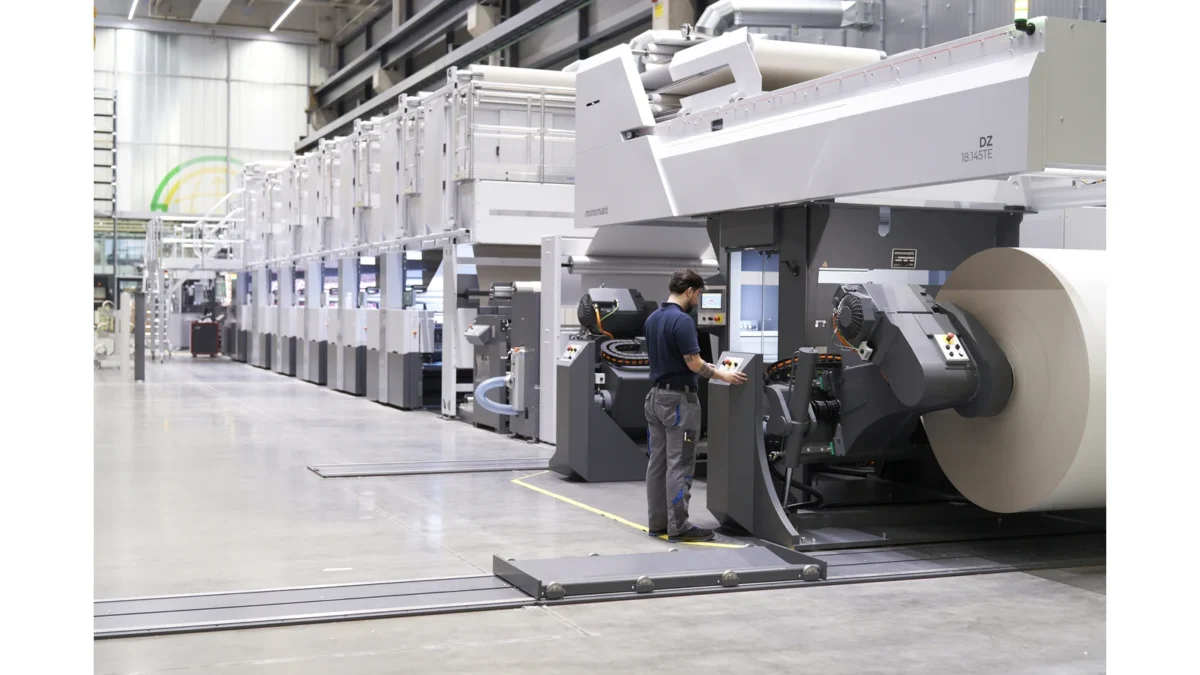
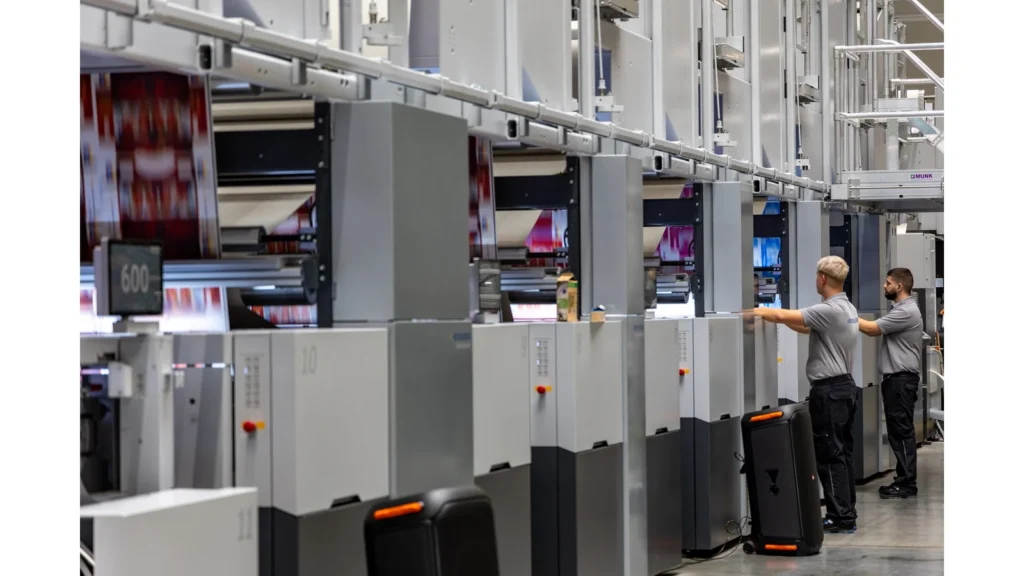
Opal opened a new A$70 million folding-carton facility at Moorebank in south-west Sydney on 10 November 2026. The Australian packaging producer says the 27,233-square-metre site houses the country’s only Heidelberg Boardmaster inline flexographic press, with automated changeovers and a production system intended for food-grade cartons. The opening is a real manufacturing event. But the more useful industry story is what this investment reveals about the economics of paperboard conversion: the value of a modern plant increasingly depends on how quickly it can change jobs and how little board it wastes between them. [S1] [S2]
Related analysis: machine investment and production trials.
For food manufacturers, the significance is not simply a faster printing machine. Folding cartons are often ordered in many versions—different sizes, recipes, promotional graphics, languages and retailer requirements. A converter that can run those versions efficiently may compete on lead time and operating flexibility, even where total market demand is not expanding quickly. This is an interpretation of the production model, not a claim that Opal has reported a measured market-share gain.
The opening: what is verified
Opal’s 10 November announcement identifies a completed facility, an A$70 million investment and the installation of a Heidelberg Boardmaster. It describes a purpose-built production footprint and a food-grade carton focus. The company reports technology capable of reducing changeover waste to less than 10 metres of board, which it characterises as a reduction of up to 90% under its stated comparison. It also says that the new operation uses water-based inks, incorporates heat-recovery drying and does not use natural gas. [S1]
These claims have different evidentiary status. The opening date and company announcement are documented events. The changeover figure is an equipment or operating capability reported by the company, not an independently audited average across all print jobs. The energy configuration is a plant characteristic, not a complete site life-cycle assessment.
| Reported element | What the source establishes | What it does not establish |
|---|---|---|
| A$70 million investment | Stated investment associated with the Moorebank facility | A measured return on capital |
| 27,233 m² site | Reported facility footprint | Net installed annual carton output |
| Heidelberg Boardmaster | Reported installed inline flexographic system | Utilisation, yield or output on every SKU |
| Less than 10 metres of changeover waste | Company-described capability | Verified average waste for all production runs |
| Planned 2027 rail deliveries | Opal expects about 1,557 twenty-foot containers of board by rail | Completed 2027 freight activity or audited carbon savings |
The last distinction matters. Opal’s rail figure is explicitly forward-looking: the company expects approximately 1,557 twenty-foot containers of paperboard via rail in 2027, using nearby intermodal connections. It should not be written as a freight volume already achieved. [S1]
Why changeover waste deserves more attention than headline speed
High-speed presses attract attention because their nameplate capacity is easy to photograph, market and compare. In mixed-SKU food carton work, however, the economically relevant output is usable, approved packaging delivered on schedule. It is not simply metres of board passing through a press each minute.
Consider two hypothetical converters. One has a very fast line but loses substantial paperboard and production time when changing graphics or formats. The other runs at a slightly lower continuous speed but changes over with less waste. A buyer ordering one long, standard carton run may prefer the former. A buyer with seasonal packaging, short promotional windows and frequent artwork revisions may value the latter. Neither preference can be inferred from nominal press speed alone.
This suggests a more serious procurement metric: accepted cartons per scheduled production hour after all changeovers and quality rejects, not a single manufacturer’s maximum line speed. To compare suppliers properly, purchasers would need the order mix, run length, changeover definition and actual reject rates. Opal has not disclosed those operating figures in the cited announcement.
Domestic supply is a resilience proposition, not an automatic cost saving
Opal presents the new site as strengthening local packaging production. For Australian food brands, local conversion can shorten some shipping legs and improve coordination on artwork, proofs and urgent replenishment. However, local production does not automatically mean local sourcing of all input board, inks, additives or machine components.
The company itself points to an intended rail connection for board freight. That is a useful reminder that carton conversion is part of a longer industrial chain: pulp and board production, transport, printing, die-cutting, folding and filling may take place at different sites. The correct supply-chain question is how the full chain performs, not whether the carton carries a domestic-manufacture label.
There is a second tension. A highly automated plant may reduce handling and improve consistency, but the business still needs enough order density to use the installed capacity productively. An investor can build the machine; the market must supply the repeatable work. No announced investment amount by itself demonstrates durable utilisation.
The environmental story needs a defined denominator
Opal cites shorter changeovers, reduced waste, water-based inks, energy-efficient drying and the absence of natural gas on the site. These may be favorable design and operating characteristics, but they should remain separate from claims about full-package environmental superiority.
Water-based inks are not a blanket certification of recyclability or food-contact suitability. Recyclability depends on the finished construction, contamination, collection and mill compatibility. Energy use depends on output and the energy mix. Rail transport may reduce certain transport impacts relative to road under matched routes and loads, but the actual emissions outcome requires a transport calculation.
An appropriate performance comparison would therefore distinguish metres of setup waste per changeover, kilograms of waste per accepted carton, energy per thousand accepted cartons, quality rejects, and transport intensity per tonne of delivered board. These measures answer different questions. Combining them into one unsupported ‘green factory’ rating would conceal the trade-offs.
What converters should learn from the investment
A competing folding-carton converter does not need to purchase the same press to learn from Moorebank. The transferable lesson is to measure the nonproductive time and material that sit between revenue-generating runs. A factory operating old equipment can sometimes improve its economics through standardised settings, better artwork preparation, ink management and disciplined maintenance before considering a full new line.
The opening also illustrates why packaging machinery should be evaluated as part of a system: press, dryer, quality control, board logistics, warehousing and customer order management must work together. Automated changeovers lose their value if the right material, tooling or approved files are unavailable when production starts.
For brand owners, the questions are equally practical. Can the converter accommodate a design revision without restarting the entire production calendar? What is the production yield on a short run rather than the machine’s demonstration run? How consistently can color and registration be held across repeat orders? Can the supplier document its material losses and delivery performance?
Editorial assessment: capacity is not the only story
The Moorebank opening is an important recent investment in Australian carton manufacturing. Its more general significance lies in the move from capacity-focused investment narratives to flexibility-focused conversion economics. A press that produces less waste between jobs can be economically valuable even when total paperboard demand is flat.
That conclusion remains conditional on actual running data. The next meaningful milestones will be Opal’s disclosed operational performance, customer adoption, job-mix results and realised freight movements—not the repetition of the original investment figure. [S1]
Sources / References
- [S1] Opal — Opal boosts Australian manufacturing with $70 million investment in new Moorebank facility, company media release, 10 November 2026. Original announcement; full relevant public search extract reviewed. Operating performance claims are attributed to Opal.
- [S2] PKN Packaging News — Opal lifts carton manufacturing with $70m investment, 12 November 2026. Trade press corroboration of the event and machinery description; public extract reviewed.
Found an error? Read our corrections policy and contact the editors.