
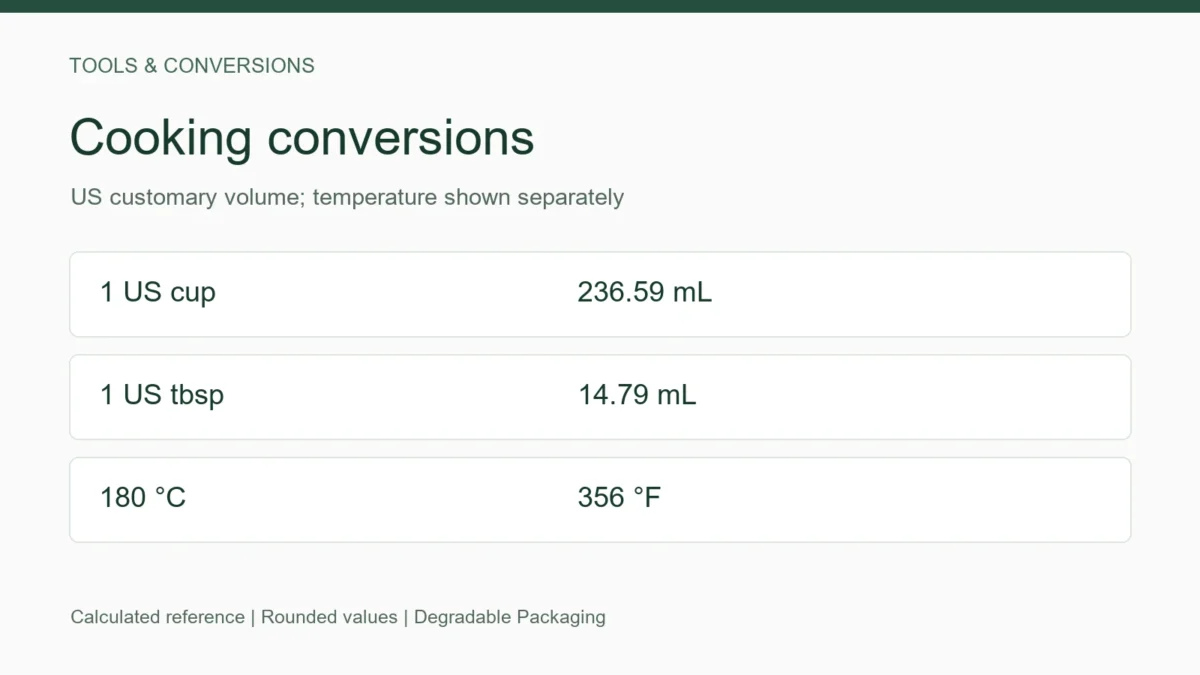
Start by identifying whether a recipe quantity is volume, mass or temperature. One US customary cup is 8 US fl oz or 16 US customary tablespoons; it is exactly 236.5882365 mL. Grams and weight ounces require a mass conversion, while grams-to-cups estimates require a named ingredient.
Choose a consistent measuring system
This guide compares three explicitly different cup sizes: US customary, 236.5882365 mL; US nutrition-label, 240 mL; and metric, 250 mL. A cup is a volume unit, not necessarily the capacity of a drinking cup. Match the cup convention to the recipe or source, then keep that convention throughout the calculation.
US customary tablespoon and teaspoon volumes follow the cup relationship: one tablespoon is 1/16 cup, or 14.78676478125 mL; one teaspoon is 1/48 cup, or 4.92892159375 mL. The US nutrition-label convention instead uses 15 mL and 5 mL. A spoon marked with another mL capacity must be read by that capacity; the word “tablespoon” alone is not enough to reconcile every recipe.
US customary cooking volume chart
| US cups | US fl oz | US tbsp | mL |
|---|---|---|---|
| 0.0625 | 0.50 | 1.00 | 14.79 |
| 0.125 | 1.00 | 2.00 | 29.57 |
| 0.25 | 2.00 | 4.00 | 59.15 |
| 1/3 | 2.67 | 5.33 | 78.86 |
| 0.375 | 3.00 | 6.00 | 88.72 |
| 0.5 | 4.00 | 8.00 | 118.29 |
| 2/3 | 5.33 | 10.67 | 157.73 |
| 0.75 | 6.00 | 12.00 | 177.44 |
| 1 | 8.00 | 16.00 | 236.59 |
| 1.25 | 10.00 | 20.00 | 295.74 |
| 1.5 | 12.00 | 24.00 | 354.88 |
| 1.75 | 14.00 | 28.00 | 414.03 |
| 2 | 16.00 | 32.00 | 473.18 |
| 2.25 | 18.00 | 36.00 | 532.32 |
| 2.5 | 20.00 | 40.00 | 591.47 |
| 3 | 24.00 | 48.00 | 709.76 |
| 3.5 | 28.00 | 56.00 | 828.06 |
| 4 | 32.00 | 64.00 | 946.35 |
| 5 | 40.00 | 80.00 | 1182.94 |
| 6 | 48.00 | 96.00 | 1419.53 |
For bottle or jug readings, compare fluid ounces to mL or the reverse mL to fluid ounces. The mL to cups chart compares the three cup sizes, and cups to mL covers fractional cup quantities. Use ounces to cups only after confirming the ounces measure fluid volume.
Keep ingredient grams separate
The estimates below use King Arthur Baking’s stated recipe-chart masses for one cup: all-purpose flour 120 g; granulated white sugar 198 g; packed brown sugar 213 g; unsifted confectioners’ sugar 113 g; and old-fashioned or quick-cooking oats 89 g. These are ingredient-specific recipe references, not exact physical constants. Use your recipe author’s own gram equivalent when it is supplied.
| Recipe cups | All-purpose flour (g) | Granulated white sugar (g) | Brown sugar, packed (g) | Confectioners’ sugar, unsifted (g) | Oats, old-fashioned or quick-cooking (g) |
|---|---|---|---|---|---|
| 0.25 | 30.00 | 49.50 | 53.25 | 28.25 | 22.25 |
| 0.5 | 60.00 | 99.00 | 106.50 | 56.50 | 44.50 |
| 0.75 | 90.00 | 148.50 | 159.75 | 84.75 | 66.75 |
| 1 | 120.00 | 198.00 | 213.00 | 113.00 | 89.00 |
| 1.5 | 180.00 | 297.00 | 319.50 | 169.50 | 133.50 |
| 2 | 240.00 | 396.00 | 426.00 | 226.00 | 178.00 |
For the reverse calculation and preparation limits use grams to cups for common ingredients. For mass alone, grams to ounces avoids the uncertainty of scooping. Do not read an ingredient column as a universal density or apply it silently to a differently sized cup.
Scale a recipe in its original units
For one and a half batches, multiply each original ingredient amount by 1.5 before converting. A ¾ US cup liquid amount becomes 1⅛ US cups, approximately 266.16 mL. A 120 g flour amount becomes 180 g; it does not become 180 mL. Use the recipe author’s original grams when available.
Oven temperatures: conversion, then appliance instructions
| Celsius (°C) | Fahrenheit (°F) |
|---|---|
| 140 | 284.00 |
| 150 | 302.00 |
| 160 | 320.00 |
| 170 | 338.00 |
| 180 | 356.00 |
| 190 | 374.00 |
| 200 | 392.00 |
| 220 | 428.00 |
The Celsius to Fahrenheit guide explains the formula and temperature changes. A 180 °C setting equals 356 °F mathematically. Selecting a nearby available dial mark, changing oven type, or deciding whether food is cooked safely are separate decisions; use the recipe and the appropriate appliance or food-safety instructions.
Common questions
Can I use one chart for every ingredient?
Use a volume chart for volume-to-volume conversions. Use the named ingredient’s reference for mass-to-volume estimates; a cup of flour and a cup of sugar have different masses.
Should I convert all units before scaling?
Scale the original quantities first, retain the selected measuring system, then convert and round once. This reduces repeated rounding and avoids changing cup conventions mid-recipe.
Sources and calculation method
All chart results are calculated from the stated full factors, then rounded once to two decimal places using round-half-up. Trailing zeros show a consistent display, not the precision of a measuring tool.
- NIST — Handbook 44 (2026), Appendix C: General Tables of Units of Measurement. C-4, C-6, C-9, C-15–19 and C-25; exact definitions and explicitly rounded equivalents distinguished.
- Office of the Federal Register / FDA — 21 CFR 101.9(b)(5)(viii). Nutrition-label household measures only: cup 240 mL, tablespoon 15 mL, teaspoon 5 mL, fluid ounce 30 mL.
- King Arthur Baking — Ingredient Weight Chart. All-purpose flour 120 g/cup; granulated white sugar 198; packed brown sugar 213; unsifted confectioners sugar 113; old-fashioned/quick oats 89.
- NIST — SI Units – Temperature. Temperature Conversion (Exact): Celsius × 1.8 + 32.
- USDA ARS — Measurement Conversion Tables. Measure Equivalents only: 16 tablespoons and 48 teaspoons per cup; 8 fl oz per cup.
Found an error? Read our corrections policy and contact the editors.