
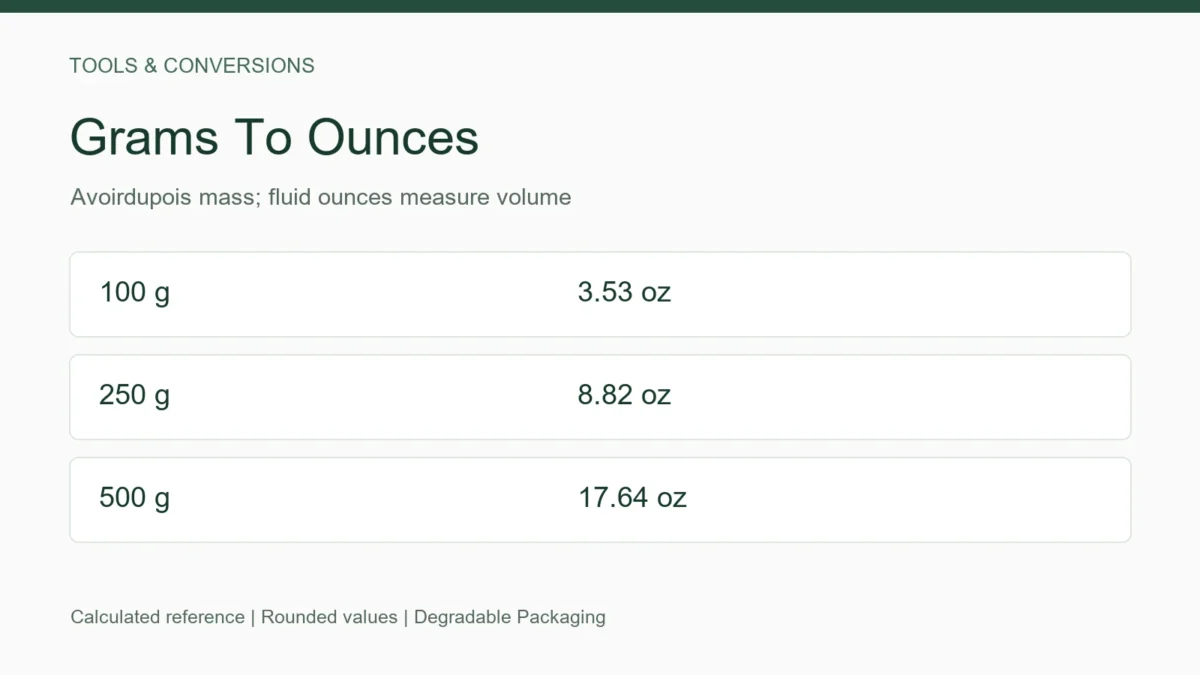
To convert grams to ounces, divide by 28.349523125. One gram is approximately 0.035274 oz; 100 g is approximately 3.53 oz. This guide uses the ordinary avoirdupois ounce of mass, the ounce used for everyday weights.
Choose this chart when a scale, ingredient list or parcel weight is stated in grams and you need ounces. A measuring-jug reading in fluid ounces is a volume and needs a different calculation. A number alone, such as “8 oz,” needs its context checked before conversion.
The g to oz formula
ounces = grams ÷ 28.349523125. The factor is exact. The short multiplier 0.035274 is useful for an estimate, but division by the full factor avoids accumulating rounding error when scaling quantities. The gram is one thousandth of a kilogram; 16 avoirdupois ounces make one pound.
Grams to ounces chart
| Grams (g) | Ounces (oz) |
|---|---|
| 1 | 0.04 |
| 2 | 0.07 |
| 5 | 0.18 |
| 10 | 0.35 |
| 15 | 0.53 |
| 20 | 0.71 |
| 25 | 0.88 |
| 28 | 0.99 |
| 30 | 1.06 |
| 40 | 1.41 |
| 50 | 1.76 |
| 60 | 2.12 |
| 75 | 2.65 |
| 85 | 3.00 |
| 100 | 3.53 |
| 125 | 4.41 |
| 150 | 5.29 |
| 175 | 6.17 |
| 200 | 7.05 |
| 225 | 7.94 |
| 250 | 8.82 |
| 300 | 10.58 |
| 350 | 12.35 |
| 400 | 14.11 |
| 450 | 15.87 |
| 500 | 17.64 |
| 600 | 21.16 |
| 750 | 26.46 |
| 900 | 31.75 |
| 1000 | 35.27 |
Work through a scale reading
For a 250 g ingredient quantity, calculate 250 ÷ 28.349523125 = approximately 8.82 oz. If the recipe is doubled, convert 500 g directly to approximately 17.64 oz. Do not double a value that you first rounded to a whole ounce; that can change the recipe materially.
A scale with 0.1 oz increments may display 8.8 oz for that 250 g quantity. The chart’s extra decimal place does not make the scale more sensitive. If your scale supports grams, retaining the original grams avoids an unnecessary conversion.
Which ounce does the source mean?
The avoirdupois ounce is approximately 28.35 g. A troy ounce, used in precious-metal contexts, is 31.1034768 g and requires its own factor. A fluid ounce measures volume. Neither alternative should be substituted silently for an ordinary weight ounce.
For a reading already in ounces, use the ounces to grams chart. For a larger quantity stated in kilograms, the kilograms to pounds guide keeps the calculation in larger mass units.
Common questions
Is 28 g exactly 1 oz?
No. It is a convenient rounded value; one avoirdupois ounce is exactly 28.349523125 g.
Does 100 g always occupy the same volume?
No. Equal masses of flour, sugar and oil can occupy different volumes. A mass conversion does not establish a cup quantity.
Sources and calculation method
All chart results are calculated from the stated full factors, then rounded once to two decimal places using round-half-up. Trailing zeros show a consistent display, not the precision of a measuring tool.
- NIST — Handbook 44 (2026), Appendix C: General Tables of Units of Measurement. C-4, C-6, C-9, C-15–19 and C-25; exact definitions and explicitly rounded equivalents distinguished.
Found an error? Read our corrections policy and contact the editors.