
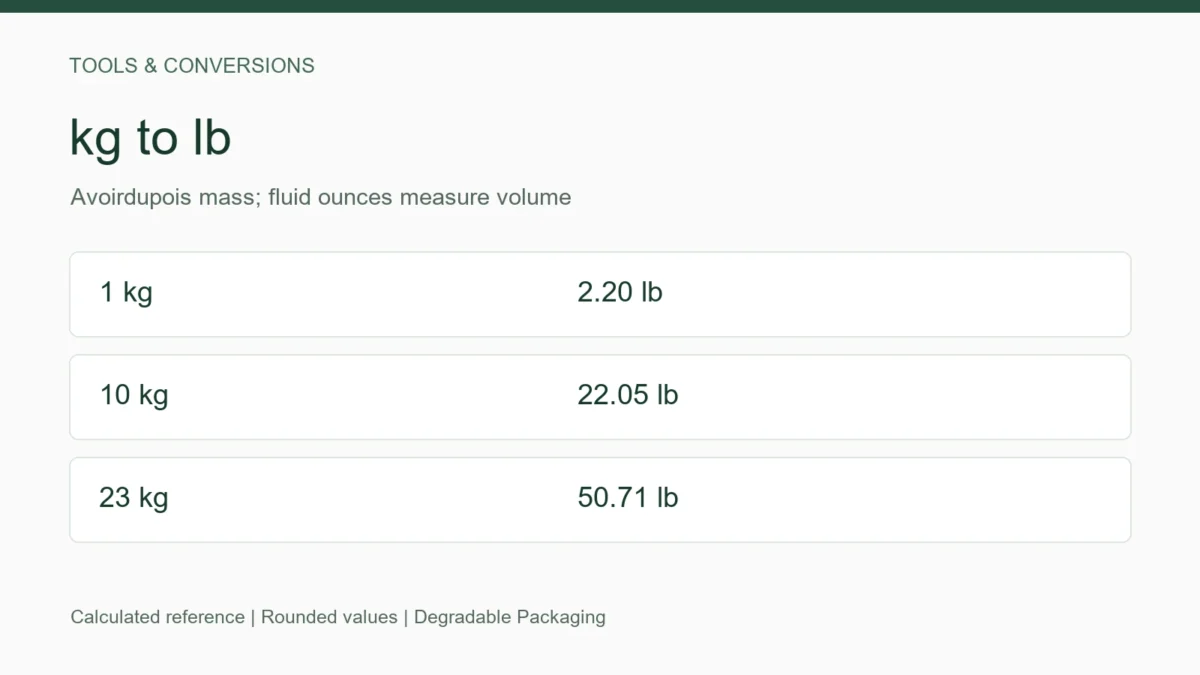
One kilogram is approximately 2.20462262 pounds. To convert kilograms to pounds, divide by 0.45359237. For example, 10 kg is approximately 22.05 lb. The exact underlying relationship is 1 avoirdupois pound = 0.45359237 kg.
Kilograms to pounds formula
pounds = kilograms ÷ 0.45359237. For an estimate, multiplying kilograms by 2.2 is convenient. For a limit or a specified quantity, use the full factor and follow the rounding rule attached to that particular task. The chart uses lb as the unit symbol; “lbs” is a common search spelling.
KG to LBS chart
| Kilograms (kg) | Pounds (lb) |
|---|---|
| 0.1 | 0.22 |
| 0.25 | 0.55 |
| 0.5 | 1.10 |
| 1 | 2.20 |
| 2 | 4.41 |
| 3 | 6.61 |
| 4 | 8.82 |
| 5 | 11.02 |
| 6 | 13.23 |
| 7 | 15.43 |
| 8 | 17.64 |
| 9 | 19.84 |
| 10 | 22.05 |
| 12 | 26.46 |
| 15 | 33.07 |
| 20 | 44.09 |
| 23 | 50.71 |
| 25 | 55.12 |
| 30 | 66.14 |
| 40 | 88.18 |
| 50 | 110.23 |
| 60 | 132.28 |
| 70 | 154.32 |
| 75 | 165.35 |
| 80 | 176.37 |
| 90 | 198.42 |
| 100 | 220.46 |
| 120 | 264.55 |
| 150 | 330.69 |
| 200 | 440.92 |
Decimal pounds are not pounds and ounces
A 2.5 kg quantity is approximately 5.51 lb. To express it as pounds and ounces, keep the unrounded pound value, take the whole pounds, then multiply the fractional part by 16. The result is approximately 5 lb 8.18 oz. Reading 5.51 lb as “5 lb 51 oz” is incorrect.
For the ounce portion alone, see grams to ounces. To convert a reading already expressed in ounces, see ounces to grams. These smaller-unit guides use the same avoirdupois system.
Use conversion without inventing measurement precision
A displayed 23 kg value converts to approximately 50.71 lb. That arithmetic does not establish whether the original measurement was rounded up or down, nor whether a carrier’s allowance includes packaging or uses a particular scale tolerance. Preserve the original specified unit when comparing a measurement with a stated limit.
This reference concerns mass. It does not convert newtons or establish a force rating. Although everyday English often calls a scale reading “weight,” a force calculation needs additional physical context.
Common questions
Is 1 kg exactly 2.2 lb?
No. The 2.2 multiplier is approximate and is less suitable when a rounded result could affect a limit.
How do I reverse the conversion?
Multiply pounds by 0.45359237 to get kilograms. For example, 10 lb is exactly 4.5359237 kg before display rounding.
Sources and calculation method
All chart results are calculated from the stated full factors, then rounded once to two decimal places using round-half-up. Trailing zeros show a consistent display, not the precision of a measuring tool.
- NIST — Handbook 44 (2026), Appendix C: General Tables of Units of Measurement. C-4, C-6, C-9, C-15–19 and C-25; exact definitions and explicitly rounded equivalents distinguished.
Found an error? Read our corrections policy and contact the editors.