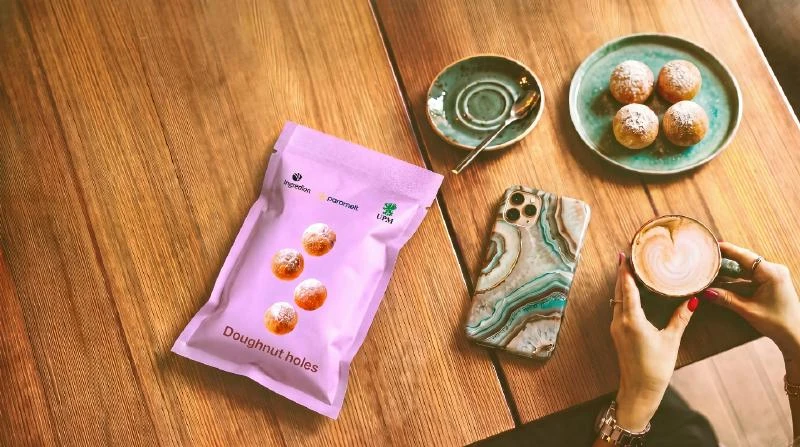
UPM, Ingredion and Paramelt have announced joint development of starch-based barrier technologies for paper food packaging. UPM’s 20 October 2026 release says the partners are investigating structures that combine paper, grease resistance and heat sealing, and reports an early recyclability-testing milestone for one construction. [1]
The collaboration brings together functions normally specified at different points in the packaging supply chain. It gives paper converters a named development to investigate, while leaving the performance of a final commercial pack to be qualified for its intended use.
Three partners combine paper, grease barrier and sealing
The development uses UPM Solide Lucent 78 gsm and UPM Asendo 65 gsm papers. Ingredion contributes plant-based starch grease-barrier technology, while Paramelt contributes bio-based heat-seal and barrier coatings. UPM identifies the Solide Lucent 78 gsm structure specifically as having passed Part 1 testing at Western Michigan University. The announcement does not extend that result to every construction in the collaboration. [1]
In a companion technical story, UPM says the development is compatible with existing coating, converting and packaging equipment and offers a wide sealing window. It also says development continues. These are the company’s statements; no independent commercial line-speed result is established by the pages examined.
What the reported test milestone covers
The companion story identifies the test as SBS-E Part 1. How2Recycle’s public fiber-packaging guidance distinguishes Part 1 repulpability testing from Part 2 recyclability testing and requires both where testing is needed within its assessment framework. It also calls for assessment of the package as it enters the recycling stream, including print and decoration. That guidance explains the distinction; it does not independently verify this particular sample. [2]
The announced pass should therefore be read as a company-reported development result, rather than proof of complete recyclability or recycling in practice. A full sample-specific laboratory report was not obtained for this report.
Commercial position remains to be established
The papers’ stated basis weights are not coating add-on weights or finished-pack weights. The two company disclosures examined do not establish coating weight, industrial production cost, commercial foodservice conversion, long-term customer contracts or orders, or a complete sample-specific recyclability assessment. That describes the public evidence examined, not a finding that such activity does not exist.
For converters, the next meaningful evidence would connect a final pack specification with demonstrated production output and customer use. Grease resistance should not be substituted for beverage resistance, nor sealability for a validated commercial speed. The announcement provides a reason to evaluate the structure; it does not establish starch barriers as a mature, lower-cost mainstream replacement for PE.
For the broader technical context, read our analysis of paper food-packaging barrier systems. This news report records the three-company development announced on 20 October; it does not report a subsequent commercial launch.
Sources / References
- UPM, Ingredion and Paramelt explore the potential of starch-based barriers in recyclable paper packaging, 20 October 2026. Read alongside UPM Specialty Materials’ same-day technical story, “UPM × Ingredion × Paramelt: Grease-resistant, heat-sealable paper packaging developed to help replace fossil-based materials.” Both are company disclosures.
- How2Recycle, Guidelines for Use, August 2026–January 2027 edition, page 32, Testing for Fiber Packaging.
Found an error? Read our corrections policy and contact the editors.