

Packaging cost per 1,000 units is the total cost within a clearly defined boundary, divided by the number of accepted, usable packages, multiplied by 1,000. The denominator matters. A carton quoted at $0.08 each is not necessarily an $80-per-1,000 purchase after tooling charges, delivery, inspection, replacement terms and rejects are considered.
For buyers comparing paper bowls, flexible pouches, molded-fiber trays, plastic tubs or printed cartons, the first question is not “Which supplier has the lowest unit price?” It is “What will 1,000 conforming units cost at the same location and quality specification?” This guide provides formulas, worked calculations and a quotation checklist. All sample dollar amounts below are hypothetical teaching inputs, not current packaging prices or an industry average.
The basic packaging cost-per-1,000 formula
For a buyer purchasing ready-made packaging, start with:
Cost per 1,000 accepted packages = (purchase cost + buyer-paid one-time charges + additional delivery/handling + other included buyer costs − applicable supplier credits) ÷ accepted usable quantity × 1,000.
“Accepted usable quantity” means units that meet the agreed specification and are available for the intended operation. If a supplier supplies replacements or grants a credit for defective units, the numerator or denominator changes; document the agreed remedy instead of counting the same reject twice. If the buyer only needs an invoice-price comparison, use the invoice price and label that narrower measure clearly.
| Cost line | Buyer-side quotation model | In-house manufacturing model | Check for double counting |
|---|---|---|---|
| Materials / base unit price | Included in the supplier’s quoted unit price | Raw stock consumed by starts, after actual material yield | Do not add raw resin or paper again if finished-unit quote includes it |
| Conversion and labour | Usually embedded in finished-unit price | Processing time, labour, energy and defined overhead | Separate fixed setup from time-based running cost |
| Tools, plates, dies | Add only the charge the buyer actually bears outside the quote | Charge or amortize over an explicitly stated volume and useful life | Check whether already amortized in the unit price |
| Rejects / yield | Reflect rejected delivered units only when no replacement or credit offsets them | Calculate required production starts from actual good-unit yield | Do not apply an extra waste multiplier to a quote priced per accepted unit |
| Transport / inspection | Add costs not included up to the chosen receiving point | Add logistics and inspections at the equivalent boundary | Do not add freight already covered by the stated delivery term |
| Tax, duty, local fees | Optional, with country and contract specified | Optional, on a consistent accounting basis | Do not assume taxes are identical or recoverable in all markets |
Incoterms 2020 rules allocate specified delivery tasks, costs and risks between buyer and seller when incorporated into a sale contract. Record the named place and the edition for every quoted rule. Use the actual contract and quote to identify charges borne by the buyer. [1]
Worked example 1: a finished packaging purchase
Imagine a buyer orders 10,000 custom paper food containers with an invented unit quote of $0.085. The order includes one separate printing-plate charge, buyer-paid transport after the quoted delivery point and incoming quality inspection. Suppose 300 delivered units fail the agreed acceptance test and the hypothetical contract provides no credit or replacement for these units.
| Input | Assumed figure | Calculation |
|---|---|---|
| Units invoiced | 10,000 | Order quantity |
| Finished-package quote | $0.085 each | 10,000 × $0.085 = $850 |
| One-time plate charged to this order | $150 | One separate charge; assumed not reusable for this model |
| Buyer-paid transport beyond quote | $240 | Additional cost to defined receiving point |
| Incoming inspection | $60 | Buyer-side cost not in supplier quote |
| Total included cost | $1,300 | $850 + $150 + $240 + $60 |
| Accepted units | 9,700 | 10,000 − 300 hypothetical rejects |
| Invoice price per 1,000 invoiced | $85.00 | $850 ÷ 10,000 × 1,000 |
| Buyer cost per 1,000 accepted | $134.02 | $1,300 ÷ 9,700 × 1,000, rounded |
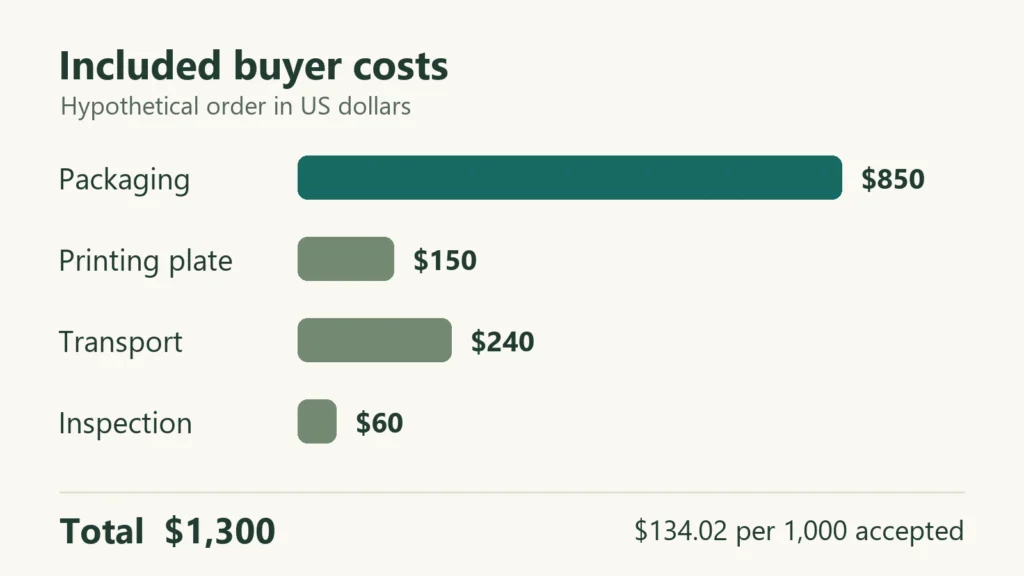
The $85.00 and $134.02 results are not competing answers to the same question. The first is the supplier’s quoted unit price expressed per 1,000 invoiced items. The second includes the specified additional buyer costs and only the 9,700 assumed usable items. If 300 units were replaced free of charge, or if tooling would be used across several agreed orders, the second result would change. The calculation is useful because it exposes the assumptions rather than hiding them in a single blended price.
Worked example 2: costing packages made in your own operation
A manufacturer needs a different denominator because a factory buys input material and pays for production attempts, not just good pieces. In a simplified single-stage model:
Running starts needed = ceiling(target accepted quantity ÷ running first-pass yield). Add any separate make-ready units scrapped before normal running. Multiply the total attempted or consumed units by the corresponding variable cost only if that cost is charged per attempt. Add fixed setup, tooling and other included charges. Then divide by target accepted output.
Consider a fictional production job targeting 20,000 accepted packaging units. Assume 96% running first-pass yield, 500 additional make-ready units, a $0.058 variable cost per started unit, $250 fixed setup, a $300 order-specific tooling charge, $180 delivery and $90 QC. The variable cost is assumed to include all material and time charged per start, so no extra scrap percentage is added.
| Item | Method | Result |
|---|---|---|
| Target accepted output | Input | 20,000 pieces |
| Running first-pass yield | Input | 96% |
| Running starts | Ceiling(20,000 ÷ 0.96) | 20,834 |
| Separate make-ready scrap | Input | 500 starts |
| Total costed starts | 20,834 + 500 | 21,334 |
| Variable cost of all starts | 21,334 × $0.058 | $1,237.37 |
| Fixed setup + tooling | $250 + $300 | $550.00 |
| Delivery + QC | $180 + $90 | $270.00 |
| Total model cost | Unrounded variable cost + $550 + $270 | $2,057.37 |
| Cost per 1,000 accepted | $2,057.372 ÷ 20,000 × 1,000 | $102.87 |
The ceiling step is important: planned running attempts must be whole numbers. The model uses expected yield as a planning assumption; it does not assert that exactly 20,000 good packages will emerge from a real 96% process. Actual production yield and scrap must be reconciled to counts from a specific lot or period. If the $0.058 rate is already a cost per good item, multiplying it by gross starts would overstate the total.
Calculate raw packaging material cost from GSM and blank area
A paperboard converter can estimate an input-material component from the material’s mass per unit area, the blank area and the purchase price per kilogram. This is a separate material-only example, not an extra charge to add to either full-cost table above. See the guide to paperboard basis weight for how GSM is defined.
Suppose a single flat paperboard blank has an assumed area of 0.12 m² and uses nominal 300 GSM board. Its theoretical board mass is 0.12 m² × 300 g/m² = 36 g per blank, or 36 kg for 1,000 ideal blanks. If only 88% of input board mass becomes those usable blanks, required purchased board is 36 kg ÷ 0.88 = 40.91 kg. At an assumed board price of $1.30/kg, the board-material component is $53.18 per 1,000 blanks.
This is not a finished-container quote: it excludes ink, coating, handles or lids, production labor, tools, and logistics. The assumed 88% is material yield (usable material divided by material input), not the rejection rate of finished formed units. If the incoming 300 GSM refers only to base board, separately account for coating only where it is separately purchased and not already priced into the sheet. Do not assume that GSM determines board thickness, stiffness or material suitability.
How tooling and order quantity affect the denominator
One-time charges can be large for an initial small run and small when spread over a genuinely committed production volume. For a hypothetical $500 die charge, allocation over 20,000 accepted units gives $25 per 1,000; over 100,000 accepted units gives $5 per 1,000. This is arithmetic, not a claim that a supplier will honor the same die price for either run or that the tool will last for 100,000 parts.
Ask whether a tooling fee is a separately invoiced buyer expense, embedded in the price, refundable after a volume threshold or retained by the supplier. If it is embedded in the unit price, do not allocate it again. If a customer only commits to 20,000 units, allocating the fee across an unapproved forecast of 100,000 creates an artificially low cost.
Design revision can also reset an investment: a new lid diameter, material specification, graphics plate or stacking geometry may need new tools or additional trials. A lower quoted unit rate at a higher minimum order quantity is not a savings if unsold stock, warehouse cost or obsolete artwork consumes the difference.
Compare supplier quotations at the same landed-cost boundary
Before comparing $ per 1,000, normalize quotes to the same product and receiving point. A factory-gate quote and a delivered-to-warehouse quote are not equivalent just because both are in US dollars. Terms also need a named place: “FCA [named place] Incoterms 2020” is more informative than “shipping included.” For containerized international shipments, buyers should have the correct Incoterms rule confirmed with their logistics team rather than automatically selecting FOB by habit. The packaging supply-chain analysis explains why freight and lead time can shift the delivered comparison.
- Specification: exact dimensions, volume, material construction, coating/film layers, print coverage, lid fit, packing count and performance requirements.
- Quantity: invoice units, expected usable units, units per carton and required order increments.
- Tooling: separate charges, ownership, revisions, lifetime assumptions and whether repeat orders are charged again.
- Delivery: named delivery point, contract term and edition, transport, insurance if relevant, warehousing and receiving charges.
- Quality: sampling method, acceptable-defect criteria, replacement/credit policy and cost of production disruption if appropriate.
- Currency and tax: quote currency, exchange-rate assumption, duty or applicable fees and whether a tax is recoverable under the buyer’s circumstances.
In one procurement model, keeping tax outside both bids may be the correct decision when it is fully recoverable; in another model a nonrecoverable tax or duty may be a real cost. Mark the choice and apply it consistently. Incoterms allocates trade responsibilities; it does not determine all customs, tax, ownership or payment issues.
Why the cheapest packaging quote can be the costlier purchase
A lower quoted rate can be offset by a larger minimum run, extra tooling, lower accepted yield, unstable lid fit, expensive storage, or freight that is absent from the quote. Equally, a more expensive but stable package may reduce filling-line interruptions or product losses. That broader effect belongs in a separately labeled total cost of ownership or packaging-system model; do not quietly mix it into a narrowly defined factory-conversion figure.
Packaging systems also contain multiple items. A food container with a lid, tamper seal, label and secondary carton should be compared as the same complete unit of service. If one option uses a cheaper container but requires an expensive compatible lid, a container-only comparison misses the decision. The packaging’s protective function, food safety and fitness for use must be qualified independently of its price.
This is where material cost, contract cost and environmental performance need to be kept separate. A recycled or bio-based material quote is not proof of lower total cost, recyclability or carbon impact. Those conclusions require their own evidence and defined geographical system.
A copy-ready packaging cost worksheet
Use the following worksheet as a specification for a spreadsheet or RFQ. Each buyer should add only charges not already included in the quoted base price. The source for each input should be identifiable: supplier quotation, actual goods-received record, freight invoice, tool contract or internal accounting entry.
| Field | Unit / source to capture | Check |
|---|---|---|
| SKU and specification version | Product ID, drawing revision, substrate, print and compatible components | Same function across bids? |
| Order quantity (Q) | Invoiced pieces | Purchase order and carton rounding |
| Supplier unit price (P) | Currency per piece | Is production waste included? |
| Separately billed charges (F) | Tooling, plates and documented setup fees | Are fees repeated on later orders? |
| Additional buyer costs (L) | Transport, inspection and charges to same receiving point | Already included under delivery term? |
| Credits or refunds (C) | Documented supplier credit | Not also counted as replacement units? |
| Accepted units (A) | Count from inspection / receiving records | Do accepted units meet the specification? |
| Buyer cost per 1,000 | [(Q × P) + F + L − C] ÷ A × 1,000 | Reject or hold result if A is zero or unknown |
Retain the exact inputs, currency, source date, delivery terms and rounding convention next to every calculated result. The worksheet is a decision aid, not a substitute for a financial audit or a supplier contract. Where supplier terms, material construction or accepted-quantity assumptions cannot be reconciled, report the two quotes as not yet comparable rather than publishing a misleading winner.
Sources
Found an error? Read our corrections policy and contact the editors.