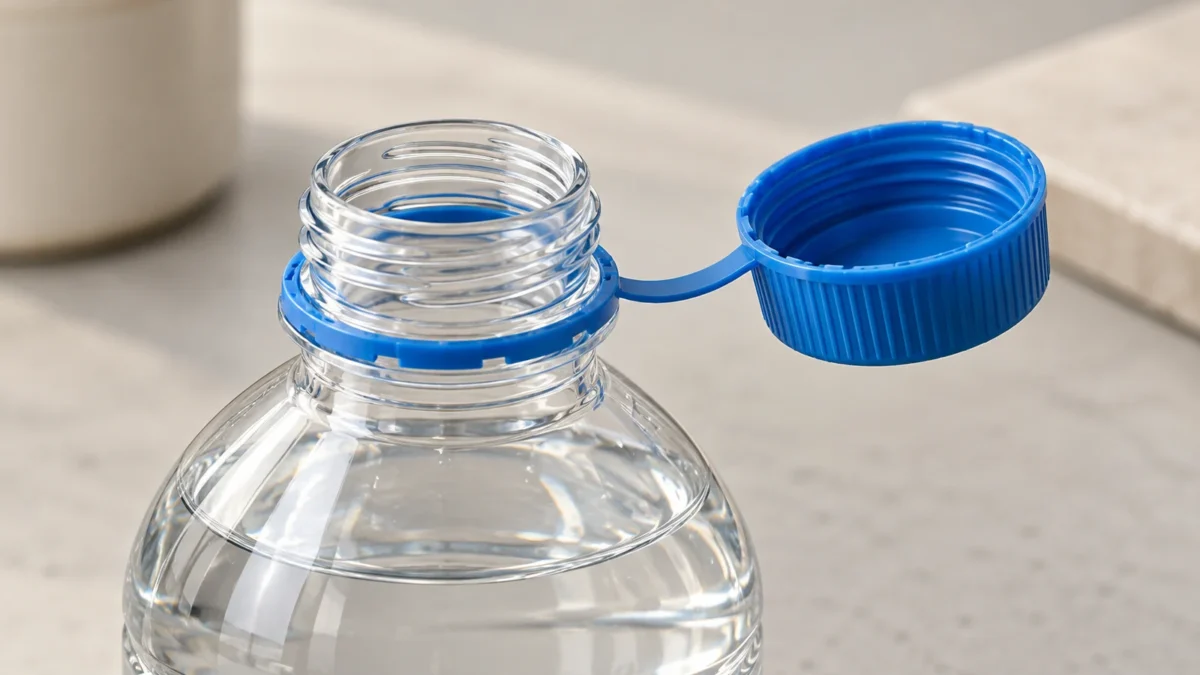
An attached cap is a product-design obligation for a defined category of single-use beverage packaging. It is not an EU requirement that every lid on every package must remain attached. Article 6 of the Single-Use Plastics Directive, read with Part C of its Annex, supplies the starting boundary. National implementing law supplies the local enforcement route. [1]
For a closure developer, the first question is therefore whether the filled container belongs to that category. Asking only whether the cap is plastic skips the container, capacity and use conditions that determine the scope.
Start with the container, then the closure
Part C covers beverage containers with a capacity of up to three litres, including beverage bottles and composite beverage packaging, with their caps and lids. It excludes glass or metal beverage containers with plastic caps and lids, and the specified containers for liquid foods for special medical purposes. The exception should be checked against the actual intended product, rather than a general description such as “health drink”. [1]
Article 6(2) also says that metal caps or lids with plastic seals are not treated as plastic caps or lids for this requirement. That provision illustrates why a bill of materials matters: the presence of a plastic element somewhere in an assembly is not the complete legal classification.
| Question | Rule or evidence | Important boundary |
|---|---|---|
| Single-use beverage container up to three litres | Check Annex Part C and plastic closure | Includes the directive’s specified composite beverage packaging |
| Glass or metal beverage container | Excluded from Part C | A plastic cap alone does not bring it into that category |
| Metal cap with a plastic seal | Not a plastic cap for Article 6 | Article 6(2) makes this distinction |
| Special medical-purpose liquid-food container | Check the Annex exception | The specified liquid-form food category has an exclusion |
What remaining attached means
The directive requires the plastic cap or lid to remain attached to the container during its intended use stage. It does not prescribe one commercial hinge design. Article 6 anticipates harmonised standards addressing the necessary strength, reliability and safety of beverage-container closure systems, including those for carbonated drinks. [1]
A drawing showing a tether does not establish performance. The relevant evidence concerns the finished closure-container combination and the intended opening, pouring, drinking and reclosing sequence. Any reference to a harmonised standard should identify the actual edition and published reference; this article does not certify a closure or reproduce a testing protocol.
Keep the cap deadline separate from bottle-content targets
Article 17 identifies 3 July 2024 for the attached-cap requirement. The recycled-content provisions elsewhere in Article 6 concern different product categories and calculations. A tethered cap does not establish that a bottle meets a recycled-content target, and recycled resin does not establish that the attachment requirement has been satisfied. [1]
This separation is useful when a specification combines several sustainability claims. The closure function, the container’s recycled-content documentation and its food-contact suitability each require their own evidence. None can serve as a proxy for the others.
The useful specification boundary
A scoped record should identify the beverage and container category, nominal capacity, body and closure materials, applicable national implementation and the evidence for the actual intended use. A family description such as “EU compliant cap” leaves too much unstated when different containers or closure constructions are supplied under one sales name.
The practical contribution of the directive is a specific litter-prevention design condition. It does not make the package reusable, establish local recycling acceptance or substantiate a claim of overall environmental superiority. Those remain different questions even when the attachment design works.
Sources
Sources checked 21 October 2026. Legal text, official interpretation and editorial examples are distinguished above. No individual product or business conformity assessment was performed.
- European Parliament and Council / Official Journal via BOE. Directive (EU) 2019/904 on single-use plastics. 5 June 2019; OJ 12 June 2019. Locator: Articles 6(1)–(4), 17; Annex Part C. Relevant full original provisions read in the official Spanish rendition; English explanation is an editorial paraphrase, not an official translation.
Found an error? Read our corrections policy and contact the editors.