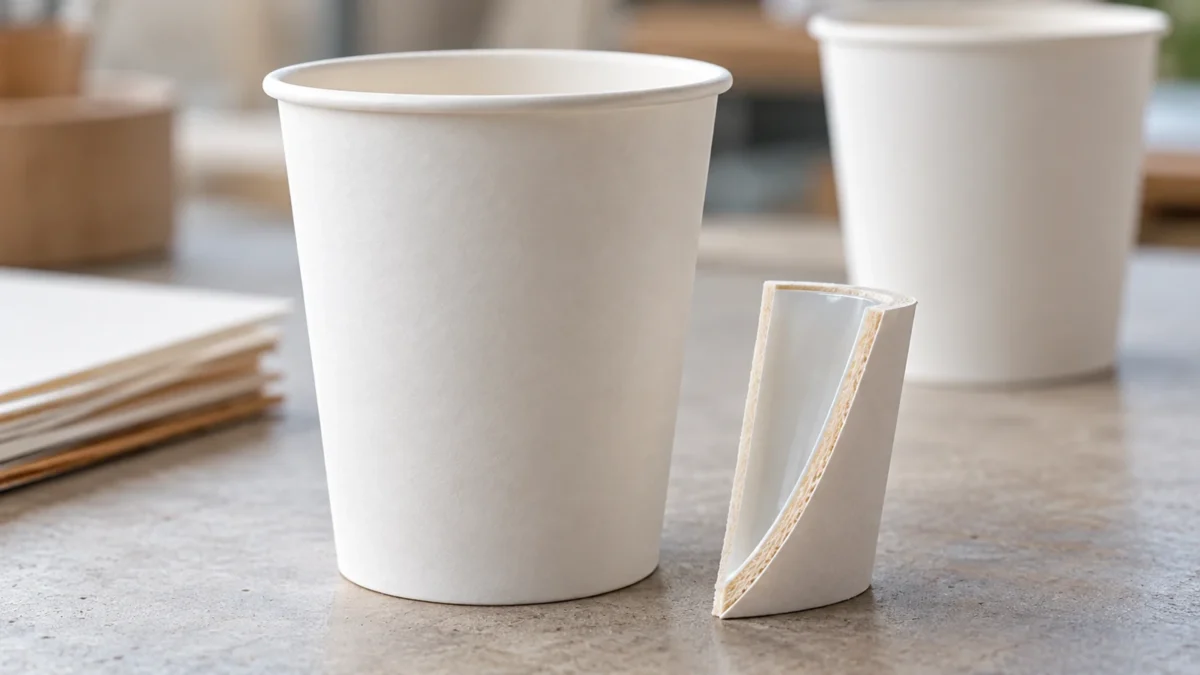
A paper-based beverage cup can still fall within the EU Single-Use Plastics marking framework when its actual construction includes plastic. The directive defines single-use plastic products as products made wholly or partly from plastic, subject to its definitions and scope. Implementing Regulation (EU) 2020/2151 then distinguishes marking specifications for beverage cups made partly and wholly from plastic. [1][2]
The useful starting point is the finished cup’s construction and use. Calling a product “paper”, “bio-based” or “compostable” does not by itself answer whether the plastic definition applies or which marking specification is relevant.
Read the definition before choosing the artwork
Article 3 of Directive (EU) 2019/904 defines plastic by reference to a polymer-based material that can function as a main structural component of final products, with an exception for natural polymers that have not been chemically modified. It separately defines a single-use plastic product. Those legal definitions should not be replaced by a marketing material category. [1]
For a coated cup, the relevant assessment identifies the coating or barrier material and the product’s intended use. This article does not classify a named coating formulation or declare that every water-based dispersion is inside or outside the definition. The actual formulation and applicable official interpretation are needed for that question.
| Question | Rule or evidence | Important boundary |
|---|---|---|
| Single-use cup partly made of plastic | Relevant partly-plastic marking route | A paper substrate does not remove the plastic layer |
| Single-use cup wholly made of plastic | Separate Annex IV specifications | Do not copy artwork for a different category |
| Natural polymer claim | Check the directive’s definition and chemical-modification boundary | Bio-based is not a universal exemption |
| Artwork | Official specification, language and corrigenda | A homemade lookalike is not a verified legal template |
Cups carry their own marking
Article 7 and Part D of the directive distinguish beverage cups from other listed products. For beverage cups, the marking is placed on the product itself. The directive identifies the information purpose: appropriate waste management, the presence of plastic and the environmental consequences of littering or other inappropriate disposal. [1]
That purpose is different from a certification logo or a declaration of recyclability. The mark does not establish that a local collection programme accepts the cup, that its barrier is harmless in every application, or that the package has been independently tested by this publication.
The implementing specification is not decorative guidance
Annex IV of Regulation 2020/2151 sets the relevant specifications for cups. The Commission’s marking page links the specifications, corrigenda and vector pictograms. Those are the appropriate records for an artwork workflow, rather than a resized image copied from a supplier’s photograph. [2][3]
Category, dimensions, positioning, contrast and the required language need to be checked against the actual applicable specification. No replica compliance mark is supplied here. The original editorial scope map accompanying this guide explains the decision sequence and must not be used as packaging artwork.
Material claims and disposal claims remain separate
Article 17 identifies 3 July 2021 for the directive’s marking measures. Future PPWR sorting labels have another purpose and timeline; they should not be treated as if they retroactively replace every existing marking duty. [1]
A useful cup file therefore connects the real construction, the applicable category, official artwork specification and destination-market language. Compostability or recyclability evidence can be retained alongside it, but neither makes the marking-scope question disappear.
Sources
Sources checked 21 October 2026. Legal text, official interpretation and editorial examples are distinguished above. No individual product or business conformity assessment was performed.
- European Parliament and Council / Official Journal via BOE. Directive (EU) 2019/904 on single-use plastics. 5 June 2019; OJ 12 June 2019. Locator: Directive 2019/904 Articles 3, 7 and 17; Annex Part D; Implementing Regulation 2020/2151 Annex IV and Commission corrected artwork guidance. Relevant full original provisions read in the official Spanish rendition; English explanation is an editorial paraphrase, not an official translation.
- European Commission / Official Journal via BOE. Implementing Regulation (EU) 2020/2151: single-use plastic marking. 17 December 2020; Annex IV read with Commission corrected-artwork guidance. Locator: Directive 2019/904 Articles 3, 7 and 17; Annex Part D; Implementing Regulation 2020/2151 Annex IV and Commission corrected artwork guidance. Relevant full original provisions read in the official Spanish rendition; English explanation is an editorial paraphrase, not an official translation.
- European Commission, DG Environment. Single-use plastics marking specifications. Current official specification/corrigenda and artwork page checked 21 October 2026. Locator: Directive 2019/904 Articles 3, 7 and 17; Annex Part D; Implementing Regulation 2020/2151 Annex IV and Commission corrected artwork guidance. Relevant official text read; scope is the cited provision or guidance.
The public corrections channel is currently inactive. Read our corrections policy.