
Editorial company profile
TotalEnergies Corbion
TotalEnergies Corbion develops and produces Luminy PLA in Thailand for packaging converters and other markets. Its portfolio spans standard, high-heat and specialist grades, including foam applications. Packaging teams should distinguish the resin specification, converted structure and practical collection route when evaluating its composting, recycling and renewable-feedstock claims.
Official websiteOriginal explanatory diagram: Degradable Packaging. Resin certification does not establish local collection or finished-pack acceptance.
Packaging value chain
TotalEnergies Corbion — packaging value chain
PLA bioplastics and packaging applications
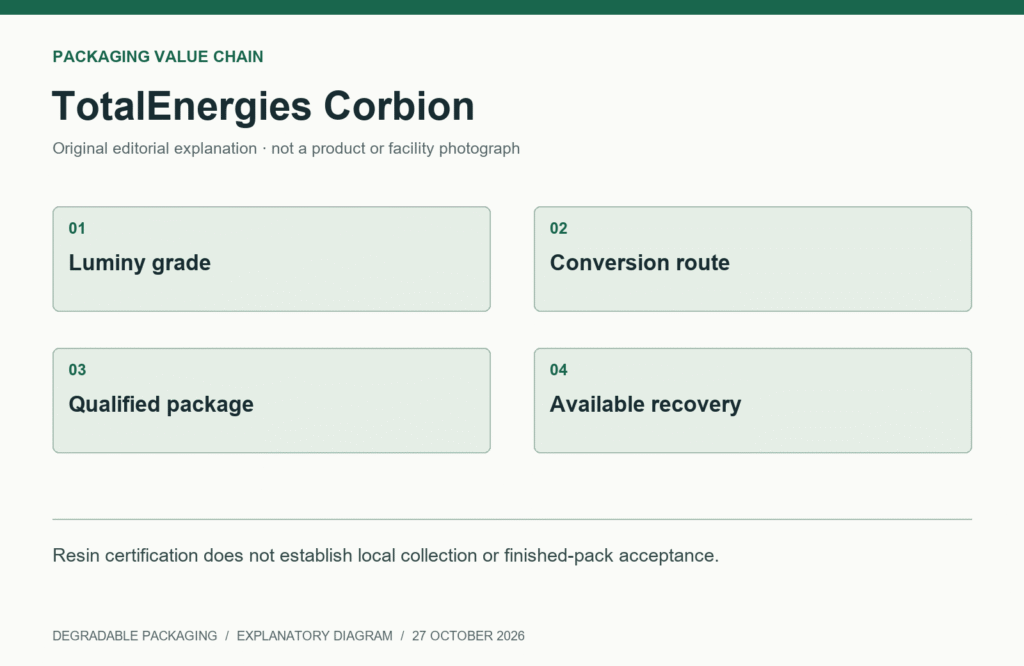
Company-specific value-chain explanation, visibly labelled as an illustration. Resin certification does not establish local collection or finished-pack acceptance.
Explore product rangeCompany overview
TotalEnergies Corbion develops and manufactures Luminy PLA, supplying converters rather than acting as the manufacturer of every package made with its resin. Its current corporate website identifies a Netherlands-headquartered, equal joint venture between TotalEnergies and Corbion, with PLA production in Rayong, Thailand. Corbion's May 2026 investor presentation also described a continuing process to sell its interest; an intended disposal should not be reported as a completed ownership change.
The company's packaging relevance is in grade selection and application support. Its current portfolio distinguishes high-heat PLA, standard PLA, low-heat grades typically used in seal layers, and PDLA for nucleation or stereocomplex formulations. Packaging applications therefore involve more than replacing one resin label with another. Forming, sealing, stiffness and heat requirements can lead to different formulations and conversion settings.
Recent work extends that application focus into protective foams and recycling demonstrations. These developments require careful stage descriptions: a prototype box, a commercially offered resin grade and a pilot recycling chain answer different questions. None establishes that a finished pack is routinely collected and recycled in every market.
Packaging portfolio
| Area | Packaging role | Qualification boundary |
|---|---|---|
| Rigid and foodservice applications | Standard and high-heat Luminy PLA grades | Validate forming and service temperature. |
| Flexible and seal layers | Low-heat PLA and grade-specific formulations | Check compatibility with the whole film structure. |
| Foam development | Expanded PLA projects and extrusion-foam grades | Separate resin availability from validated finished-pack supply. |
Materials and technologies
The portfolio offers different crystallisation and flow behaviour rather than one material specification. PDLA has a different formulation role from a general-purpose packaging grade. Foam conversion adds cell structure, density, dimensional stability and cushioning to the qualification task. Results for one foam route should not be carried over to another without trials. [1], [2], [3], [4]
Sustainability and circularity position
The company describes Luminy as biobased and offers composting and recycling pathways. Its grade documentation is relevant evidence about its own resin; final package certification and regional acceptance must be checked separately. The ReBioCycle result demonstrates a technical route through sorting and repolymerisation, not a universally available municipal PLA recycling service. [1], [2], [3], [4]
Why this company matters
Watch the connection between polymer supply and usable conversion routes. A new PLA foam formulation matters only if it survives the purchaser's cushioning, temperature and logistics tests. Recycling progress matters when sorted feedstock, treatment capacity and viable outlets connect. These are more useful indicators than a general promise that the polymer is circular.
Recent developments
- 20 April 2026 — TotalEnergies Corbion reported work with Useon on expanded PLA foam, including perfume-box prototypes. The release describes application development, not widespread protective-packaging adoption.
- 1 September 2026 — The company reported ReBioCycle sorting and chemical-recycling work with Torwash and other partners. Sorting was at pilot scale, with further scale-up still ahead.
What packaging teams should verify
- Select the grade and crystallisation route against service-temperature and converting requirements.
- For foam, test compression, cushioning and dimensional stability on the actual transported product.
- Check certification coverage for every layer and component; obtain a credible regional recovery route rather than relying on resin-level recyclability.
Sources / References
Sources checked on 27 October 2026 with AI assistance. Company statements are attributed; no independent product testing is claimed. Post-publication human review by the Degradable Packaging Editorial Team is pending.
- [1] TotalEnergies Corbion, About us and Luminy portfolio, accessed 27 October 2026; joint venture, Rayong and grade distinctions. https://totalenergies-co
rbion.com/products/ - [2] Corbion AGM presentation, 13 May 2026, slide 9; 50% ownership and proposed divestment process. https://www.corbion.com/
-/media/corbion/files/sh areholder-meeting/2026-f iles/english/presentatio n-ceo.pdf - [3] TotalEnergies Corbion, expanded PLA / Useon, 20 April 2026; protective foam and prototypes. https://totalenergies-co
rbion.com/blog/expanded- pla-a-low-carbon-footpri nt-alternative-to-eps-fo ams/ - [4] TotalEnergies Corbion, ReBioCycle, 1 September 2026; pilot sorting, hydrolysis and repolymerisation. https://totalenergies-co
rbion.com/blog/rebiocycl e-demonstrates-closed-lo op-recycling-of-pla-biop lastics-from-mixed-plast ic-waste/
Disclosure
Editorial company profile. Inclusion does not constitute a product endorsement, membership statement or commercial partnership.