

Editorial company profile
Sappi
Sappi supplies functional and barrier papers, heat-sealable papers and packaging board within a broader pulp-and-paper business. Its packaging work combines substrate design, surface treatment and converting support. A paper's reported barrier or repulpability should be distinguished from the shelf life, seal integrity and recovery performance of a completed package.
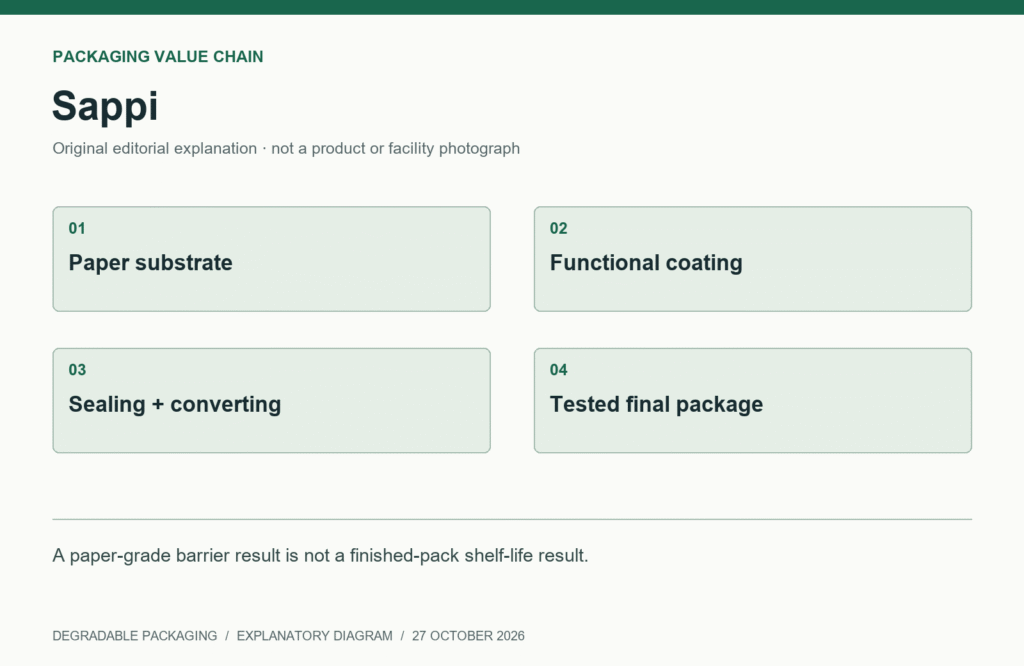
Official websiteOriginal explanatory diagram: Degradable Packaging. A paper-grade barrier result is not a finished-pack shelf-life result.
Packaging value chain
Sappi — packaging value chain
Functional and barrier packaging papers
Company-specific value-chain explanation, visibly labelled as an illustration. A paper-grade barrier result is not a finished-pack shelf-life result.
Explore product rangeCompany overview
Sappi is a South Africa-based pulp and paper group whose packaging business includes functional papers, flexible packaging substrates and paperboard. It supplies materials for converters and brand owners; it is not the manufacturer of every pouch or wrapper made from those materials. Packaging is also one part of a wider group that retains other paper and pulp activities. A profile focused on packaging should not present that segment as the whole business.
Its functional-paper proposition combines the paper substrate with coatings and other surface properties. The Guard portfolio addresses barrier requirements, while sealable grades support particular converting routes. These are meaningful technical differences: moisture, oxygen, grease and heat-sealing requirements do not necessarily occur together, and one grade should not be assigned another grade's performance.
Sappi's recent reporting also connects product development with changes in the manufacturing asset base, including the Somerset paperboard project. That makes the company relevant both to flexible-paper trials and to longer-term paperboard supply. Neither a grade launch nor a converted paper machine establishes the actual performance or recoverability of a customer's finished pack.
Packaging portfolio
| Area | Packaging role | Qualification boundary |
|---|---|---|
| Functional papers | Guard portfolio | Grade-dependent oxygen, moisture and grease protection. |
| Sealable papers | Seal products and Seal GR | Heat sealing and application-specific grease resistance. |
| Paperboard | Somerset conversion and other packaging grades | Distinguish installed assets, ramp-up and saleable output. |
Materials and technologies
A barrier-coated paper is a construction, not simply fibre with a new trade name. For a food wrapper, teams must examine the relevant transmission test, humidity and temperature together with seal behaviour. Printing, creasing and flexing may change the result. Paperboard expansion answers a supply question; it should not be used as proof of flexible-paper barrier performance. [1], [2], [3]
Sustainability and circularity position
Sappi describes its functional papers as alternatives to selected plastic and composite structures. Its sustainability report is a company disclosure, not an independent test of every package sold by its customers. Sourcing certificates, coating composition, repulpability and actual collection should remain separate checks. A paper-rich structure should not automatically be called plastic-free or universally recyclable. [1], [2], [3]
Why this company matters
Sappi is useful to follow because it connects coating development with established papermaking and converting relationships. The important adoption signal is a repeatable pack that meets product-protection requirements at an acceptable converting cost. If moving to paper requires shorter shelf life or an additional incompatible layer, the substrate change alone does not settle the packaging decision.
Recent developments
- FY2025 — Sappi reported completing the conversion and expansion of Somerset PM2 toward paperboard, reducing exposure to graphic papers. Completion of the project is distinct from sustained full output.
- FY2025 — Its sustainability report records Guard ICC development for ice-cream cone sleeves and a Seal GR launch for lightweight sealable secondary packaging. The grades have different functions and application boundaries.
What packaging teams should verify
- Specify the Guard or Seal grade, grammage and barrier conditions rather than buying a generic 'barrier paper'.
- Run seal-window, crease and shelf-life tests on the printed final construction.
- Confirm coating composition, fibre-sourcing documents, repulpability method and the relevant local recovery route.
Sources / References
Sources checked on 27 October 2026 with AI assistance. Company statements are attributed; no independent product testing is claimed. Post-publication human review by the Degradable Packaging Editorial Team is pending.
- [1] Sappi, 2025 Global Sustainability Report, Competitive position; Guard ICC, Seal GR and packaging development. https://www.sappi-ir-rep
orts.co.za/online-report s/gsr-2025/competitive-p osition.php - [2] Sappi, 2025 Annual Integrated Report, Our Thrive strategy and performance; Somerset PM2 completion and business transition. https://sappi-ir-reports
.co.za/online-reports/ai r-2025/our-strategy-and- performance.php - [3] Sappi, FACHPACK 2025 Guard announcement; grade-specific barrier applications and trials, not blanket finished-pack validation. https://www.sappi.com/en
-gb/about-us/news-and-ev ents/sappi-expands-recyc lable-high-barrier-paper -portfolio-primary-packa ging
Disclosure
Editorial company profile. Inclusion does not constitute a product endorsement, membership statement or commercial partnership.