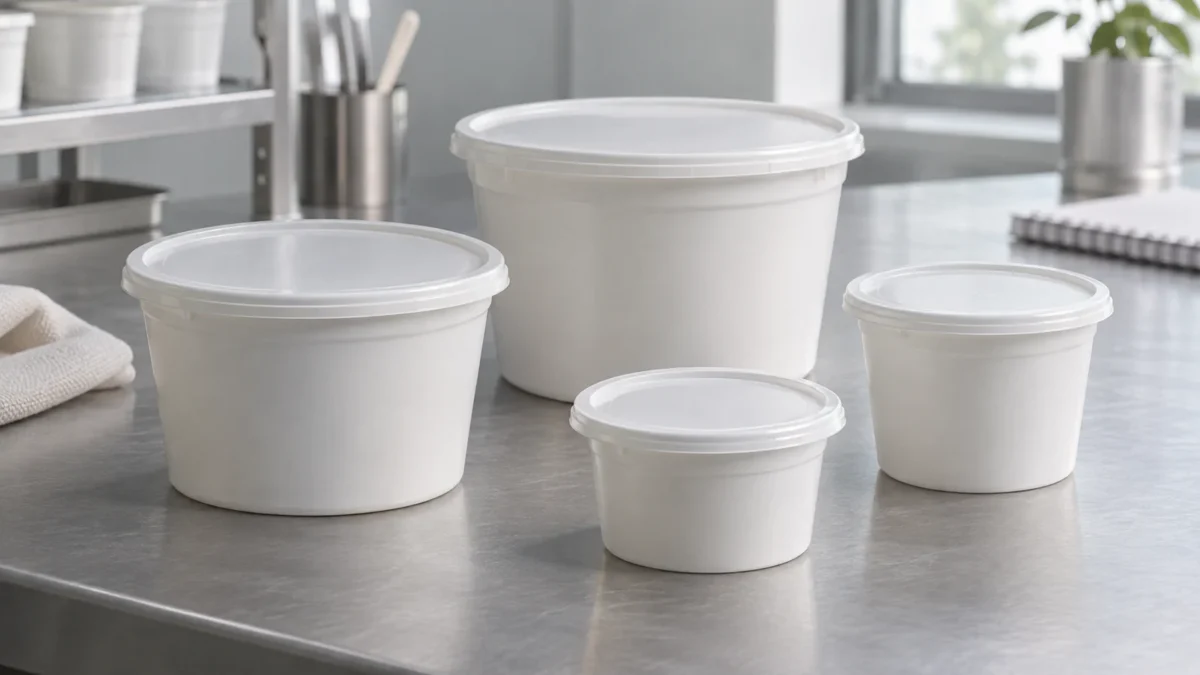
Amcor’s 24 November 2026 announcement presents UniPak Luma, a polypropylene food pot for cold- or ambient-fill applications such as yoghurt, crème fraîche and cottage cheese. Amcor reports up to 35% less plastic than comparable pots in its existing UniPak range, with savings varying by format. It lists 210, 280, 350 and 520 mL sizes. [1]
Amcor had previously named Luma in its 27 August 2026 preview of Empack Stockholm. The November announcement adds detail on geometry, molding and the comparison used for the reduction claim.
Injection compression molding and the shape of a pot
Amcor says it uses injection compression molding to distribute the polymer at lower pressure. It describes thinner walls, a redesigned skirt, a lighter lid, a snap closure and changes to tamper evidence. [1]
In broad engineering terms, reducing mass can involve changes to the distribution of material rather than simply specifying a thinner nominal wall everywhere. The rim, base and skirt of a pot serve different purposes. Material distribution needs to support the loads imposed by stacking, opening, handling and filling. A reduction in one region may be accompanied by a change in geometry elsewhere.
Amcor containers product line director Katrina Burrett attributes part of the material saving to the redesigned skirt and says the new shape is easier to hold. Treat grip and handling as acceptance checks on the chosen filled pot. [1]
What does up to 35% mean in practice?
A meaningful material-reduction claim needs a defined reference container. Ask for paired masses at the same volume and identify whether each includes the body, lid and tamper-evident components. Compare both constructions against the same filling, stacking and distribution requirements. See the guide to lightweight rigid packaging for trade-offs across thin-wall formats.
For illustration, suppose a reference pot weighed 20 grams and a replacement achieved a 35% reduction on that exact boundary. The replacement would weigh 13 grams, a saving of 7 grams per pot. At one million accepted units, that would correspond to seven tonnes less material on that boundary. These are deliberately hypothetical numbers, not published Luma weights.
If the lid, label or secondary packaging changes as well, the complete-system comparison needs to include those changes. Nor is the saving in polymer mass identical to a percentage reduction in carbon footprint. Manufacturing yield, energy, transport, food loss and recovery are separate variables in an environmental assessment.
The production-line test is more than a top-load number
| Evaluation | What to test on the chosen size |
|---|---|
| Container stiffness | Handling and deformation of actual filled and empty pots under relevant conditions |
| Top load and stacking | Complete filled pack and distribution stack, including the actual lid |
| Denesting | Reliable release of nested containers into the intended filling line |
| Closure | Fit, opening force, seal or snap engagement and tamper-evidence behaviour |
| Distribution | Vibration, handling and impact conditions relevant to the product’s route |
| Quality yield | Saleable units, rejects, downtime and changeover results at representative output |
Editorial acceptance framework. No performance results in this table are claimed for Luma or an alternative pack.
Some failures appear only when a small design change reaches the actual production system. Empty pots that pass a laboratory stiffness test may be difficult to separate reliably from a stack. A lid that fits a sample well may need to be checked against the variation of a long production run. A container that retains its shape on a bench may behave differently in a filled distribution stack.
This is why the approved specification should include tolerances and the conditions of the test, not simply the lightest sample produced. A buyer needs repeatable performance across the intended manufacturing and handling conditions.
Weight reduction and packaging EPR
Where a disposal-fee scheme uses packaging mass as one of its inputs, a lower mass may reduce the fee exposure for an otherwise equivalent material and rating. But the applicable reporting category, the complete construction, the relevant jurisdiction and the actual fee mechanism still determine the result. It would be misleading to infer a universal EPR saving from the 35% material headline.
The same applies to recycling. A predominantly PP pack can be designed with a compatible recovery route in mind, but resin identity alone does not establish collection, sorting or reprocessing of a particular finished pack. Labels, decoration, closures, residues and local facilities matter. Food-contact compliance also requires its own evidence for the actual application.
The buying decision should be made on accepted units
Our editorial assessment is that lightweighting is attractive when it preserves the package’s complete service at a lower total resource or cost burden. A thinner pot that increases filling losses, requires an expensive equipment change or causes more product damage may have a different economic result from the one suggested by material savings alone.
For dairy brands comparing alternatives, begin with a matched volume and service requirement. Obtain the measured mass of the body, lid and other relevant components; then qualify the intended SKU on the real filling and distribution route. Compare cost per accepted filled pack, not just the unit price of an empty container.
Ask the supplier for size-specific masses and a trial on the filling line. Approve a lighter pot only when the filled pack meets the same performance limits and the savings hold at the expected yield.
Sources
Found an error? Read our corrections policy and contact the editors.