
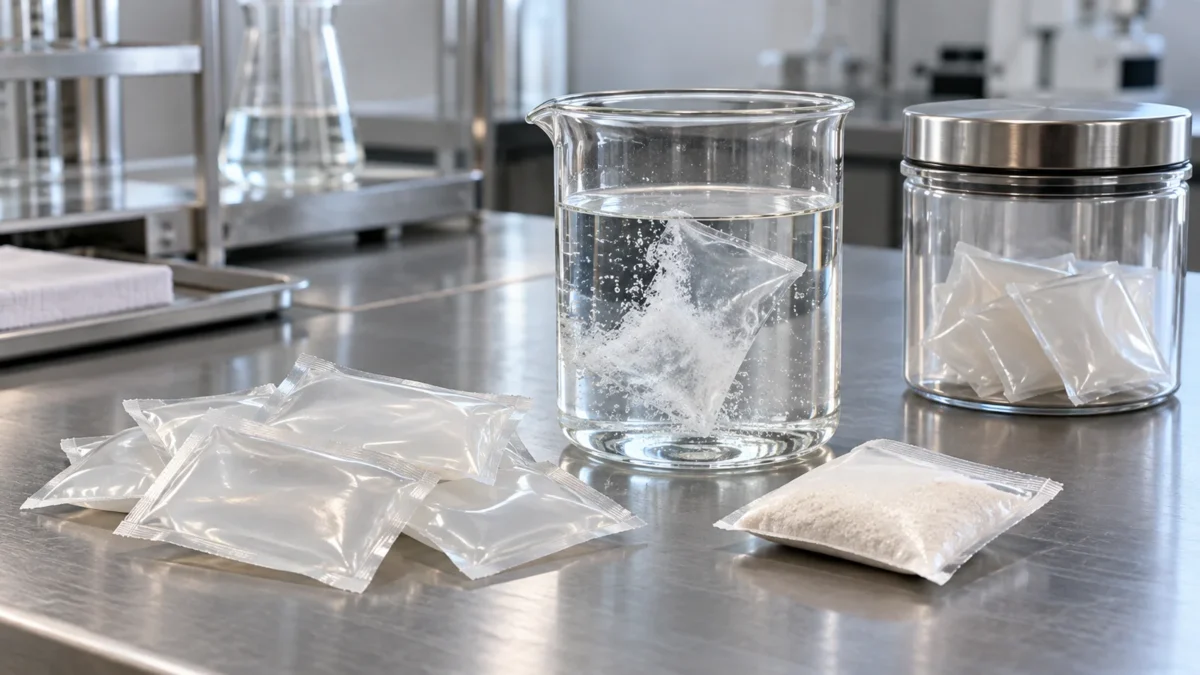
Water-soluble packaging solves a very specific problem: the package is supposed to disappear from the user’s workflow at the moment the product is used.
A laundry capsule goes into the wash without being opened. A pesticide dose pack can go into a mixing tank without the operator pouring concentrated powder. Infectious linen can be enclosed in a bag that opens or dissolves in the laundry process. Industrial chemicals can be pre-dosed so the operator never handles the concentrate directly.
That is a real packaging function. It is not the same as saying the package “disappears harmlessly.” Dissolution, biodegradation, wastewater removal and environmental mineralisation are different processes, and PVOH/PVA films vary substantially by polymer grade, thickness, formulation and use conditions.
The design question is therefore: does dissolution at the point of use solve a dosing, hygiene or worker-exposure problem that justifies using a water-soluble polymer system?
PVOH is not one film with one dissolution temperature
Poly(vinyl alcohol), usually written PVOH or PVA, is produced by hydrolysing polyvinyl acetate. Commercial grades differ mainly in molecular weight or degree of polymerisation, and in the degree of hydrolysis—how completely acetate groups have been converted to hydroxyl groups. [S1] [S2]
Those variables strongly affect water behaviour. Peer-reviewed work on packaging-grade PVOH shows that partially hydrolysed grades can be engineered for cold-water solubility, while more fully hydrolysed grades become more crystalline and require warmer water for rapid dissolution. Molecular weight also changes viscosity, film strength and dissolution behaviour.
This means “water soluble” is not a complete specification. A useful film brief should state:
- polymer grade and degree of hydrolysis;
- molecular weight or degree of polymerisation;
- film formulation and plasticiser/additive system;
- film thickness;
- required disintegration and complete-dissolution temperature;
- water agitation, hardness and chemistry where relevant;
- storage temperature and relative humidity;
- compatibility with the packaged formulation.
Research on controlled-solubility PVOH films also shows that film composition and thickness materially change both break-up time and complete dissolution. A film that ruptures quickly is not necessarily fully dissolved at the same moment.
See the open-access study on controlled water solubility of PVOH films.
Dissolution is a sequence, not an on/off property
When a water-soluble film enters water, several things can happen before the polymer is molecularly dispersed. Water penetrates the film, the polymer swells, the structure weakens, the film disintegrates, chains disentangle and the polymer dissolves into the aqueous phase. [S3]
Temperature and agitation matter. A 2026 ChemSusChem study of PVOH in multilayer films observed much more complete dissolution at higher temperatures and slower, geometry-dependent dissolution where water access and agitation were limited. That study used a different multilayer-recovery application from detergent pods, but it illustrates the same principle: “contact with water” is not enough to predict dissolution rate.
Thickness matters too. Thicker films can provide greater mechanical robustness during filling, transport and storage, while generally requiring more time or more favourable conditions to dissolve. The correct thickness is therefore a compromise between survival before use and release at use.
Humidity is the enemy before water becomes the trigger
The unusual challenge of water-soluble packaging is that the same affinity for water that enables disposal at use can damage the package during storage. [S14]
PVOH is hydrophilic. High relative humidity can plasticise the film, change strength, make surfaces tacky, weaken seals and alter barrier properties. Very dry storage can also change film flexibility depending on formulation.
For this reason, unit-dose films often sit inside a second package whose job is almost the opposite of the inner film: protect the water-soluble unit from ambient moisture until the moment of use.
This is not redundant packaging. It is part of the system. A laundry capsule that dissolves perfectly in the washing machine but softens, leaks or blocks together during humid storage has failed as packaging.

Laundry and dishwasher unit dose: convenience depends on controlled delay
Consumer detergent capsules are the most visible water-soluble application. The film must survive manufacturing, distribution, storage and brief accidental water contact, then open and dissolve during the wash. [S4]
EU chemical-packaging rules illustrate that deliberate delay. For liquid consumer laundry detergent in soluble single-use packaging, CLP Annex II requires an outer package with child-protection features. The soluble pack itself must contain an aversive agent, retain its liquid contents for at least 30 seconds in water at 20°C, and meet a defined mechanical compression requirement.
Those provisions are safety requirements, not a specification for every PVOH film or every dishwasher product. They show that a “water-soluble” consumer dose is deliberately engineered not to dissolve immediately under every contact condition.
See the applicable EU soluble-laundry-packaging requirements.
Agrochemical dose packs: dissolution can remove a hazardous handling step
Water-soluble pesticide packs demonstrate a stronger functional reason for dissolvable packaging than simple convenience. [S5] [S6]
The US Environmental Protection Agency states that, when used properly, water-soluble pesticide packaging can significantly reduce handler exposure during mixing and loading and can qualify as a closed mixing/loading system under the Agricultural Worker Protection Standard. The operator can place a sealed pre-measured package into the mixing tank instead of opening a container, measuring concentrate and pouring it manually.
But EPA also documented field practices that defeated the safety system, including deliberately breaking water-soluble bags or spraying them with high-pressure water. The agency revised label instructions because misuse could increase exposure rather than reduce it.
This is an important packaging lesson: the worker-protection benefit comes from the sealed handling workflow, not from PVOH chemistry alone.
See EPA’s current water-soluble pesticide packaging guidance.
Product compatibility can be harder than water solubility
The film has to dissolve in the final water system while remaining stable against the packaged concentrate for months beforehand. [S1] [S2]
That can be difficult because detergent, pesticide and industrial formulations may contain water, solvents, surfactants, salts, plasticising ingredients or other components that interact with PVOH. A film can swell, embrittle, lose seal strength or change dissolution behaviour during storage even when the fresh film passes a laboratory water test.
Compatibility testing should therefore use the actual formulation in the actual film over the intended storage conditions. Useful checks include:
- seal integrity after ageing;
- film tensile/handling strength;
- blocking or tackiness;
- weight or moisture transfer;
- disintegration time after storage;
- complete dissolution after storage;
- visible gel or residue in the intended equipment;
- effect of the dissolved film on the product-use process.
A supplier statement that a film is “cold-water soluble” does not establish compatibility with a specific high-surfactant detergent or solvent-containing agrochemical.
Hospital laundry bags use dissolution as an infection-control interface
Healthcare provides another application where the value is the removal of a handling step. NHS England’s current infection-control guidance states that infectious linen should not be sorted and should be sealed in a water-soluble bag—or in an impermeable bag with soluble seams—before leaving the clinical area. [S7]
The purpose is operational containment: staff in the next stage do not have to reopen and manually sort contaminated linen before it enters the controlled laundry process.
Not every healthcare soluble bag is necessarily PVOH, and NHS terminology also includes “alginate” soluble bags. The application therefore supports the water-soluble-packaging concept, not a claim that one polymer grade is mandated.
See NHS England infection-control guidance.
Dissolved polymer is still polymer
This is the point where water-soluble packaging is most often overclaimed. [S8] [S9] [S10]
When PVOH dissolves, the macroscopic film no longer exists as a visible sheet or particle. The polymer chains are dispersed in water. That is different from ultimate biodegradation, where microorganisms transform organic carbon through biological processes, ultimately producing products such as carbon dioxide, water and biomass under aerobic conditions.
Therefore:
dissolution ≠ biodegradation ≠ complete mineralisation.
The distinction also makes “plastic-free” wording problematic. PVOH is a synthetic polymer. In its 2023 response to a petition concerning detergent-pod PVA, the US EPA noted that its Safer Choice programme does not use “safe” as a blanket chemical description and requested that partners remove claims such as “plastic-free” or “100 percent plastic-free” where PVA is part of the product.
Wastewater fate is not settled by one headline number
Published evidence on down-the-drain PVOH has produced different conclusions, partly because the studies ask different questions and use different assumptions. [S8] [S9] [S10] [S11]
A 2021 modelling study by Rolsky and Kelkar reviewed earlier degradation literature and estimated that substantial fractions of PVA from US laundry and dishwasher pods could leave conventional wastewater systems through sludge or aqueous routes. The authors emphasised uncertainty around real-world WWTP degradation and the availability of PVA-degrading microorganisms.
In 2023, the US EPA reviewed a petition asking for additional testing and regulation of PVA used in detergent pods and sheets. EPA denied the petition, stating that the petitioners had not established that available information was insufficient for the requested TSCA testing action. EPA also cited OECD biodegradation studies on specific PVA structures used in Safer Choice-certified products and concluded that the weight of evidence supported those structures not meeting its persistence or very-persistence criteria.
A 2024 peer-reviewed study then used OECD 303A wastewater-treatment simulation methods on nonmodified PVOH 18-88 and reported high biodegradation/removal during the plateau phase. All authors of that study were affiliated with Procter & Gamble, a major detergent manufacturer, although the paper states that no outside funding supported the work.
These results should not be collapsed into one universal percentage. The evidence differs by:
- PVOH grade and degree of hydrolysis;
- molecular weight;
- film formulation and additives;
- test method;
- adapted versus unadapted microbial communities;
- hydraulic and sludge retention times;
- temperature and other treatment conditions;
- whether the study measures disappearance, dissolved organic carbon removal or ultimate mineralisation.
The responsible conclusion is narrower: some detergent-film PVOH grades have demonstrated substantial biodegradation in standardised tests and WWTP simulations, but dissolution itself does not prove that every PVOH film will fully biodegrade in every wastewater or environmental condition.
The EU microplastics definition creates a legal distinction—but not an environmental conclusion
EU Regulation 2023/2055 restricts intentionally added synthetic polymer microparticles under REACH. The legal definition excludes polymers that meet specified degradability criteria and also excludes polymers with solubility greater than 2 g/L when demonstrated under Appendix 16. [S12] [S13]
Appendix 16 specifies permitted OECD solubility methods and a defined test condition: 20°C, pH 7, 24 hours, with a pass criterion above 2 g/L.
This means that a polymer proven sufficiently soluble under the Regulation’s method can fall outside the legal designation “synthetic polymer microparticle” for that restriction. It does not mean that every water-soluble film is automatically excluded, or that the polymer is environmentally harmless after dissolution.
Manufacturers, importers and industrial downstream users relying on the solubility or degradability exclusion must be able to provide supporting evidence to competent authorities on request.
See the current EU synthetic-polymer-microparticle restriction.
End-of-life questions differ by application
| Application | Why soluble packaging is used | Where the dissolved polymer goes | Main evidence question |
|---|---|---|---|
| Laundry / dishwasher unit dose | Predosing and no manual film disposal | Domestic wastewater | Dissolution at wash conditions + WWTP/environmental fate of actual film grade |
| Agrochemical dose pack | Reduce direct handling during mixing/loading | Spray tank and ultimately the use environment | Operator-exposure benefit + formulation compatibility + environmental fate |
| Industrial cleaning dose | Predosing, lower contact with concentrate | Process water / wastewater | Correct dose, equipment compatibility and site wastewater route |
| Hospital laundry bag | Avoid reopening infectious-linen containment | Laundry process / wastewater | Infection-control workflow + dissolution in actual wash process |
| Specialty sachet | Release product without package retrieval | Depends on end-use process | Whether dissolution provides a real operational benefit and whether receiving environment is appropriate |
Water-soluble packaging earns its place when dissolution is part of product delivery
PVOH-based packaging is strongest when the package itself would otherwise create a handling problem. [S8] [S10] [S1] [S5] [S9]
It can pre-dose a hazardous concentrate, remove the need to open contaminated linen, eliminate a manual measuring step or deliver a unit dose directly into a water-based process. In those applications, dissolution is not an environmental slogan; it is a functional part of the delivery system.
The specification still has to balance opposing requirements. The film must resist humidity before use but respond to water during use. It must be strong enough for filling and transport but thin and soluble enough for the intended process. It must tolerate the product for months and then release it quickly. And after dissolution, the polymer’s fate has to be evaluated separately from the fact that the visible film is gone.
The useful procurement question is therefore not “Is this film biodegradable?” It is:
Which PVOH grade and finished-film construction will survive storage, dissolve under the actual use conditions, remain compatible with the product, and have defensible evidence for the wastewater or environmental route that follows?
Methodology and editorial note
This article separates film dissolution, wastewater removal, biodegradation and mineralisation. It compares application-specific evidence and official rules; no PVOH product is declared environmentally harmless or universally suitable. Evidence and source scope checked 21 October 2026. The main image is a disclosed generic editorial illustration or original concept diagram, not a named company, real facility or tested product. Editorial Team human review remains pending after publication.
Sources and reference notes
- [S1] Frontiers in Chemistry / authors listed by journal. Effect of Chemical Grafting Parameters on the Manufacture of Functionalized PVOH Films Having Controlled Water Solubility. Introduction; water solubility; WRT/disintegration/dissolution tests; WVTR section. Handoff access record: 21 October 2026.
- [S2] Food Bioengineering / Alvarado et al.. Recent progress in polyvinyl alcohol (PVA)/nanocellulose composite films for packaging applications: A comprehensive review of the impact on physico-mechanical properties. Section 1.2. Handoff access record: 21 October 2026.
- [S3] ChemSusChem / Prommart et al.. Aqueous Dissolution and Recovery of Poly(Vinyl Alcohol) in Multilayer Film. Dissolution screening; temperature/agitation/geometry sections. Handoff access record: 21 October 2026.
- [S4] European Union. Commission Regulation (EU) No 1297/2014 amending Regulation (EC) No 1272/2008 as regards liquid consumer laundry detergents in soluble packaging for single use. Annex II section 3.3. Handoff access record: 21 October 2026.
- [S5] US Environmental Protection Agency. Revised Label Language for Pesticide Products in Water Soluble Packaging to Protect Handlers. Main guidance text. Handoff access record: 21 October 2026.
- [S6] European Food Safety Authority. Guidance on the assessment of exposure of operators, workers, residents and bystanders in risk assessment of plant protection products. Water-soluble bags in mixing/loading exposure assessment. Handoff access record: 21 October 2026.
- [S7] NHS England. National infection prevention and control manual for England — Chapter 1: Standard infection control precautions. Safe management of linen. Handoff access record: 21 October 2026.
- [S8] Rolsky & Kelkar; International Journal of Environmental Research and Public Health. Degradation of Polyvinyl Alcohol in US Wastewater Treatment Plants and Subsequent Nationwide Emission Estimate. Abstract; WWTP process analysis; degradation literature synthesis. Handoff access record: 21 October 2026.
- [S9] US Environmental Protection Agency. Polyvinyl Alcohol (PVA); TSCA Section 21 Petition for Rulemaking; Reasons for Agency Response; Denial of Requested Rulemaking. PVA petition decision; biodegradation evidence; Safer Choice status; claims language. Handoff access record: 21 October 2026.
- [S10] McDonough et al.; Integrated Environmental Assessment and Management. Application of standardized methods to evaluate the environmental safety of polyvinyl alcohol disposed of down the drain. Abstract; OECD 303A results; authors/acknowledgment/COI. Handoff access record: 21 October 2026.
- [S11] Byrne et al.; Tenside Surfactants Detergents. Biodegradability of Polyvinyl Alcohol Based Film Used for Liquid Detergent Capsules. Water solubility; OECD biodegradation discussion/conclusion. Handoff access record: 21 October 2026.
- [S12] European Union. Commission Regulation (EU) 2023/2055 amending Annex XVII to REACH as regards synthetic polymer microparticles. – Entry 78 definition. Handoff access record: 21 October 2026.
- [S13] European Chemicals Agency. Microplastics — Hot topics. Regulation 2023/2055 implementation/resources. Handoff access record: 21 October 2026.
- [S14] Peer-reviewed packaging research. High-Barrier, Biodegradable Films with Polyvinyl Alcohol/Polylactic Acid + Wax Double Coatings: Influence of Relative Humidity on Transport Properties and Suitability for Modified Atmosphere Packaging Applications. Abstract / relative humidity effects. Handoff access record: 21 October 2026.
The public corrections channel is currently inactive. Read our corrections policy.