Paperization is easy to misunderstand when the example is a cereal box.
Outside food, the packaging problem is different.
A luxury skincare carton may never touch the formula but still has to protect a glass jar, carry decoration and survive retail handling. A soap refill carton has to hold liquid for months. A detergent pack may need chemical resistance, pouring control and a child-resistant opening. A premium presentation box can contain windows, metallic effects, magnets, foam or plastic inserts that make the “paper package” much more complex than it looks.
That is why the current move toward paper-based formats in beauty, personal care and household products is not one material switch.
It is several migrations happening at different levels of the package.
The easiest move is usually replacing plastic in secondary packaging. The hardest is asking paperboard to become the primary liquid container.
Walk the shelf and the paper is doing different jobs
Consider three current examples. [S1] [S2] [S3]
Shiseido says it is replacing plastic with certified paper in secondary packaging for ANESSA and ELIXIR, while Clé de Peau Beauté uses FSC-certified paper for the individual cartons of its products. In that case, paper mainly surrounds and presents a primary cosmetic package.
Dr. Bronner’s Japan business moved in a more demanding direction in 2026. Its 946 ml Magic Soap refill uses a paper-based carton as the refill container itself. The company discloses a structure of 69% FSC-certified paper, 5% aluminium and 26% polyethylene, plus a polypropylene cap. It says the format reduces plastic by 86% compared with an equivalent quantity in its conventional containers.
Saraya introduced a paper-pack refill for Yashinomi dishwashing detergent and says the 1,400 ml format reduces plastic use by 34% compared with its previous 1,500 ml refill pouch. In September 2026 the company said the product received Japan’s plastic-use product design certification. This company comparison is per pack across different fill volumes; it is not a per-litre reduction or life-cycle assessment.
All three are “paperization.”
But they represent three different engineering problems:
- paper replacing plastic around a primary pack;
- paperboard becoming part of the liquid barrier package;
- paperboard replacing a flexible refill format while retaining enough polymer to contain the product.
Those distinctions matter more than the word “paper.”

First distinguish primary, secondary and tertiary packaging
| Packaging level | Typical examples | What paper has to do | Difficulty |
|---|---|---|---|
| Primary | Liquid refill carton, paper tube in direct product contact, composite bottle | Contain product, resist chemistry/moisture, seal, dispense | Highest |
| Secondary | Folding carton, sleeve, presentation box, paper tube around a bottle/jar | Protect, display, carry information, support branding | Usually lower |
| Insert / fitment support | Paperboard insert, molded-fiber tray, dividers | Locate and protect the primary pack | Application-dependent |
| Tertiary | Corrugated transit case, protective box, shipping sleeve | Distribution and handling | Often technically mature |
This hierarchy explains why beauty has been able to move some visible packaging from plastic to paper faster than it can replace every jar, tube, pump and bottle. [S1]
The outer carton does not have to tolerate perfume, surfactant, alcohol, oil or shampoo directly.
The primary pack does.
Beauty is the easiest place to see secondary paperization
Beauty products frequently use secondary packaging for reasons that go beyond containment. [S1]
The carton can provide:
- brand area;
- ingredient and regulatory text;
- tamper evidence;
- protection for glass or decorated rigid packs;
- gift presentation;
- retail stacking;
- light protection;
- space for inserts or instructions.
Replacing a plastic blister, plastic sleeve or plastic presentation tray with paperboard can therefore remove plastic without changing the formula-contact package.
That is technically attractive because the packaging engineer can preserve the validated bottle or jar while redesigning the surrounding system.
It is also why the claim needs precision.
A skincare product can have a paper carton and still use a glass jar with a multi-material pump or a plastic inner cup.
Paper secondary packaging is not the same as a paper primary package.
Certified fiber answers a sourcing question—not a recycling question
Beauty companies frequently specify FSC-certified paper for cartons. [S9]
That can be useful evidence about fiber sourcing and chain of custody.
FSC explains its Chain of Custody system as a way to verify that eligible forest-based material is identified and tracked through processing and distribution into finished goods.
That is not the same question as whether the finished cosmetic carton will recycle successfully in a given mill.
A carton can use certified paper and still contain:
- a large plastic window;
- heavy lamination;
- metallic decoration;
- magnets;
- foam inserts;
- hot-melt adhesive;
- a plastic tray.
Fiber sourcing and packaging recyclability therefore need separate evidence.
Luxury decoration can turn a simple carton into a sorting problem
This is where beauty packaging becomes technically interesting. [S6]
A premium carton may use foil effects, metallised surfaces, black coloration, windows, integrated decorative parts or magnetic closures.
4evergreen’s February 2026 Circularity by Design Guideline now gives these components explicit attention.
Its new sorting-disruptor guidance notes that large non-paper integrated components such as plastic windows can cause optical sorting systems to misread a paper-based pack. It also identifies large-area metallic pigments, dark carbon-black coloration, ferromagnetic components and aluminium layers as potential sorting disruptors under defined conditions.
That does not mean luxury packaging must become visually plain.
It means decoration has become a recovery-system variable.
A premium look created with a coating or metallisation that remains compatible with the intended paper route is a different design from one that depends on a laminated film, magnet and plastic insert.
The window is a small feature with a large sorting consequence
A clear window can help shoppers see a product.
But an integrated plastic window can occupy enough visible area to interfere with optical identification of the paper package.
4evergreen recommends avoiding strongly attached windows where possible and considering detachable, thin and lightweight solutions.
That creates a useful design question for cosmetics and personal care:
Does the customer really need to see the bottle through the carton?
If the answer is no, removing the window may simplify both material use and sorting.
If the answer is yes, the window should be designed as a component with a known separation and recovery strategy—not as an invisible exception to the “paper carton” claim.
Primary paperization is much harder because formulas attack packaging
The problem changes completely when paperboard becomes the refill container. [S2]
Liquid soap, shampoo and detergent expose packaging to water, surfactants, fragrance oils, solvents, alkaline or acidic ingredients and long storage periods.
Untreated paper cannot perform that job alone.
The package generally needs some combination of:
- polymer barrier layers;
- aluminium or other high-barrier layers where necessary;
- heat-seal layers;
- spouts;
- caps;
- adhesives;
- coatings.
This is why a “paper carton refill” is often better described as a paper-dominant composite package.
The Dr. Bronner refill makes the composite visible
Dr. Bronner’s 2026 Japan refill is useful precisely because the company publishes the composition. [S2]
The company says the 946 ml carton is 69% FSC-certified paper, 5% aluminium and 26% polyethylene, with a polypropylene cap.
That structure demonstrates the real engineering trade-off.
The paper provides the dominant structural substrate. Aluminium and polyethylene provide functions that the soap package still needs. The plastic cap provides controlled opening and reclosing.
The package is therefore not “plastic-free.”
Its company-reported benefit is a reduction in plastic use versus the compared conventional containers.
The company also tells Japanese consumers to rinse the empty carton, recycle it as waste paper according to local rules and separate the cap as plastic.
That disposal advice is market-specific and should not be copied to a different country without checking the local collection route.
Household detergent puts paperboard under chemical and handling stress
Saraya’s 2026 paper refill illustrates a second household route. [S3] [S4] [S5]
The pack is designed to stand upright for pouring and to collapse more compactly after use. The company says changing from the previous 1,500 ml refill pouch to the 1,400 ml paper-pack format cuts plastic use by 34%.
The important engineering issue is not only the material reduction.
A household detergent refill must still survive:
- warehouse compression;
- wet handling;
- chemical contact;
- transport vibration;
- consumer gripping;
- pouring;
- closure use where fitted;
- storage after opening.
Moving from flexible pouch to paper-dominant carton can improve standing and pouring behavior, but it also changes the manufacturing and recovery system.
The refill still has to be qualified as a package, not merely as a paperboard substrate.
Dry household products create a much easier opening
Paper cartons become less demanding when the product itself does not require a liquid barrier. [S3]
Examples include:
- detergent tablets or capsules inside a suitable primary barrier;
- powdered cleaning products;
- soap bars;
- bath products;
- solid cosmetics;
- dry personal-care accessories;
- refill tablets or concentrates.
Here, the paperboard can focus more on structure, child resistance where needed, tamper evidence, print and transport.
But even dry household packaging can carry safety requirements. A detergent-capsule carton, for example, may need a child-impeding or child-resistant opening system rather than a simple tuck flap.
Paperization does not eliminate the product-specific safety function.
Paper tubes occupy the space between carton and rigid pack
Beauty and personal care also use rigid paper tubes and composite canisters for products such as soaps, balms, powders, fragrances, gift sets and dry accessories. [S6]
They can deliver a different shelf presence from a folding carton and may replace rigid plastic presentation packs.
But the end-of-life design can become more complicated when the tube includes:
- plastic shoulders or bases;
- metal ends;
- laminated decorative wraps;
- plastic windows;
- foam or flocked inserts.
Again, “paper tube” describes the dominant visible substrate.
It does not describe every component.
Sometimes the better redesign is less carton, not more carton
Paperization can become a slogan if designers assume that replacing plastic with paper is always the objective. [S1] [S10]
Beauty offers a useful counterexample.
Shiseido reports that it has also been reducing tertiary packaging—protective boxes and pillow pouches—and says it reduced such packaging across 54 SKUs in 2025.
L’Oréal’s 2026 refill campaign similarly reports that several refill systems reduce cardboard as well as glass, metal or plastic compared with repurchasing the complete original package.
These examples point to a broader rule:
the objective is not to maximize paper. It is to remove unnecessary packaging while using paper where paper performs the required job well.
A paper carton can still be overpackaged
A rigid jar placed inside a large folding carton, held by a paper insert, wrapped in a sleeve and shipped in another presentation box may contain little plastic in its secondary packaging. [S11]
It can still use more material and volume than necessary.
For premium categories, this creates tension between:
- retail presentation;
- unboxing experience;
- giftability;
- product protection;
- resource minimisation;
- transport efficiency.
Paper is not exempt from source-reduction discipline.
That is particularly important in Europe, where PPWR packaging-minimisation requirements will make unnecessary weight, volume and packaging components more difficult to justify from 2030.
The best paperization target is often the easiest plastic function to eliminate
Instead of asking where plastic exists, designers can ask what the plastic is doing. [S1] [S10]
| Existing component | Paper-based redesign opportunity | Main technical question |
|---|---|---|
| Plastic secondary blister / tray | Folding carton, paperboard support or molded fiber | Can protection and presentation be maintained? |
| Plastic sleeve / outer presentation pack | Paper sleeve or printed carton | Is the outer pack needed at all? |
| Rigid plastic gift box | Paperboard carton or paper tube | Can decoration avoid sorting disruptors? |
| Liquid refill pouch | Paper-dominant composite refill carton | Can barrier, seal, formula compatibility and pouring be qualified? |
| Plastic insert | Paperboard or molded-fiber insert | Does it protect the product through distribution? |
| Tertiary protective packaging | Corrugated/paper solution—or elimination | Can material be removed without increasing damage? |
The shelf-migration rule
Paper is moving into beauty, personal care and household packaging because these categories contain many functions that fiber-based structures can already perform well: printing, presentation, stiffness, secondary protection, refill support and transport. [S6] [S11]
But the migration gets harder as paper moves closer to the product.
A folding carton around a perfume bottle is mostly a structure and communication problem.
A refill carton full of surfactant is a barrier, seal, chemical-compatibility and recovery problem.
A luxury presentation pack with foil, magnets and windows is a sorting and material-separation problem.
That produces a practical hierarchy:
remove unnecessary packaging first → replace simple plastic secondary components next → redesign inserts and presentation formats → move paper into primary/refill packaging only when the barrier and recovery system are proven.
Paperization works best when the package becomes simpler.
If the redesign needs enough plastic, aluminium, decoration and extra components to recreate the old package, the material switch may have changed the label more than the system.
Methodology and editorial note
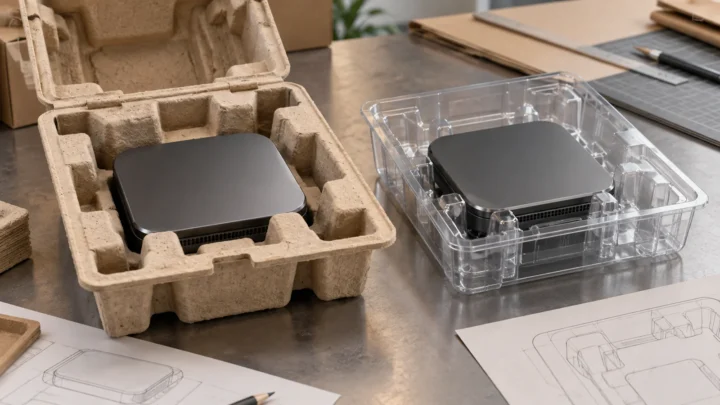
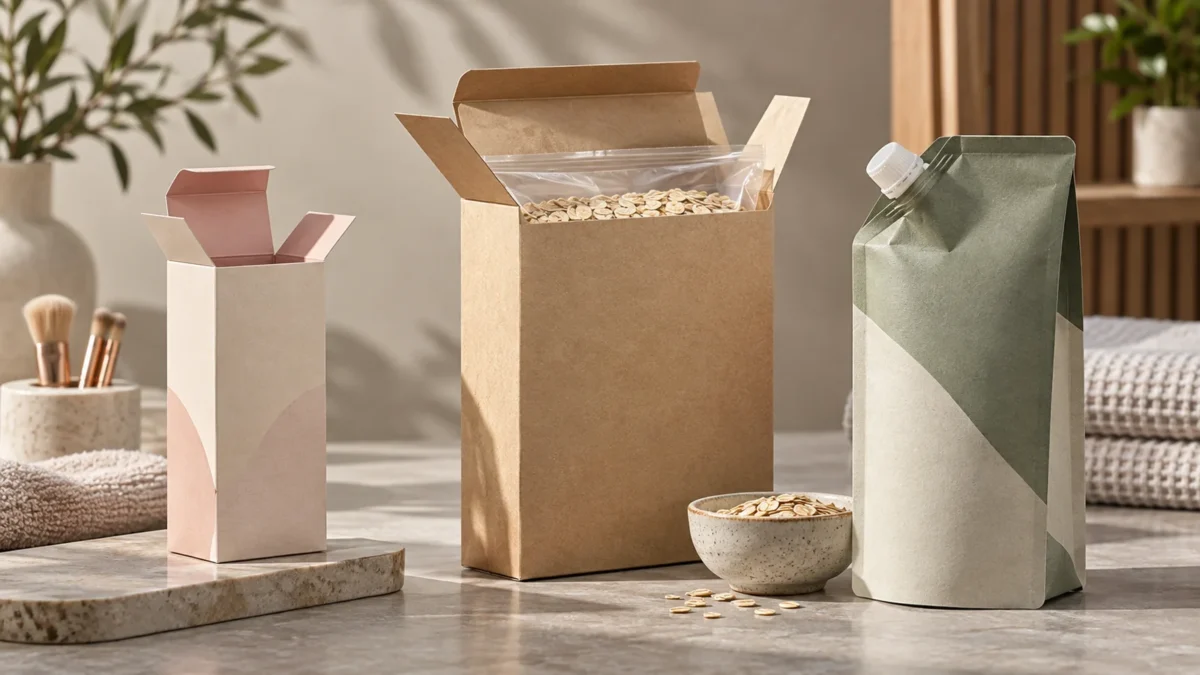
Named company packages are attributed examples, not independently verified environmental outcomes. The refill percentage compares the stated older pouch and new pack, not an LCA. Fiber sourcing, recyclability and minimisation are separate questions. Sources checked 20 October 2026. The main image is an AI-generated editorial illustration of a generic packaging scene; it does not depict a named product, facility, company or test.
Sources and reference notes
- [S1] Shiseido Company. Developing Sustainable Products. Shiseido current secondary-packaging actions. Company statements are attributed; scientific/technical claims are limited to the stated test or review scope. Accessed 20 October 2026.
- [S2] Dr. Bronner Japan / Nature’s Way. Dr. Bronner Japan 2026 paper refill carton. Dr. Bronner Japan 2026 paper refill carton. Company statements are attributed; scientific/technical claims are limited to the stated test or review scope. Accessed 20 October 2026.
- [S3] Saraya. Yashinomi Detergent 1400mL refill renewed in paper-pack format. Saraya Yashinomi 1400 ml refill launch. Company statements are attributed; scientific/technical claims are limited to the stated test or review scope. Accessed 20 October 2026.
- [S4] Saraya. Saraya paper-pack design certification / 34% plastic reduction. Saraya paper-pack design certification / 34% plastic reduction. Company statements are attributed; scientific/technical claims are limited to the stated test or review scope. Accessed 20 October 2026.
- [S5] Ministry of Economy, Trade and Industry, Japan. First certifications under Plastic Resource Circulation Act product-design certification system. Japan METI plastic product design certification framework. Company statements are attributed; scientific/technical claims are limited to the stated test or review scope. Accessed 20 October 2026.
- [S6] 4evergreen. Circularity by Design Guideline. 4evergreen Circularity by Design Guideline v4. Company statements are attributed; scientific/technical claims are limited to the stated test or review scope. Accessed 20 October 2026.
- [S9] Forest Stewardship Council. Chain of Custody Certification. FSC Chain of Custody. Company statements are attributed; scientific/technical claims are limited to the stated test or review scope. Accessed 20 October 2026.
- [S10] L’Oréal Groupe. L’Oréal calls on consumers around the world to #jointherefillmovement. L’Oréal 2026 refill movement as counterexample to “more paper”. Company statements are attributed; scientific/technical claims are limited to the stated test or review scope. Accessed 20 October 2026.
- [S11] European Parliament & Council / EUR-Lex. PPWR packaging minimisation. PPWR packaging minimisation. Company statements are attributed; scientific/technical claims are limited to the stated test or review scope. Accessed 20 October 2026.
The public corrections channel is currently inactive. Read our corrections policy.