

Editorial company profile
Eco-Products
Eco-Products supplies foodservice packaging through distinct compostable, post-consumer recycled-content and reusable product routes, rather than a single disposal category.
Official websiteLogo: Eco-Products; source: official company site.
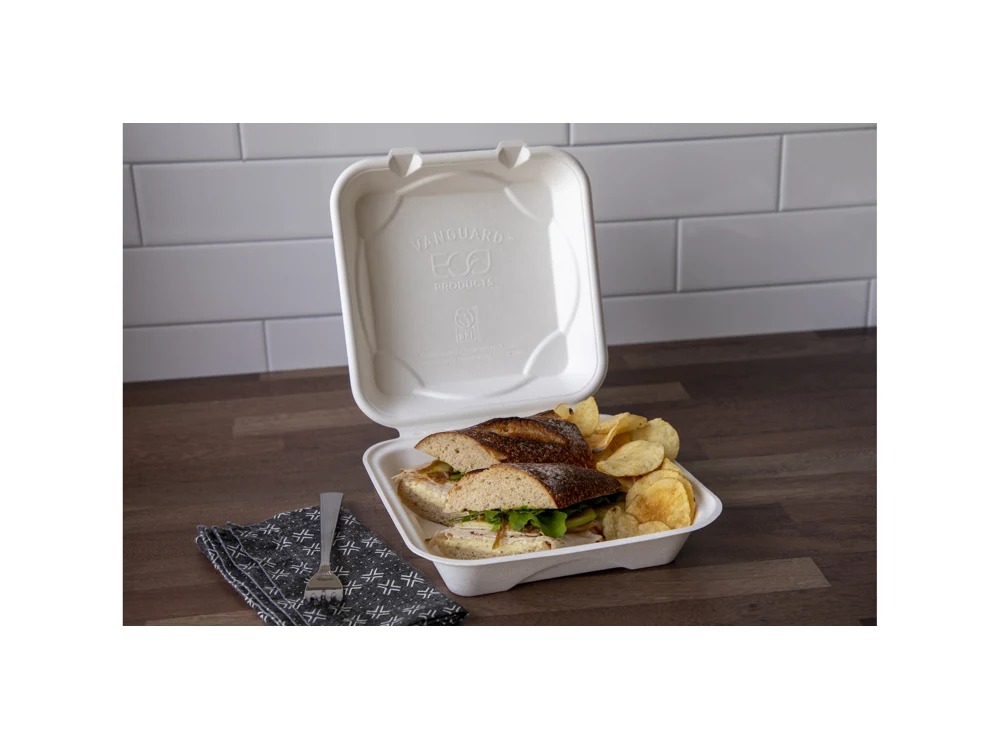
Featured packaging
Vanguard molded fiber clamshells
Sugarcane fiber
Eco-Products’ Vanguard line includes molded-fiber hinged containers for takeaway foodservice. The clamshell format combines the base and lid in one piece, offering a plant-fiber alternative for serving and carrying prepared meals. The image is from the company’s Vanguard announcement; the linked product page provides the current 9-inch clamshell specification.
Explore product rangeCompany overview
Eco-Products supplies foodservice products through several different material and use pathways. Its catalogue includes cups, containers, clamshells, trays and reusable serviceware. The company's own description distinguishes renewable and compostable products from products made with post-consumer recycled content, with reusable products added to the offering in 2025.
Its official history traces the business to Boulder, Colorado, in 1990, initially distributing recycled-content office and building supplies. The account describes a later shift towards foodservice as commercial compostable packaging became available. That history explains why material sourcing and post-use routes are prominent in the current business identity.
The distinctions between the lines are more informative than a general environmental description. The company explicitly states that BlueStripe products made with post-consumer recycled content are not compostable. It also makes clear that a customer's access to recycling or composting affects product selection. The useful company profile therefore follows those separate pathways instead of presenting all Eco-Products items as equivalent compostable packaging.
Packaging portfolio
| Packaging area | Examples | Main applications |
|---|---|---|
| Compostable serviceware | Renewable-material foodservice ranges | Operations with a compatible organics collection route |
| Recycled-content products | BlueStripe range | Foodservice products using post-consumer material |
| Reusable products | Reusable serviceware added in 2025 | Service systems designed for repeated use |
| Foodservice formats | Cups, trays, clamshells and containers | Defined food and beverage applications |
Materials and technologies
Eco-Products' material organisation is a practical part of its product proposition. Renewable inputs, post-consumer recycled inputs and reusable service systems are not interchangeable technical features. The company also distinguishes post-consumer recycled material from production scrap retained within manufacturing. For a buyer, that difference affects the evidence needed for an input claim. Reusable items introduce another requirement: the operator must consider repeated-use, return and washing arrangements, rather than judging the purchase through the material description alone.
Sustainability strategy and packaging direction
The company presents circularity through different routes for different lines. Its compostable products are intended for a compatible composting system, recycled-content items create demand for recovered material, and reusable products depend on a repeated-use operation. Those are company-stated approaches, with separate practical conditions. The BlueStripe distinction is particularly important: recycled content does not mean compostable. This profile therefore keeps the company's product organisation visible and does not assign one certification or disposal instruction across its full catalogue.
Why this company matters in packaging
Eco-Products is worth following because it makes several competing foodservice strategies visible within one business. An operator can examine compostable, recycled-content and reusable offerings without pretending that they solve the same problem in the same way. The editorial value is the link between the product line and the operation that can support it: collection for compostables, a suitable recovery route for recyclable formats, or a working return-and-wash system for reuse. That is a more useful company-specific discussion than a broad promise about environmentally friendly packaging.
What packaging buyers should verify
- Confirm the selected line and whether its intended route is composting, recycling or repeated use.
- For recycled-content claims, request the post-consumer percentage and the product-specific evidence.
- For reusables, agree the washing, return and loss-management system; for compostables, verify the receiving facility's acceptance.
Disclosure
Editorial company profile. Inclusion does not constitute a product endorsement, membership statement or commercial partnership.