
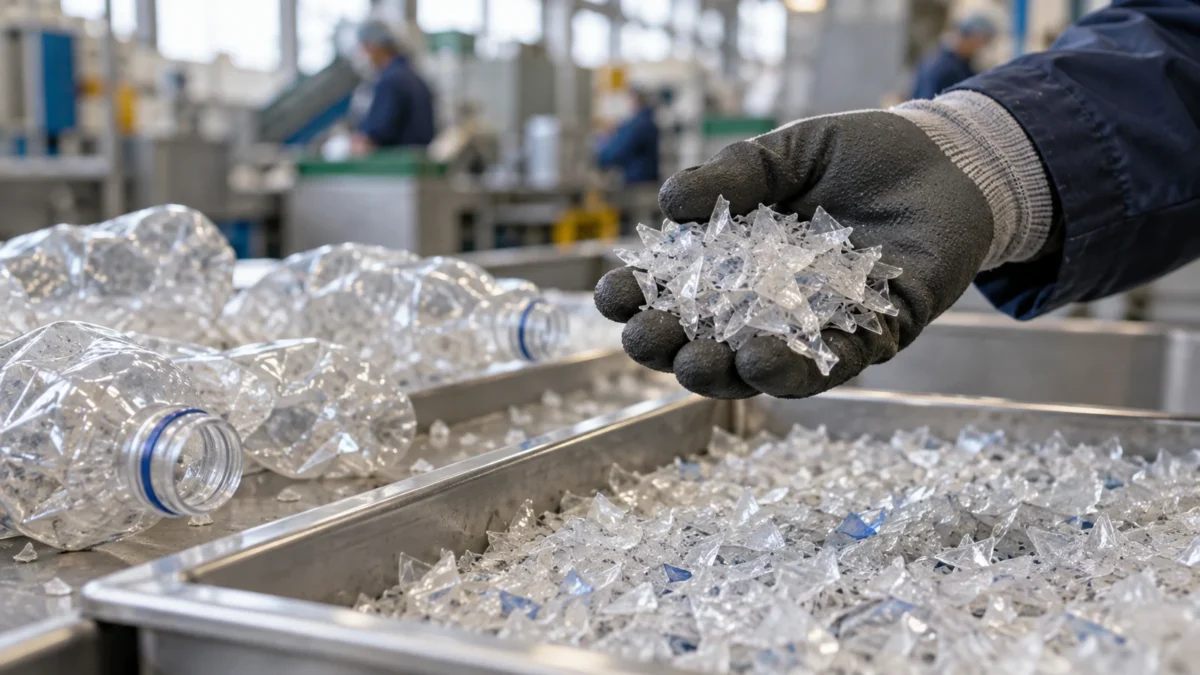
Short answer: Recycled content is the proportion of a package made from material recovered from a waste stream and used again as material. PCR usually refers to post-consumer recycled material—material recovered after a product has reached users or the market—while PIR is a commercial term commonly used for post-industrial or manufacturing-stage material. The exact definitions matter: U.S. FTC rules use the term pre-consumer, and EU PPWR minimum recycled-content targets for plastic packaging count material recovered from post-consumer plastic waste, not all recycled material.
That distinction affects claims, purchasing specifications and compliance. A package can truthfully contain recycled material but still fail a post-consumer-content target. Factory scrap can sometimes count as pre-consumer recycled material, but routine scrap that is normally fed straight back into the original manufacturing process may not support a recycled-content claim under U.S. FTC guidance. And recycled content is separate from recyclability: one describes what went into the package; the other concerns what may happen after the package is used.
For buyers, the useful question is not only “What percentage recycled content does this package have?” It is: what material is being counted, from which waste stage, in which component, using which denominator and verification method, and does the finished package still meet the required performance and regulatory conditions?
PCR, PIR and pre-consumer material are not interchangeable labels
“PCR” has a relatively clear practical meaning across packaging markets: material recovered after consumer or end-user use. Legal wording still varies by jurisdiction, but the concept is tied to material that has already entered use or the market.
“PIR”—post-industrial recycled—is less uniform. It is widely used commercially for manufacturing-stage waste, offcuts or rejected material recovered for another production use. In U.S. environmental-marketing rules, however, the Federal Trade Commission uses the term pre-consumer, not PIR, and places an important condition on it: the material must have been recovered or otherwise diverted from the waste stream during manufacturing. [R1]
| Term | Typical meaning | Can it support a recycled-content claim? | Critical qualification |
|---|---|---|---|
| PCR / post-consumer recycled | Material recovered after products have been distributed, sold or used by consumers or other end users. | Yes, when the claim and calculation follow the applicable definition and evidence route. | Jurisdictions can define the qualifying waste stream and collection/recycling conditions differently. |
| Pre-consumer recycled | Manufacturing-stage material diverted from the waste stream before consumer use. | Potentially. | Under FTC rules, the marketer should be able to substantiate that the material otherwise would have entered the waste stream. |
| PIR / post-industrial recycled | Common commercial label for industrial/manufacturing-stage recovered material. | Potentially, depending on the applicable definition. | Do not assume “PIR” is a globally standardized legal synonym for pre-consumer recycled content. |
| Internal rework / in-process scrap | Scrap, regrind, spills or trim routinely returned to the same production process. | Not automatically. | FTC Example 1 says material normally reused within the original manufacturing process and not normally entering the waste stream does not support a recycled-content claim. |
Editorial synthesis of the identified source provisions and evidence boundaries; illustrative examples are not product test results or compliance determinations.
The practical consequence is significant. A supplier declaration that says “30% recycled plastic” is incomplete if the buyer needs 30% post-consumer recycled plastic. The source stage needs to be identified.
What counts as recycled content under U.S. FTC rules?
Section 260.13 of the U.S. FTC Green Guides says a product or package should not be represented as containing recycled content unless the material was recovered or otherwise diverted from the waste stream either during manufacturing—pre-consumer—or after consumer use—post-consumer. If a marketer distinguishes between the two, it should substantiate the claimed percentages. [R1]
The same section contains several useful packaging examples:
- routine spills and scraps normally reused within the original manufacturing process do not support a recycled-content claim;
- overrun newspaper stock that was never sold cannot truthfully be described as post-consumer material;
- a claim about an entire multi-component package can be deceptive when only one component contains recycled material; and
- when a package is only partly made from recycled material, the percentage should be clearly qualified, generally by weight.
This is why a claim such as “package made from 50% recycled material” needs a defined denominator. Does 50% apply to the bottle body, the plastic component, the paperboard box, or the entire package including lid, label and sleeve?
Recycled content, recyclability and recycling rate are three different metrics
| Metric | Question it answers | Typical evidence |
|---|---|---|
| Recycled content | How much recovered material is incorporated into this package? | Material declarations, mass balance where specifically allowed, chain-of-custody records, component weights and calculation method. |
| Recyclability | Can the finished package be collected, sorted and processed into secondary material in the intended system? | Construction, design-for-recycling assessment, collection/sorting access, process compatibility and operator acceptance. |
| Recycling rate | What proportion of a defined waste stream was actually recycled over a stated geography and period? | Waste-system data with a clear numerator, denominator, material scope, geography and year. |
Editorial synthesis of the identified source provisions and evidence boundaries; illustrative examples are not product test results or compliance determinations.
A package can contain 100% recycled material and still be difficult to recycle after use. A highly recyclable package can contain no recycled material. And neither fact establishes a recycling rate for the market where the package is sold.
See the separate recyclability evidence framework.
The distinction also matters in symbols and marketing. FTC Example 8 warns that an unexplained Möbius-loop symbol can imply both that packaging is recyclable and that it is made entirely from recycled material, depending on context. [R1]
Why PCR is receiving more regulatory attention than PIR
Post-consumer material closes a different loop from manufacturing scrap. It creates demand for material recovered after products have entered the market and waste-management system.
The EU Packaging and Packaging Waste Regulation (PPWR), Regulation (EU) 2025/40, reflects that distinction. Article 7 sets future minimum recycled-content requirements for the plastic parts of packaging using recycled content recovered from post-consumer plastic waste. Article 3(48) defines post-consumer plastic waste by reference to plastic products that have been placed on the market or supplied for distribution, consumption or use. [R2]
That means pre-consumer or PIR material may still be useful recycled material, but it cannot simply be substituted for PCR when a PPWR Article 7 minimum specifically requires post-consumer recycled content.
See the broader PPWR explainer for the overall phased framework.
PPWR Article 7: the 2030 and 2040 recycled-content targets
PPWR Article 7 sets category-specific minimums for the plastic parts of packaging. The first-stage date is conditional: the requirements apply by 1 January 2030 or three years after the Article 7(8) implementing act enters into force, whichever is later. [R2]
| Plastic packaging category | First-stage minimum | 2040 minimum |
|---|---|---|
| Contact-sensitive packaging with PET as the major component, excluding single-use plastic beverage bottles | 30% | 50% |
| Contact-sensitive packaging made from plastics other than PET, excluding single-use plastic beverage bottles | 10% | 25% |
| Single-use plastic beverage bottles | 30% | 65% |
| Other plastic packaging | 35% | 65% |
Editorial synthesis of the identified source provisions and evidence boundaries; illustrative examples are not product test results or compliance determinations.
These percentages are not necessarily a simple per-SKU number. Article 7 says they are calculated per packaging type and format as an average per manufacturing plant and year. Compliance also has defined exceptions, including specified medical/medicinal packaging, compostable plastic packaging, dangerous-goods packaging, certain packaging for infants and young children, and other scoped cases. A plastic part representing less than 5% of the total weight of the whole packaging unit is also exempt from the Article 7(1) and (2) minimums. [R2]
The table does not apply without exceptions. Article 7(4)–(5) identifies defined exclusions, including specified medical/medicinal uses, compostable plastic packaging and dangerous-goods packaging, and plastic parts representing less than 5% of the whole packaging unit’s weight. Its food-contact exception is conditional on a human-health threat and non-compliance with Regulation (EC)No 1935/2004, not a blanket exemption for every food pack. Check the complete provision for the actual packaging. [R2]
Article 7(8) requires the Commission to establish the calculation and verification methodology and the technical-documentation format. Because that methodology is part of the legal timing formula, buyers should not reduce PPWR planning to a fixed “30% by 2030” slogan without checking the current implementing act and exemptions.
EU beverage bottles already have a separate recycled-content regime
Single-use plastic beverage bottles have an earlier EU recycled-content framework under Directive (EU) 2019/904. Article 6(5) requires PET beverage bottles covered by the Directive to contain at least 25% recycled plastic from 2025, calculated as an average for PET bottles placed on the market in a Member State. From 2030, the target becomes at least 30% recycled plastic for the covered beverage bottles. [R3]
The official record identifies Decision (EU)2026/1425 as a calculation, verification and reporting measure for single-use plastic beverage bottles. It is not a general permission for every packaging claim. This review could not retrieve its complete direct rendition, so no detailed allocation method from that Decision is prescribed here. [R4]
Recycled content can be averaged—but the averaging basis matters
Not every recycled-content percentage is measured separately in every individual package.
FTC Example 7 describes a paper product claim based on an annual weighted average of recycled material purchased from several sources after accounting for production fiber loss. PPWR Article 7 uses a different legal averaging basis: packaging type and format, averaged per manufacturing plant and year. [R1] [R2]
These examples show why an “average recycled content” statement needs context. The relevant questions are:
- average of what products or components;
- over what period;
- at which plant or legal entity;
- by mass or another unit;
- whether losses are accounted for; and
- whether the applicable regulation permits that averaging basis.
Quality is not the same as recycled-content percentage
Increasing recycled content can change material quality and process behavior, especially in mechanically recycled plastics. The recycled-content percentage alone does not describe contamination, polymer purity, thermal history, odor, color or mechanical performance.
A 2025 critical review of industrial PET mechanical recycling describes contamination and polymer degradation as major variables affecting recycled-PET quality. It links sorting and pretreatment efficiency, non-PET contamination and repeated processing to changes in material properties and suitability for higher-value applications. [R5]
For packaging engineers, this means a 50% PCR specification still needs performance requirements appropriate to the package:
- mechanical strength and impact performance;
- color and appearance;
- odor where relevant;
- melt/process stability;
- barrier performance;
- seal behavior;
- dimensional consistency;
- migration and contaminant control for food contact.
The relevant tests depend on the polymer, process and use. One “PCR quality” certificate cannot replace the actual application specification.
Food-contact recycled plastic needs a separate safety file
Recycled content is not, by itself, a food-contact authorization.
In the United States, FDA identifies three main concerns for post-consumer recycled plastics used in food-contact articles: contaminants from the recovered material, incorporation of material not regulated for the intended food-contact use, and non-compliant adjuvants. FDA therefore evaluates relevant recycling processes and use conditions, including source controls and contaminant-removal capability. [R6]
FDA’s 2021 guidance explains the chemistry considerations for recycled plastics in food packaging and states that the potential migration of contaminants is a central issue. The guidance is nonbinding and describes FDA’s current recommendations rather than creating a recycled-content percentage requirement. [R7]
Food-contact assessment also depends on the destination jurisdiction and applicable process and use conditions. A U.S. process opinion should not be treated as an EU authorization, and a recycled-content percentage should not be treated as a finished-package safety conclusion.
FDA’s chemistry guidance describes source controls, surrogate-contaminant testing and intended-use considerations. These illustrate the evidence task; they are not a universal laboratory procedure or a certificate for the purchased material. [R7]
The practical conclusion is narrow but important: a “30% PCR” material declaration and a food-contact compliance file answer different questions. A buyer may need both.
Paper, metal and glass use recycled content too
Recycled-content discussions often focus on plastic because current regulation sets explicit PCR targets for several plastic-packaging categories. But recycled content is also common in paper, board, glass and metal packaging.
The same claim discipline still applies. A paperboard package can contain recovered fiber without being made entirely from post-consumer fiber. A glass or metal container can contain recycled feedstock while its final percentage varies by production route and batch. The claim should identify the material, component and percentage being described.
For paper and board, fiber performance and food-contact requirements can constrain the grade and share of recovered fiber in some applications. The fact that recovered fiber is technically available does not by itself establish suitability for a specific direct-food-contact construction.

What evidence should sit behind a recycled-content claim?
| Evidence field | What to record | Why it matters |
|---|---|---|
| Material identity | Polymer, paper/fiber grade, glass, metal or other material | Different materials use different recycling and compliance routes. |
| Waste stage | Post-consumer, pre-consumer/PIR, or another clearly defined source | PCR-specific laws cannot be met with an undefined “recycled” stream. |
| Percentage and denominator | Percent by weight and whether it applies to a component or the whole package | Prevents a recycled box from being presented as an entirely recycled multi-component package. |
| Calculation period | Per item, batch, annual weighted average, plant/year or another allowed basis | Different legal and claims systems permit different averaging methods. |
| Chain of custody | Supplier declarations, transaction records, audit trail and allocation method where applicable | Connects claimed recycled material to the purchased input. |
| Manufacturing losses | Yield, scrap treatment and whether in-process rework is excluded where required | Prevents routine rework from being counted as recycled content without basis. |
| Performance evidence | Application-relevant mechanical, barrier, visual and process tests | Recycled content does not guarantee equivalent package performance. |
| Food-contact evidence | Applicable process authorization/guidance, migration or decontamination evidence and intended conditions of use | Food-contact suitability is separate from the recycled-content percentage. |
Editorial synthesis of the identified source provisions and evidence boundaries; illustrative examples are not product test results or compliance determinations.
How to write a stronger recycled-content specification
A weak purchasing line might say:
“Packaging must contain at least 30% recycled material.”
A more auditable specification could define:
- the exact package component covered;
- the required percentage by weight;
- PCR versus pre-consumer/PIR source;
- the accepted calculation or averaging basis;
- the chain-of-custody evidence;
- allowed manufacturing loss and rework treatment;
- performance requirements;
- food-contact or other regulated-use conditions; and
- the destination-market legal basis where the percentage is regulatory rather than voluntary.
This avoids a common procurement failure: receiving a technically true “recycled content” certificate that does not answer the buyer’s actual PCR, component or compliance requirement.
Methodology and editorial note
This article is an editorial synthesis of current U.S. environmental-marketing rules, EU packaging and single-use-plastics legislation, official food-contact guidance and technical recycling literature. It does not create a universal definition of PIR, certify any chain-of-custody scheme or provide a product-specific food-contact conclusion. Legal targets are presented with their scope and timing conditions, and mass-balance treatment is kept within the legal framework that expressly provides for it.
Sources checked 18 October 2026. The main image is an AI-generated editorial illustration; the explanatory figure is an original editorial diagram. Neither is a photograph of an identified product or facility, a laboratory result or an independent environmental assessment.
Legal discussion is limited to the identified provisions and dated source explanations. No product-specific compliance determination, comprehensive audit of subsequent measures or universal laboratory procedure is provided.
Official sources and reference notes
- [R1] U.S. Federal Trade Commission / eCFR. 16 CFR § 260.13 — Recycled content claims. eCFR displayed as up to date through 15 October 2026. §260.13(a)–(d), Examples 1–8. Relevant public text checked 18 October 2026; source scope retained. Accessed 18 October 2026.
- [R2] European Union / EUR-Lex. Regulation (EU) 2025/40 on packaging and packaging waste. Regulation (EU)2025/40, OJ22 January 2025. Article 3(48); Article 7(1)–(10). Relevant original OJ provisions read in full via official PDF; dated Commission guidance checked separately. Not a comprehensive audit of all secondary or national measures. Accessed 18 October 2026.
- [R3] European Union / EUR-Lex. Directive (EU) 2019/904 on the reduction of the impact of certain plastic products on the environment. Live source. Article 3 definition; Article 5 oxo-degradable scope; Article 6(5) beverage-bottle targets as relevant. Relevant original official Directive text read; national implementation and product-specific conclusions not audited. Accessed 18 October 2026.
- [R4] European Commission / EUR-Lex. Commission Implementing Decision (EU) 2026/1425. 30 June 2026; OJ 3 July 2026. Official indexed document title and scope only. Official indexed record only; full direct legal rendition was blocked. No detailed allocation formula or threshold used. Accessed 18 October 2026.
- [R5] Bezeraj et al. State-of-the-art of industrial PET mechanical recycling: technologies, impact of contamination and guidelines for decision-making. RSC Sustainability3(5), 2025,1996–2047; DOI 10.1039/D4SU00571F. Public abstract/introduction and section5.1 extracts on contaminants and process quality. Public record and relevant visible section extracts read; no quantitative result or whole study audit claimed. Accessed 18 October 2026.
- [R6] U.S. FDA. Recycled Plastics in Food Packaging. Live source. FDA’s current concerns about PCR contaminants, unauthorized input and adjuvants; source controls; contaminant-removal evidence; conditions-of-use review. Relevant public text checked 18 October 2026; source scope retained. Accessed 18 October 2026.
- [R7] U.S. FDA. Guidance for Industry: Use of Recycled Plastics in Food Packaging (Chemistry Considerations). July 2021. SectionsII–V; scope, contamination, process and surrogate-testing discussion. Relevant full public guidance sections read; nonbinding recommendations, not a percentage requirement or product approval. Accessed 18 October 2026.
The public corrections channel is currently inactive. Read our corrections policy.