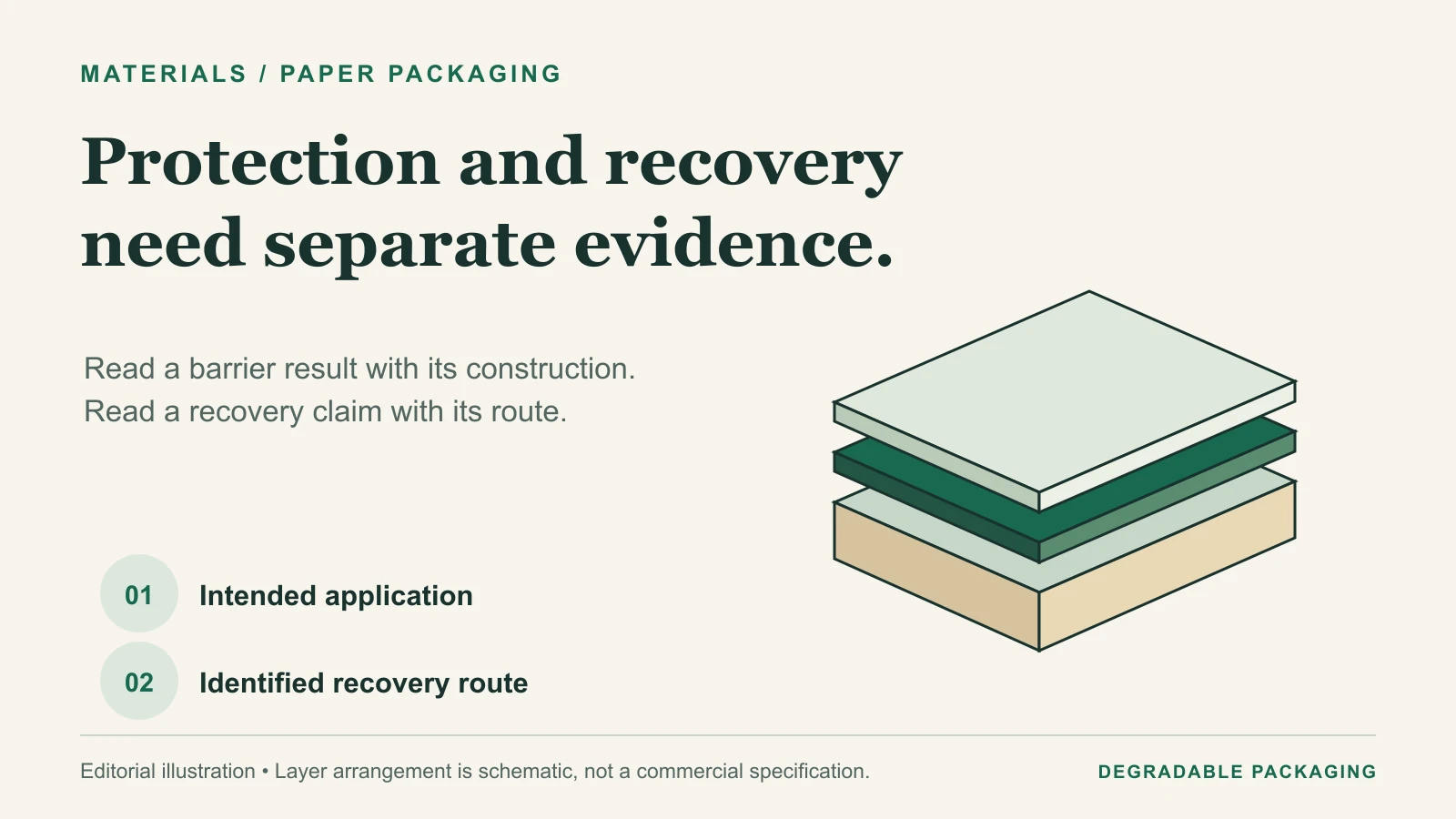
A paper-based packaging proposal needs two evidence tracks: protection in the intended application, and recovery through an identified end-of-life route. A material description cannot settle both. Published research is useful when its construction, measurement and limits stay attached to the result.
The editorial brief
Measure protection; document the recovery route
- Oxygen transmission and water-vapour transmission are different specifications.
- A layered construction can change performance; a result is specific to its substrate, formulation and processing.
- Laboratory separation or coating removal does not establish acceptance by a local recycling system.
Evidence baseThree original publication / institutional records, dated 2022–2026.
InterpretationResearch observations, not cross-study rankings or procurement pass thresholds.
Read a number with its construction
A 2026 review describes films in which a cellulose-nanomaterial core contributes oxygen protection and outer plastic layers address water vapour. It also identifies humidity, interlayer adhesion, scale-up and standardisation questions. The useful procurement question is which tested architecture matches the proposed finished package. [M1]
| Study / metric | Reported observation | Construction / boundary | Reference |
|---|---|---|---|
| 2022 / moisture transmission | Double-layer results were 40–70% of single-layer values | Cellulose-nanofibre/coating systems studied by the authors; not a 40–70% improvement claim. | [M2] |
| 2022 / oxygen transmission rate | 920 cm3 / (m2 · day) | Three-layer coated paperboard reported in the university abstract; retain full test conditions before comparison. | [M3] |
| 2022 / water-vapour transmission rate | 240 g / (m2 · day) | Double-coated paperboard in that study; a different metric from oxygen transmission. | [M3] |
| 2026 / separation evidence | Water-based separation reported at laboratory scale | Review of cellulose-core / plastic-layer structures; scale-up and standardisation remain questions. | [M1] |
These repository records do not provide a harmonised comparison dataset. Before using a value in a specification, examine the full study for specimen details, method, temperature, relative humidity and boundary conditions. No universal acceptance threshold is inferred from this table.
Construction and process are part of the result
The double-layer study varied coat weights and layer arrangements. Hot-pressing two dry layers did not outperform the single-layer arrangement in that experiment. More processing or more layers should therefore not be treated as an automatic performance guarantee. [M2]
A supplier record should identify the substrate, coating formulation, coat weight, adhesives, layer order and converting steps. If one changes, ask which previous test remains applicable. A flat-material result also needs to be distinguished from tests of the filled and sealed pack, particularly when seams or closures contribute to the protective function.
Recycling evidence has a different endpoint
The paperboard study investigated removal of a specific waterborne coating in alkaline solution. Its preliminary removal observations do not document all the stages of collection, sorting, fibre recovery and recycled-product quality. The review’s laboratory water-separation observation has a similarly defined scope. [M3] [M1]
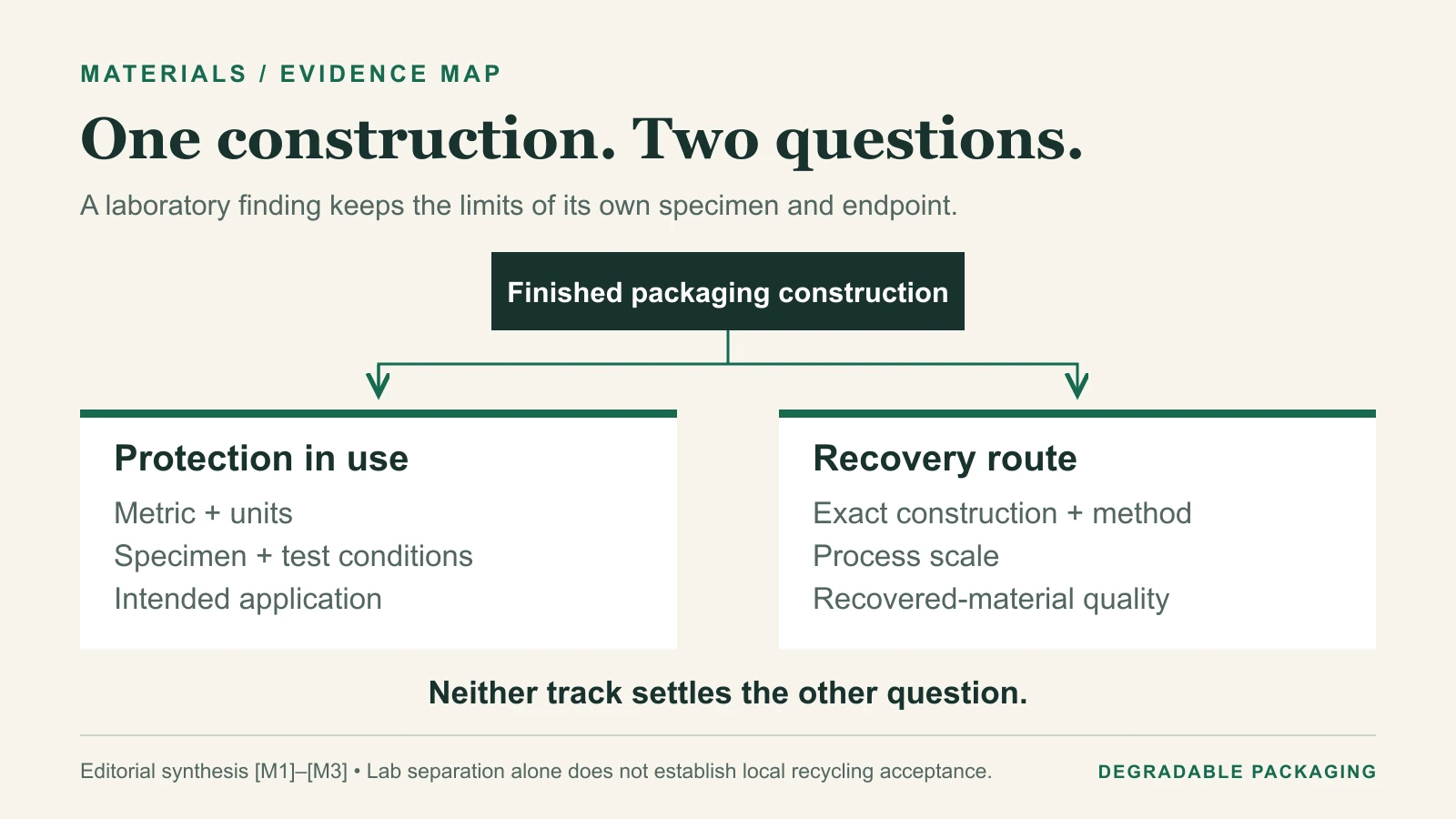
| Review track | Record to request | Question it does not settle alone |
|---|---|---|
| Protection | Metric, units, method, conditions, specimen and intended service life | Whether the construction is collected, sorted or recycled in the destination market. |
| Recovery route | Exact construction, assessment method, process scale and recovered-material quality | Whether barrier performance is adequate for the actual filled pack. |
| Change control | Versioned specification and reasons for retesting | Whether a modified material or converting process is covered by earlier results. |
Keep a promising finding within its evidence boundary
A laboratory finding can justify further development without becoming a claim about industrial recycling or every coated-paper format. Name the measured endpoint, the tested construction and the intended application before carrying a research result into purchasing or marketing language.
Methodology / editorial note
Desk review of the cited repository abstracts and publication records. No original laboratory testing, independent product certification, full-paper systematic review or pooled comparison was performed. Publication years or months are retained where an exact publication day was not verified. Quantitative observations are attributed to their own constructions; missing test conditions are not invented.
Sources & reference notes
- [M1]Nan and colleagues: nanocellulose / plastic multilayer-film review. 2026. USDA Forest Service record and abstract; DOI 10.1016/j.tifs.2026.105750. Research synthesis, not a commercial product specification.
- [M2]Al-Gharrawi and colleagues: double-layer coating study. 2022. USDA Forest Service record and abstract; DOI 10.1016/j.fpsl.2022.100895. Studied cellulose-nanofibre/coating constructions.
- [M3]Bakker and colleagues: paperboard coating performance and removal. December 2022. Eindhoven University of Technology record and abstract; DOI 10.3390/coatings12121841. Defined coating systems and preliminary removal observations.
Update history
16 October 2026 — Added an attributed research-observation table, a two-track evidence comparison and explicit method boundaries; source records rechecked. The original publication date is retained. Added an original explanatory figure and updated the shared reading layout.
The public corrections channel is currently inactive. Read our corrections policy.