
As of 16 October 2026, the PPWR’s general application date has passed. A useful packaging review now needs to identify the specific provision, its timing and the evidence for the finished package. A single “PPWR-ready” label cannot do that work. [R2]
The editorial brief
One regulation, several evidence questions
JurisdictionEuropean Union
ScopeSource-reading and evidence organisation; no individual product compliance determination.
Read the timetable in phases
- 11 February 2025Entry into force, as recorded in the Commission guidance. [R3]
- 12 August 2026General application. The Commission also identifies the food-contact PFAS restriction in this phase. [R2]
- 2030 measuresThe Commission identifies later recyclability and recycled-content milestones. Check each provision and associated measure rather than assigning one date to every duty. [R2]
The guidance distinguishes the general recyclability requirement from later design-for-recycling and recycled-at-scale criteria. A later milestone is therefore not a reason to disregard earlier requirements. Record the article being assessed and the version used, together with the scope and any relevant exception. [R3]
Food-contact PFAS: preserve the analytical scope
Article 5(5) addresses food-contact packaging placed on the market from 12 August 2026. The restriction concerns concentrations equal to or above the listed values, subject to its wording about other Union prohibitions. The three rows describe different measurements. [R1]
| Reference value | Measurement scope | Qualification / source |
|---|---|---|
| 25 ppb | Any individual PFAS measured by targeted analysis | Polymeric PFAS excluded from quantification. Article 5(5)(a). [R1] |
| 250 ppb | Sum measured by targeted PFAS analysis | Prior precursor degradation where applicable; polymeric PFAS excluded. Article 5(5)(b). [R1] |
| 50 ppm | PFAS including polymeric PFAS | Distinct from the total-fluorine proof requirement described below. Article 5(5)(c). [R1] |
If total fluorine exceeds 50 mg/kg, Article 5(5)(c) specifies an on-request proof requirement distinguishing fluorine attributable to PFAS or non-PFAS. Total fluorine and a measured PFAS total are not interchangeable. Article 5(6) requires demonstration in the Annex VII technical documentation. [R1]
What a supplier result still needs
Match the tested specimen to the supplied packaging, identify the analytical coverage and reporting limits, and retain the report version. A material name, an unqualified “PFAS-free” statement or a result addressing only one measurement does not document every question in the table.
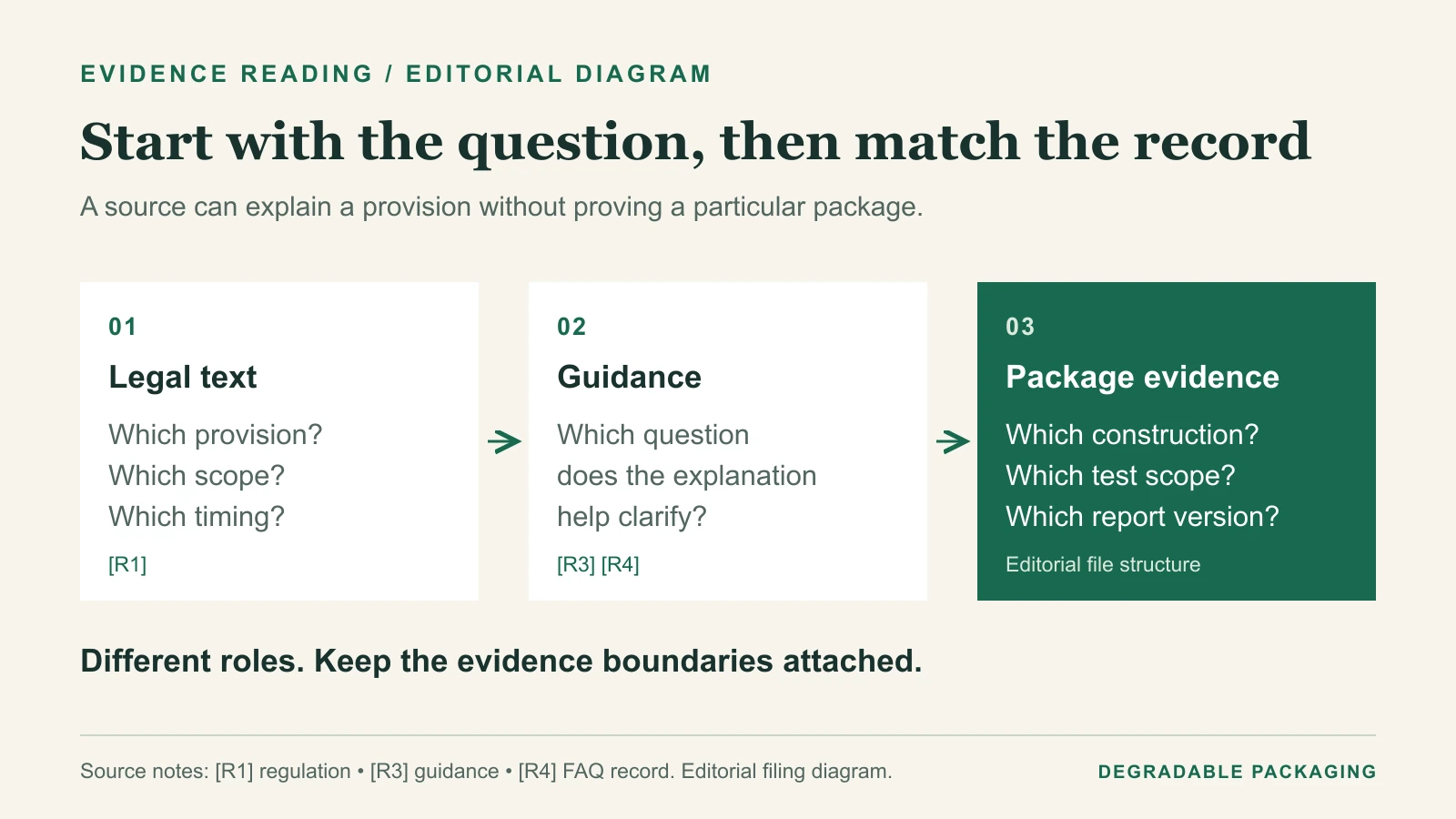
Keep the law, guidance and product evidence distinct
| Document | What it contributes | What to retain |
|---|---|---|
| Regulation | Applicable legal provisions | Article, paragraph, scope and timing reference. [R1] |
| Commission guidance / FAQ | Explanations of selected questions | Version, question and relationship to the legal text. [R3] [R4] |
| Package-specific evidence | Specifications, tests and factual supply-chain information | Exact construction, intended use, report scope and unresolved questions. |
The guidance notice states that it does not replace, add to or amend the PPWR. It must be read with the legislation; binding interpretation remains with the Court of Justice of the European Union. Use an explanation to clarify a question, rather than presenting it as a certificate for a manufacturer’s package. [R3]
Build a provision-specific evidence file
- Identify the complete package, components, intended use and destination markets.
- Record the factual supply-chain role before choosing the applicable provisions.
- Separate the provision’s legal timing from the date on a supplier declaration.
- Keep the specification, test method, report version and responsible follow-up contact together.
- Record unanswered questions explicitly, especially when a construction or process changes.
Methodology / editorial note
Desk-based synthesis of the Commission announcement, guidance and FAQ publication record, with reference values checked against official indexed text of the original regulation. Direct EUR-Lex retrieval presented bot verification. This is not a consolidated register of all later measures, a laboratory assessment or a package-specific legal conclusion. Source checks are recorded separately from human editorial review.
Sources & reference notes
- [R1]Regulation (EU) 2025/40 — original act. Official Journal, 22 January 2025. Article 5(5)–(6) and Article 71; see the exact provision and any later applicable changes.
- [R2]European Commission: application-phase announcement. 11 August 2026. General application and selected later milestones.
- [R3]Commission guidance notice C/2026/3084. 10 June 2026. Interpretative scope; the notice does not amend the regulation.
- [R4]Commission PPWR FAQ publication page. 3 August 2026. Publication/version reference; no unseen FAQ answer is paraphrased.
Update history
16 October 2026 — Rebuilt the article with a phased timeline, qualified PFAS reference table and evidence hierarchy; source references rechecked. The original publication date is retained. Added an original explanatory figure and updated the shared reading layout.
The public corrections channel is currently inactive. Read our corrections policy.